This document is an instruction manual for Anko Front Load Drum-type Washing Machines, specifically models AFLW60G and AFLW75G.
Function Description
These are front-load washing machines designed for household and similar applications. They are capable of washing various types of laundry using different programs and temperature settings. The machines feature a detergent dispenser with compartments for pre-wash detergent, main wash detergent (liquid or powder), and softener.
Important Technical Specifications
Model AFLW60G:
- Washing Capacity: 6.0kg
- Dimensions (W x D x H mm): 595 x 400 x 850 mm
- Net Weight: 55kg
- Rated Power: 2050W
- Power Supply: 220-240V, ~50Hz
- Standard Water Pressure: 0.05MPa~1.0MPa
Model AFLW75G:
- Washing Capacity: 7.5kg
- Dimensions (W x D x H mm): 595 x 565 x 850 mm
- Net Weight: 68kg
- Rated Power: 2050W
- Power Supply: 220-240V, ~50Hz
- Standard Water Pressure: 0.05MPa~1.0MPa
Both models are designed for cold and hot water connection, with a water supply pressure of 320 kPa. The drum type is standard, and the detergent quantity is default. The detergent is dissolved in 1L of water. The anti-sudsing agent is Max. For the 6kg machine, the test load mass is 6.0kg and water consumption is 61L. For the 7.5kg machine, the test load mass is 7.5kg and water consumption is 77L.
Usage Features
The washing machine features a control panel with a program dial, display, and buttons for Speed, Delay, Function, and Pause/Start.
Program Selection:
The program dial allows selection of various washing programs, including:
- Quick 15
- Rapid 45
- Mix 20°C, Mix 40°C, Mix 60°C
- Hot Wash 90°C
- Rinse & Spin
- Spin Only
- Cotton Cold, Cotton 20°C, Cotton 40°C, Cotton 60°C
- Jeans
- Delicate
- Cotton Eco
Optional Functions:
- Speed: Adjusts the default speed (rpm) for each program.
- Delay: Delays the start of the washing load for 0-24 hours.
- Pre Wash: Adds an extra pre-wash cycle.
- Extra Rinse: Provides an extra rinse at the end of the selected cycle.
- Child Lock: Locks the control panel to prevent accidental changes during operation. To activate, press the Temperature & Function buttons simultaneously for 3 seconds.
Washing Considerations:
- Sort clothes by color, fabric type, and care labels.
- Avoid overloading the machine.
- Use appropriate detergent quantity to prevent excessive suds and residue.
- For heavily soiled items, a pre-wash or higher temperature may be beneficial.
- Delicate items should be placed in a special washing bag.
- The machine operates best with a stable water supply and drain hose.
- Ensure the appliance is level and stable to prevent excessive vibration and noise.
Washing Programs and their Applications:
- 90°C: Suitable for seriously soiled cotton, pure white cotton (e.g., bed linen, towels, table cloths, etc.).
- 60°C: Moderately soiled cotton, cotton and synthetic articles with certain decolourising degree (e.g., shirts, pyjamas, etc.).
- 40°C, 30°C, 20°C, Cold Water: Lightly soiled cotton, synthetics and wool.
- Rapid 45': For few and lightly soiled clothes quickly.
- Mix: For loads with mixed textiles made of cottons and synthetics.
- Jeans: Reduces wear and tear on jeans.
- Quick 15': Extra short program suitable for lightly soiled washing and small amounts of laundry.
- Spin Only: This procedure provides a spin only option. Residual soapy water shall be drained out before spinning.
- Rinse & Spin: This procedure provides a short rinse cycle followed by a spin cycle.
- Delicate: For delicate, washable textiles, e.g., made of silk, satin, synthetic fibres or blended fabrics.
- Cotton Eco: This program saves energy and limits the washing temperature to 40°C or 60°C. Use with a small quantity of clothes which are only lightly dirty.
- Cotton: To increase the washing results, the main washing time is increased. It is recommended for washing clothes for babies or worn by the persons with skin allergies. It is recommended for washing durable cotton articles, for example, bed sheets, quilt covers, pillowcases, gowns, underwear, etc.
Maintenance Features
Cleaning Procedures:
- Exterior: Clean with household cleaners and a soft damp cloth. Avoid solvents or harsh cleaning chemicals.
- Internal Drum: Clean periodically to prevent residue buildup.
- Door Seal and Glass: Wipe clean after each wash to remove lint and stains.
- Detergent Drawer: Periodically remove and clean the detergent drawer and its compartments with warm water to prevent residue buildup.
- Inlet Filter: Clean periodically to ensure proper water supply. Turn off the water supply, remove the inlet pipe, and clean the filter.
- Drain Pump Filter: Clean periodically to ensure normal operation of your washing machine.
- Open the lower cover cap.
- Rotate 90°C and pull out the emergency drain hose, and take off the hose cap.
- After water runs out, reset the drain hose.
- Open the filter by turning to the counter clockwise.
- Remove extraneous matter.
- Close the lower cover cap.
Troubleshooting:
The manual provides a comprehensive troubleshooting guide for common issues such as:
- Washing machine won't start up
- Door won't open
- Heating fault
- Water is leaking
- Water is overflowing from the base of the machine
- Display isn't lighting up
- Detergent residues remain in the detergent drawer
- Washing results aren't to expectations
- Washing machine is making an abnormal noise or vibrating
- Error codes E30, E10, E21, E12
For most issues, the guide suggests checking power supply, water connections, door closure, and proper loading. For more complex problems, it advises contacting customer service.
Safety Instructions:
- The appliance is intended for household use only.
- Always ensure the plug is turned off and removed from the power supply after every use.
- Do not install the appliance behind a lockable door or a door with a hinge on the opposite side.
- Ensure the drum is drained of all water before opening the door.
- Do not allow children to play with the appliance or packaging.
- Keep detergents away from children.
- Do not climb up or sit on top of the appliance.
- Do not use fabric softener or similar products to this appliance.
- Do not use flammable or explosive substances near the machine.
- Always ensure the machine is properly installed and leveled on a flat, stable, heat-resistant, and clean surface.
- Before moving the appliance, ensure all packaging and transport bolts have been removed.

 Need help?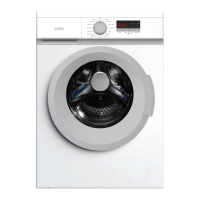

 To Next Page
 General