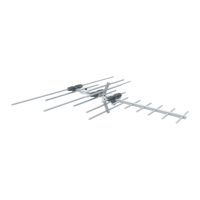
Thank you for choosing the Antsig range of quality audio video equipment.
The D-MAX Range of antenna have been designed and tested in Australia using a state-of-the-art Anechoic
Chamber. This ensures that your antenna has been optimised to capture high definition digital TV signals.
Successful antenna installation requires strong collection of the TV signal and distribution of the TV signal.
Follow these key guidelines for proper installation:
• Note your position to transmitter towers • Use RG6 quad cable for installation
• Mount antenna high as possible with fewest • Terminate with F-connectors
obstructions in line of sight with transmitter • Keep cable lengths to a minimum
If, at any time, you are unsure about performing any functions relating to antenna installation, please contact a
professional installer.
Note: The channel chart above shows the relationship between channels broadcast and the frequency
at which they are broadcast. Digital TV allows multiple TV channels to be overlayed on the one broadcast
frequency. i.e. Channel 7’s broadcast channel will contain information for TV Channels 7, 7Two and 7Mate.
Always plan your installation. Carefully think
through the job and don’t take dangerous
shortcuts. Common sense and good judgement
must be used at all times;
Carefully survey the job before the installation to
locate secure roof areas and the most convenient
placement for ladders. Work out where the
strongest points are for mast and cable mounting;
Always let someone know you are working on
the roof;
Locate and avoid overhead power lines. Antennas
must always be installed away from over-head
power lines and preferably at a distance equal
to twice the combined length of the mast and
antenna;
Do not climb on the roof when there is no-one
else around;
Wear proper shoes that are non-slip;
Do not climb on wet or icy roofs NOR attempt to
install the antenna during wet or windy weather;
Only use the sturdiest of ladders and ensure they
are securely anchored before climbing;
Do not step onto roof valleys, these are often
weak, even in new homes;
Ensure that all roof structures are structurally
sound before putting any weight on them or
mounting antenna hardware to them;
Always remember that you are standing on the
roof, take your time and don’t be distracted by
passersby;
If installing an antenna within the roof cavity,
ensure that the ceiling will support your weight.
SAFETY POINTS
2
Australian Capital City Channel Chart
(VHF Ch6-12/UHF Ch›28)
ADELAIDE
(Mt Lofty)
Service Owner Channel Frequency
SAS Seven Network 6 177.5
SBS SBS 7 184.5
NWS WIN 8 191.5
ADS Network Ten 11 219.5
ABC ABC 12 226.5
CTS Community TV 33 564.5
MELBOURNE
(Mt Dandenong)
Service Owner Channel Frequency
HSV Seven Network 6 177.5
SBS SBS 7 184.5
GTV Nine Network 8 191.625
ATV Network Ten 11 219.5
ABC ABC 12 226.5
MGV Community TV 32 557.625
BRISBANE
(Mt Coot-Tha)
Service Owner Channel Frequency
BTQ Seven Network 6 177.5
SBS SBS 7 184.5
QTQ Nine Network 8 191.625
TVQ Network Ten 11 219.5
ABC ABC 12 226.5
CTQ Community TV 28 529.5
PERTH
(Bickley/Carmel)
Service Owner Channel Frequency
TVW Seven Network 6 177.5
SBS SBS 7 184.5
STW WIN 8 191.5
NEW Network Ten 11 219.5
ABC ABC 12 226.5
CTW Community TV 32 557.5
SYDNEY
(Artarmon/Willoughby/Gore Hill)
Service Owner Channel Frequency
ATN Seven Network 6 177.5
SBS SBS 7 184.5
TCN Nine Network 8 191.625
TEN Network Ten 11 219.5
ABC ABC 12 226.5
TSN Community TV 29 536.625
HOBART
(Mt Wellington)
Service Owner Channel Frequency
SBS SBS 6 177.5
TVT WIN 7 184.625
ABC ABC 8 191.5
TNT Cross Austereo 10 212.5
TDT
Cross
Austereo/WI
11 219.5


 To Next Page
 Loading...