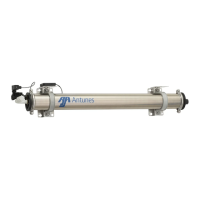
The Antunes UFL-500 Series is an innovative water filtration system designed to provide clean, filtered water for various applications. This owner's manual covers three models: UFL-510, UFL-520, and UFL-540, all utilizing proprietary multi-bore hollow fiber membranes for advanced filtration technology. The system is tested and certified by NSF International against NSF/ANSI Standards 42 and 53 for the reduction of aesthetic effects, nominal particulate reduction (Class I), health effects, cyst reduction, and turbidity reduction.
Function Description
The UFL system operates in two primary modes: Normal Operation Mode and Flush Mode. In Normal Operation Mode, water enters the system through the Inlet, flows through the UltraFilter cartridge, and exits through the Permeate Outlet as usable product water. The UltraFilter membrane effectively removes impurities, cysts, and particulates, ensuring high-quality filtered water.
The Flush Mode is a self-cleaning process designed to maintain the UltraFilter membrane's efficiency. During this mode, the Drain Valve opens, allowing water entering the Inlet to flush and clean the UltraFilter membrane by removing accumulated debris from its surface. This process is crucial for extending the life of the filter and ensuring consistent performance. The Drain Valve is only powered during Flush Mode.
The system is equipped with a Universal Pulse Controller, which manages the flush cycles. This controller allows for both automatic interval flushing and manual flushing. When a manual flush is activated by pressing the FLUSH button, the Flush LED on the controller flashes, and the Drain Valve opens for 10 seconds. After the flush, the Drain Valve closes, the Flush LED stops flashing, and the unit returns to Normal Operation Mode. Manual flushes do not interfere with the programmed interval flush settings.
Usage Features
Before installation and operation, it is essential to read and understand all instructions provided in this manual. The UFL system is designed for use with cold water only, and the water pressure should not exceed 100 psig (690 kPa). If the inlet water pressure is below 50 psig (345 kPa), a booster system with an outlet pressure of 60-100 psig (414-690 kPa) is recommended. A ground fault circuit interrupter (GFCI) must be installed on the circuit to this system for electrical safety. When installed on metallic plumbing, a properly sized electrical bonding jumper must be installed across the inlet and outlet pipes.
The system requires careful handling during transportation and installation to prevent mechanical damage. It should be protected from freezing temperatures, direct sunlight, and high temperatures (maximum operating temperature is 100°F or 38°C). Abrupt temperature variations should be avoided. The UltraFilter membrane must be kept wet and sealed at all times to prevent irreversible damage from drying out. Contact with strong solvents, chlorine-containing solvents, concentrated acids, or abrasive materials should be strictly avoided as these can damage the membrane and plastic components. All pipes must be flushed clean before installing the filter to prevent abrasive materials from damaging the membrane.
For plumbing connections, the system uses 3/4" FNPT threads for the System Inlet, System Outlet (Product Water), and Drain. It is crucial to use a back-up wrench when making connections to prevent overtightening, which can crack plastic ball valves. Quality, approved pipe sealant or thread seal tape should be used on pipe threads, but care must be taken to prevent sealant from entering the pipes. If soldered plumbing is used, heat should not be applied near the filtration system; union (O-Ring seal) connections are recommended for ease of installation and servicing.
An optional bypass installation is recommended to facilitate cartridge replacement and system servicing. This involves installing ball valves on the inlet and outlet, and a fully ported ball valve for the bypass line. During normal operation, the inlet and outlet ball valves are open, and the bypass valve is closed. For servicing, the inlet and outlet valves are closed, and the bypass valve is opened.
The controller automatically enters Flush Mode when powered on, and the Flush LED flashes. After flushing, the unit indicates power and the selected interval setting. The flush interval setting can be changed by pressing and holding the corresponding button on the Universal Pulse Controller. However, changing this setting is not recommended without consulting the factory, as it can prematurely plug the UltraFilter and reduce its life.
Maintenance Features
Regular maintenance is essential for the optimal performance and longevity of the UFL system. The UltraFilter Cartridge is pre-installed but must be rinsed to drain before use to remove air and protective storage solution. This rinsing process involves closing the Inlet Ball Valve, directing water from the outlet to a drain, opening the Outlet Ball Valve (if installed), and slowly opening the Inlet Ball Valve to allow air and water to exit. The FLUSH button is pressed six times to ensure all air and storage solution are flushed out. This is followed by a 15-minute full flow rinse, a 15-minute rest period to release trapped air, another 15-minute rinse, and six more FLUSH cycles. Finally, all downstream taps are opened, and water is run for five minutes.
Sanitizing the system and lines is necessary after installation to eliminate potential contamination. This involves turning off the water, draining the system, and pouring a liquid chlorine bleach solution (5.25% - 6% sodium hypochlorite) or Kay-5 sanitizer solution into the water line supplying the system. The sanitizer is allowed to flow until its smell is present at the faucet, then the faucet is closed, and the system stands for 15 minutes. After this, water is run until the sanitizer smell is gone, and all other faucets are flushed.
Replacing the UltraFilter Cartridge is a key maintenance task. Before replacement, the water supply to the system must be turned off by closing the Inlet and Outlet Ball Valves. The FLUSH button should be pressed multiple times to relieve system pressure. The End Cap clamp hardware and End Cap are then removed from the UltraFilter Housing. If the cartridge is difficult to remove, the opposite End Cap can be removed for assistance. The serial number of the new cartridge should be recorded. All O-rings (End Cap and Cartridge) should be inspected for nicks or cuts and replaced if necessary. Food-grade silicone lubricant should be applied to all O-rings and the inside center tube of the new cartridge. The new cartridge is then positioned and gently inserted into the housing, ensuring it is fully seated. The End Cap is pressed into position, and the UltraFilter Housing clamp and hardware are properly secured. After replacement, the new cartridge must be rinsed, and the system sanitized as per the installation instructions. The system is then repressurized by opening the Outlet Ball Valve, followed by the Inlet Ball Valve.
Troubleshooting guidance is provided for common issues such as lack of power, no water flow, low water flow, bad water taste, continuous flushing, water splashing at the drain, and leaks. Solutions range from checking power connections and valve positions to cleaning or replacing components like the inlet strainer, UltraFilter cartridge, drain valve, or controller. Lubricating O-rings and ensuring proper sealant application for fittings are also highlighted for leak prevention.
The manufacturer emphasizes the use of genuine Antunes replacement parts to maintain warranty validity and ensure proper system operation. The UltraFilter membrane cartridge has a prorated warranty of 36 months, while other equipment components are warranted for one year from the date of purchase, provided maintenance procedures are followed. Damage during transit is not covered under warranty and should be claimed directly with the carrier.


 To Next Page
 General