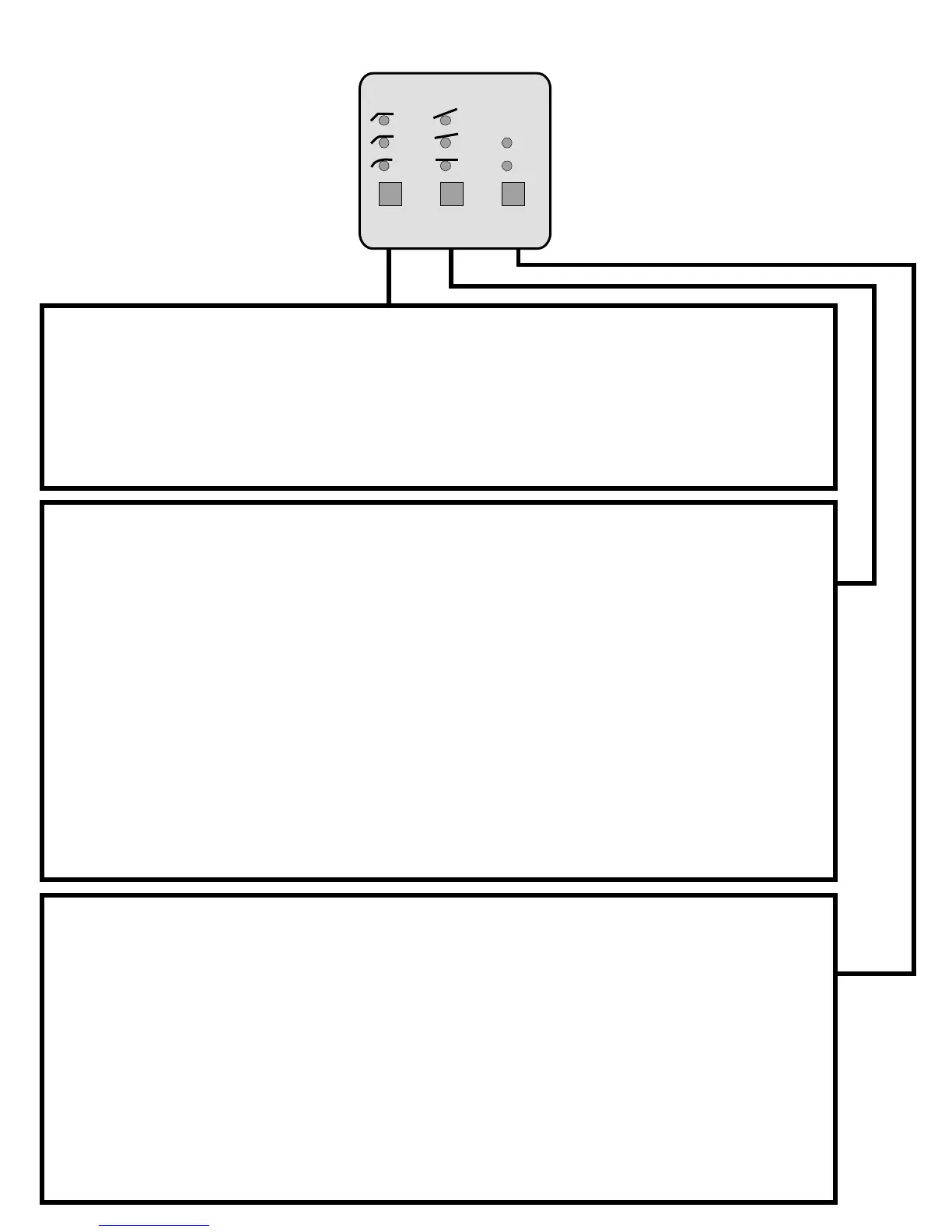
KNEE:
This control sets the KNEE, or how the point where the compressor begins to
reduce the gain of the signal applied to the unit. When in the HARD position, the
gain reduction begins at the set ratio and is a sharp transition into compression.
The MED position has a slight "fade-in" up to the set ratio. The SOFT position
has a gradual "fade-in" to the set ratio. The HARD position is very noticeable and
the SOFT position is very subtle and similar to an "over-easy" type KNEE.
THRUST:
This control sets the THRUST, a patented circuit that inserts a hi-pass filter at the
input of the RMS detector, limiting its response to lower frequencies. In the
NORM mode, there is no filter and the 2500 compresses like most units on the
market today. When MED is selected, there is a slight attenuation of the low
frequencies and a slight boost of the high frequencies, with a flat midrange
affecting the signal going into the RMS detector. This reduces the low
frequencies from pumping the compressor as much and increases the sensitivity
of the RMS detector to the higher frequencies, affecting the higher frequency
peaks of the signal. When LOUD is selected, there is a gradual, linear filter, down
15 dB at 20 Hz and up 15dB at 20K Hz, equalizing the energy going into the RMS
detector. This decreases the way the low frequencies pump the compressor and
increases the way the higher frequencies are compressed. The overall difference
is a noticeable increase of punch and low frequencies, but a uniformly
compressed signal. It is the "little more punch" switch.
TYPE:
This control sets the TYPE, or where the signal for the RMS detector comes from.
In the NEW mode, the compressor works like most newer types of compressors,
as in most of the VCA based units. This is called FEED-FORWARD compression,
where the RMS detector sends a signal to the VCA that is an exact ratio of the
desired compression, set by the RATIO control. When the OLD position is
selected, the RMS detector gets the signal from the output of the VCA, and then
feeds the VCA a signal based on a set ratio of that signal. This type of
compression is called FEEDBACK compression and is how the older API 525,
1176 type and 660 type compressors worked. The NEW mode is much harder and
the OLD mode is very smooth. When SOFT, LOUD, and OLD is selected you can
hardly hear the compression.
Tone Section
thresh detector tone
F BACK
F FWD
KNEE
THRUST
TYPE
SOFT
MED
HARD
NORM
MED
LOUD
OLD
NEW
TONE


 To Next Page
 Loading...