EasyManua.ls Logo

APlusLift HW-SL6600X - User Manual

APlusLift HW-SL6600X
25 pages
Print Icon
To Next Page IconTo Next Page
Loading...
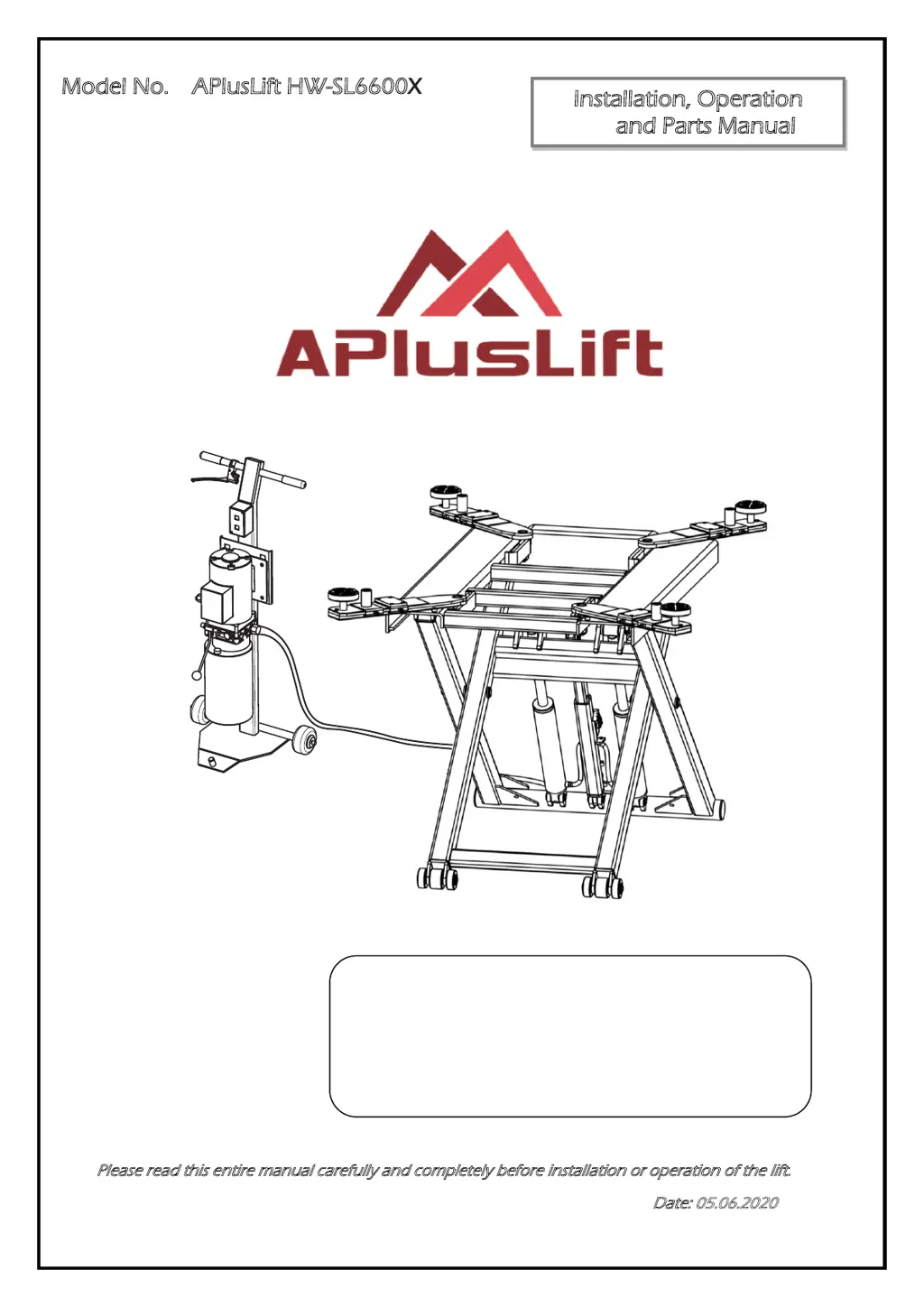
Model No. APlusLift HW-SL6600
Short Platform Scissor Lift
Mid Rise
Lifting Capacity, 6600 lbs.
Distributed by
Please read this entire manual carefully and completely before installation or operation of the lift.
Installation, Operation
and Parts Manual
Date: 13.04.2018
05.06.2020

Questions and Answers

Summary

SAFETY NOTES

Operation of Lifting Platforms

Guidelines for operating lifting platforms, emphasizing authorized users and vehicle weight limits.

Checking of the Lifting Platforms

Procedures and requirements for regular and exceptional checks of lifting platforms.

Important Safety Notices

Crucial safety guidelines for operation, maintenance, and environmental considerations.

Potential Safety Risks

Identifies electrical and physical hazards, providing essential safety measures to mitigate them.

Noise Level

Specifies acceptable noise limits during operation and recommends noise monitoring.

PACKING, STORAGE AND TRANSPORTATION

Transportation Details

Details the dismantling of the lift into two parts for transportation, including dimensions and weight.

Storage Guidelines

Provides recommendations for storing the lift packs in a protected area and advice on stacking precautions.

Opening the Packs

Instructions on how to safely open the delivery packs, checking for damage and missing parts.

PRODUCT DESCRIPTIONS

General Descriptions

Overview of the chassis supporting lift for road vehicles, highlighting its electro-hydraulic system.

Construction of the Lift

Illustrates the mechanical components and structure of the scissor lift with labeled parts.

Dimensions

Provides detailed measurements and diagrams of the lift's dimensions in both top and side views.

Technical Data

Lists key technical specifications including load capacity, rise/lower times, and oil volume.

INSTALLATION INSTRUCTIONS

Preparations for Installation

Details site preparation, including space requirements, foundation work, and electrical connections.

Space Requirements

Specifies the necessary clearance around the lift for safe operation and vehicle access.

Foundations and Connections

Outlines requirements for foundation construction and electrical power supply connections.

Tools and Equipment

Lists the essential tools and equipment required for the successful installation of the lift.

Checking Parts

Provides a list of parts to check after unpacking to ensure all components are present and undamaged.

Installation Attentions

Highlights critical points to ensure during installation, such as secure connections and bolt tightening.

General Installation Steps

Provides a step-by-step guide for assembling the lift, from fixing the power unit to connecting hoses.

Post-Installation Checks

A checklist of essential items to verify after the lift has been installed to ensure proper functionality and safety.

OPERATION INSTRUCTIONS

Precautions

Key safety precautions and checks required before operating the lift, including connection integrity and safety device status.

Operation Unit Description

Identifies and explains the components of the lift's operation unit, including buttons and handles.

Operation Instructions

Detailed steps for safely raising and lowering vehicles, emphasizing vehicle positioning and adapter contact.

Moving the Unloaded Lift

Instruction on the safe procedure for moving the lift when it is not carrying a load.

TROUBLE SHOOTING

Troubleshooting Common Issues

A guide to diagnosing and resolving common problems with the motor, lifting, and lowering functions.

MAINTENANCE

Daily Checks

Essential daily inspections to ensure the safety lock system, oil hoses, and electrical systems are functioning correctly.

Weekly Checks

Weekly maintenance tasks including checking moving parts flexibility, safety parts condition, and oil level.

Monthly Checks

Monthly maintenance involves checking hydraulic system tightness and ensuring joints are firm.

Yearly Checks

Annual maintenance includes emptying the oil tank, checking oil quality, and cleaning the oil filter.

Annex 1: Electrical Schemes and Parts List

Electrical Diagram

Provides the electrical schematic for the lift, illustrating the wiring and component connections.

Electrical Parts List

Lists the codes, names, specifications, and quantities of electrical components used in the lift.

Annex 2: Hydraulic Schemes and Parts List

Hydraulic Diagram

Presents the hydraulic schematic, showing the flow of oil and the arrangement of hydraulic components.

Power Unit Components

Lists and details the parts comprising the power unit, including hoses, cylinders, and connectors.

Seal Rings for Oil Cylinder

Specifies the types and part numbers for seal rings used in the oil cylinders.

Hydraulic System Components

Details specific hydraulic components such as oil tank, hydraulic block, and overflow valve with part numbers.

Additional Hydraulic Parts

Lists various hydraulic parts like valves, pumps, tubes, and filters with their specifications and quantities.

Annex 3: Mechanical Exploded Drawings and Parts List

Mechanical Exploded View

Provides an exploded view diagram of the lift's mechanical structure with numbered components.

Mechanical Parts List

Lists mechanical parts such as arms, bearings, shafts, and circlips with specifications and quantities.

Additional Mechanical Components

Details further mechanical parts including lifting arms, cylinders, locks, and wheels with their specifications.

Trolley Assembly Parts

Lists components for the trolley assembly, including the frame, wheels, handle, and power unit mount.

Overview

This document describes the APlusLift HW-SL6600X, a short platform scissor lift designed for lifting motor vehicles. It is a mid-rise lift with a lifting capacity of 6600 lbs. The lift is powered by an electro-hydraulic system, where a gear pump delivers hydraulic oil to oil cylinders, pushing their pistons upwards to raise the lifting beams. Its mobile design allows for easy movement within a workshop when unloaded.

Important Technical Specifications:

  • Model No.: APlusLift HW-SL6600X
  • Type: Short Platform Scissor Lift, Mid Rise
  • Lifting Capacity: 6600 lbs.
  • Full Rise Time with Load: <45s
  • Full Lowering Time with Load: <45s
  • Oil Volume: 1.6 US gal. (6 liters)
  • Power Unit: 1.5kW, 110V-1PH-60HZ-4P motor
  • Noise Level: Less than 70dB during operation.
  • Dimensions (Lift Platforms): 81" x 41.73" x 9.65" (packed)
  • Dimensions (Control and Power Unit): 20.1" x 15.75" x 43.3" (packed)
  • Weight (Lift Platforms): 1078.5 lbs.
  • Weight (Control and Power Unit): 67.9 lbs.
  • Maximum Lifting Height: 47 1/4" (1200mm)
  • Minimum Height: 4.13" (105mm)
  • Overall Length: 66.14" (1680mm)
  • Overall Width: 88.58" (2250mm)
  • Recommended Hydraulic Oil: NO.46 hydraulic oil for temperatures above 18°C, NO.32 hydraulic oil for temperatures below 18°C.

Usage Features:

  • Intended Use: Specifically designed for lifting motor vehicles. Users are prohibited from using it for any other purposes.
  • Operation Personnel: Only users aged 18 or above, who have been instructed and proven competent in operating the lift, are permitted to use it unsupervised. Written authorization from the owner is required.
  • Pre-Operation Checks: Users must read the operation instructions thoroughly and perform several trial runs before loading a vehicle.
  • Load Capacity: Always lift vehicles within the rated load capacity. Do not attempt to raise vehicles exceeding 6600 lbs.
  • Installation Surface: Must be installed on a stable, level, dry, non-slippery surface capable of sustaining the load. Asphalt surfaces are not suitable.
  • Outdoor Use: Not recommended for outdoor use in strong breezes where wind speed exceeds 14m/s.
  • Safety Locks: Always ensure safety locks are engaged before working near or under the vehicle. Never remove or use the lift if safety-related components are damaged or missing.
  • Vehicle Stability: Do not rock the vehicle on the lift or remove heavy components that could cause excessive weight shift.
  • Control Operation: Do not leave controls while the lift is in motion. Keep hands and feet clear of moving parts, especially during lowering.
  • Clothing: Avoid wearing loose clothing that could get caught in moving parts.
  • Work Area: Keep the surrounding area tidy and clear of obstructions to prevent incidents.
  • Lifting Procedure:
    1. Ensure the vehicle's center of balance is midway between adapters and centered over the lift.
    2. Position lift adapters at the vehicle manufacturer's recommended lift points.
    3. Push the UP button to raise the lift until adapters contact the vehicle.
    4. Check adapters for secure contact.
    5. Raise the lift to the desired working height.
    6. Always use all four adapters; never raise just one end, corner, or side.
  • Lowering Procedure:
    1. Ensure all personnel and objects are clear.
    2. Release the safety lock by holding the mechanical lock releasing handle.
    3. Push down the lowering handle.
    4. Once fully lowered, position lift arms and adapters to allow an unobstructed exit for the vehicle.
  • Mobility: The lift can only be moved when unloaded. Do not attempt to move it with a vehicle on it.
  • Electrical Connection: Must be performed by licensed technicians. Requires fuse protection. Power supply cable requirements: 2.5mm² (1/8 sq. inch) for 3Ph power, 4.0mm² (3/16 sq. inch) for 1Ph power.

Maintenance Features:

  • Regular Checking:
    • Daily: Check oil hose connections for leaks, electrical system, and proper engagement of safety teeth and safety blocks. This is crucial for preventing injury and loss.
    • Weekly: Check flexibility of moving parts, working condition of safety parts, and oil level in the tank (platforms should reach maximum height with sufficient oil).
    • Monthly: Check tightness of the hydraulic system and screw firm any leaking joints.
    • Yearly: Empty the oil tank, check hydraulic oil quality, and wash/clean the oil filter.
  • Lubrication: Lubricate UP rolling wheels (beneath the platform) and DOWN rolling wheels with No.1 lithium base grease.
  • Hydraulic Oil Change: Change oil 6 months after initial use, then once per year thereafter.
  • Storage (Long-Term Unuse):
    1. Disconnect power.
    2. Empty the oil tank.
    3. Lubricate moving parts with hydraulic oil.
  • Troubleshooting: A detailed troubleshooting guide is provided for common issues such as motor not running, slow lifting/lowering, and oil leakage, along with suggested causes and solutions. Users are advised to contact dealers for help if issues cannot be resolved.
  • Parts Lists: Annexes include electrical schemes, hydraulic schemes, and mechanical exploded drawings with corresponding parts lists for easy identification and replacement.

APlusLift HW-SL6600X Specifications

General IconGeneral
BrandAPlusLift
ModelHW-SL6600X
CategoryScissor Lifts
LanguageEnglish