EasyManua.ls Logo

Apollo Valves 36H Series - User Manual

Apollo Valves 36H Series
2 pages
Print Icon
To Next Page IconTo Next Page
Loading...
USA
Flush upstream piping thoroughly to remove any foreign matter prior to installing the device.
Do not install the unit in areas subject to freezing temperatures.
INSTALL THE DEVICE WITH THE ARROW ON THE VALVE POINTING IN THE DIRECTION OF FLOW.
It is important that this unit be installed between shut-off valves in order to isolate the unit during repair and
service.
Provide sufficient support on the piping system upon installation of this unit.
Increasing the spring load through the adjusting screw will increase
Under flow conditions, the pressure under the diaphragm will start to fall below the set pressure causing the
spring and the supply pressure to open the valve and allowing more water to flow.
The amount of water that will pass through the valve depends on the difference between the inlet and the outlet
pressure. As the pressure differential increases, the volume of water increases.
MAINTENANCE
Regular inspection, testing and cleaning of water pressure reducing valve and other components in a piping sys-
tem assures maximum life and proper function.
NOTE: PRIOR TO DISASSEMBLING THE UNIT, SHUT-OFF WATER SERVICE AND RELIEVE PRESSURE DOWN-
STREAM.
a) DISASSEMBLY OF SEAT
1. Unscrew bottom plug.
2. Unscrew seat disc holder.
3. Remove seat.
b) DISASSEMBLY OF SEAT DISC
1. Remove bottom plug and seat disc holder.
2. In the seat disc holder, remove seat disc by
unscrewing the seat screw.
c) DISASSEMBLY OF DIAPHRAGM
CAUTION:
CAP IS SPRING LOADED.
d) DISASSEMBLY OF BY-PASS ASSEMBLY
Body
Seat O-Ring
Seat
Seat Screw
Seat Disc Washer
Seat Disc
Seat Disc Holder
Nameplate
Lock Nut
Cap Bolt
Cap
Spring
Diaphragm
Yoke
TROUBLE-SHOOTING
PROBLEM POSSIBLE CAUSE
SOLUTION
INSTALLATION
OPERATION
3. Excessive noise within the pipe-
line at the PRH.
(c) Damaged or cut diaphragm
(d) By-pass leaking
-Inspect and replace if defective.
-Replace
1. Inlet pressure equalizes outlet
pressure at no flow conditions.
(a) Seat disc not sealing tight
against seat
2. Outlet pressure rises above inlet
pressure.
By-pass assembly not opening or
clogged
Thermal expansion downstream
High water velocity at the pipeline
can sometimes cause a whistling
noise or hum.
DIMENSIONS (in.) & WEIGHTS (lbs.)
Size
(NPT)
A BCD
EF
1/2" 4-1/8 2-1/4 7 1-7/8 8-3/8 4 7 6
3/4" 4-1/8 2-1/4 7 2-7/16 9 4 7 6
8124-11/1610-1/447-1/22-5/164-1/8
EXAMPLE:
NOTES:
1) Repair kits contact factory
MODEL PRH
High Capacity
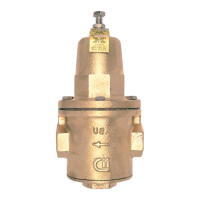
Water Pressure Reducing Valve
I-5957-00
RELIEVE SPRING PRESSURE BY
UNSCREWING THE ADJUSTING SCREW
BEFORE ATTEMPTING TO REMOVE CAP!
1. Remove cap bolts.
2. Remove cap, spring retainer, and spring.
3. Unscrew diaphragm nut.
4. Remove diaphragm washer and diaphragm.
1. Unscrew bottom plug and remove seat disc holder.
2. Relieve spring pressure on the cap and remove
cap bolts. Dismantle the spring retainer and spring.
3. Remove yoke with diaphragm attached.
Do not unscrew diaphragm nut.
4. Unscrew the by-pass assembly.
By-Pass Assembly
Bottom Plug
Bottom Plug O-Ring
Adjusting Screw
Self Sealing Washer
Spring Retainer
Diaphram Nut
Diaphragm Washer
(b) Seat O-ring may be cut or damaged
Leakage within the valve may be due
to the following:
1"
242912-1/23-3/166-3/4
232913-1/83-3/166-3/4
384712-1/23-1/28-1/82"
374912-1/23-1/28-1/8
708720-1/215-1/810-3/83"
497912-1/23-1/210-3/82"
5512-1/23-1/210-3/8
9224-1/215-1/812-1/23"
1-1/4"
1-1/2"
2-1/2"
Flanged
2-1/2"
3-15/16
10
10
3-3/8
3-7/8
4-5/8
5-15/16
6-15/16
16
16-11/16
6-1/2
6-1/2
7-5/8
7-5/8
9-3/4
105
1363-15/16
6-1/4
7-1/8
8-1/8
20
21-11/16
7-5/8
7-5/8
9-3/4
W/STRAINER W/OUT STRAINER
WGT. WGT.
At static (no flow) conditions, inlet
FLOW CURVES
Flow curves are based on static conditions of: Inlet pressure = 100 psig.
Outlet pressure = 50 psig
E (REF.)
A
F
500 100 150 200 250 300 350 450400
0
5
10
15
25
20
½"
¾
"
1" 1½" 2" 2½" 3"
PRESSURE FALL-OFF (PSI)
FLOWRATE (GPM)
the set pressure. By decreasing the spring load (turning the adjusting screw counterclockwise), the set
pressure decreases.
The APOLLO PRH must be installed in a conveniently accessible location to facilitate
testing, repair and maintenance.
The PRH is designed to reduce high supply pressure (up to 400 psig) to a lower outlet pressure within
it's adjustment range. The standard unit is factory set at 50 psig outlet pressure (static condition), and is ad-
justable from 25 to 75 psig (low and high pressure setting option available).
The PRH is designed so that it can be serviced through the bottom plug without removing the cap and
disturbing the pressure setting. Both the seat and seat disc assembly can be accessed through the bottom plug.
pressure of 100 psig and outlet set pressure of 50 psig
(standard), a PRH-3/4" unit will deliver 23 gpm
of water with a 10 psi fall-off (40 psi reduced flow
pressure). If outlet set pressure at static condition is
less than 50 psig, deduct 20% from capacity shown.
(36H SERIES)
-Slight adjustment on the PRH may
eliminate the noise. If not, the line or the
PRH may be too small for the application.
1-1/4"
WARNING! This product contains chemicals known to the State of California to cause cancer and birth defects or other reproductive harm.
(California law requires that this warning be given to the consumers in the State of California.)
THIS PRODUCT MEETS THE REQUIREMENTS OF THE EPA SAFE DRINKING WATER ACT.
(C)
B
D
During static (no-flow) conditions, the valve is closed because the magnitude of the diaphragm force exposed to
the downstream pressure is greater than the valve spring force. The balance of the forces on the supply and
spring pressure (which tends to open the valve) against the diaphragm pressure, determines the outlet or re-
duced pressure downstream of the valve.
PAGELAND, SC 29728
1418 S.PEARL ST.
CONBRACO INDUSTRIES INC.
TELEPHONE (704)841-6000
www.apollovalves.com
-Inspect by-pass washer and rubber
ball.Rubber ball should move freely inside
the housing. If defective replace the
by-pass assembly.
For more information visit www.apollovalves.com.
-Disassemble the unit, clean and replace
the by-pass assembly, if defective.
-Rubber ball should move freely inside the
housing.
Disc Holder O-Ring
On units with strainer option, it is recommended to remove and clean the strainer screen periodically as service
conditions warrant, to prevent malfunction.

Question and Answer IconNeed help?

Do you have a question about the Apollo Valves 36H Series and is the answer not in the manual?

Summary

Installation

Operation

Maintenance

Disassembly of Seat

Instructions for removing the valve seat from the bottom plug.

Disassembly of Seat Disc

Steps to remove the seat disc from the seat disc holder.

Disassembly of Diaphragm

Procedure for safely removing the diaphragm assembly and spring.

Disassembly of By-Pass Assembly

Guide to dismantling the by-pass assembly components.

Trouble-Shooting

Flow Curves

Overview

The Apollo Model PRH (36H Series) is a high-capacity water pressure reducing valve designed to regulate high supply pressure to a lower, adjustable outlet pressure. This device is manufactured in the USA by Conbraco Industries Inc.

Function Description:

The PRH valve's primary function is to reduce incoming water pressure, which can be as high as 400 psig, to a more manageable and consistent outlet pressure. The standard unit is factory-set at 50 psig outlet pressure under static (no-flow) conditions, but it is adjustable within a range of 25 to 75 psig. Options for both low and high pressure settings are available.

Under static conditions, the valve remains closed because the force exerted by the downstream pressure on the diaphragm is greater than the opposing force from the valve spring. The balance between the supply and spring pressure (which tends to open the valve) and the diaphragm pressure determines the reduced pressure downstream. Increasing the spring load via the adjusting screw increases the set pressure, while decreasing the spring load (by turning the adjusting screw counterclockwise) reduces the set pressure.

When water flows through the valve, the pressure beneath the diaphragm drops below the set pressure. This allows the spring and supply pressure to open the valve, facilitating water flow. The volume of water that flows through the valve is directly proportional to the difference between the inlet and outlet pressures; as this pressure differential increases, so does the water volume.

Important Technical Specifications:

  • Series: 36H Series
  • Capacity: High Capacity
  • Maximum Supply Pressure: Up to 400 psig
  • Standard Outlet Pressure (Static): 50 psig
  • Adjustable Outlet Pressure Range: 25 to 75 psig (low and high pressure setting options available)
  • Connections: Available in NPT (National Pipe Taper) sizes from 1/2" to 3" and Flanged sizes from 2" to 3".
  • Dimensions (NPT):
    • 1/2": A=4-1/8", B=2-1/4", C=7", D=1-7/8", E=8-3/8", F=4"
    • 3/4": A=4-1/8", B=2-1/4", C=7", D=2-7/16", E=9", F=4"
    • 1": A=4-1/8", B=2-5/16", C=7-1/2", D=?", E=10-1/4", F=4-11/16"
    • 1-1/4": A=6-3/4", B=3-3/16", C=10", D=3-3/8", E=12-1/2", F=6-1/2"
    • 1-1/2": A=6-3/4", B=3-3/16", C=10", D=3-7/8", E=13-1/8", F=6-1/2"
    • 2": A=8-1/8", B=3-1/2", C=12-1/2", D=4-5/8", E=16", F=7-5/8"
    • 2-1/2": A=8-1/8", B=3-1/2", C=12-1/2", D=5-15/16", E=16-11/16", F=7-5/8"
    • 3": A=10-3/8", B=3-15/16", C=15-1/8", D=6-15/16", E=20-1/2", F=9-3/4"
  • Dimensions (Flanged):
    • 2": A=10-3/8", B=3-1/2", C=12-1/2", D=6-1/4", E=20", F=7-5/8"
    • 2-1/2": A=10-3/8", B=3-1/2", C=12-1/2", D=7-1/8", E=21-11/16", F=7-5/8"
    • 3": A=12-1/2", B=3-15/16", C=15-1/8", D=8-1/8", E=24-1/2", F=9-3/4"
  • Weights (W/Strainer / W/Out Strainer):
    • 1/2": 7 lbs / 6 lbs
    • 3/4": 7 lbs / 6 lbs
    • 1": 12 lbs / 8 lbs
    • 1-1/4": 29 lbs / 24 lbs
    • 1-1/2": 29 lbs / 23 lbs
    • 2": 47 lbs / 38 lbs
    • 2-1/2": 49 lbs / 37 lbs
    • 3": 87 lbs / 70 lbs
    • Flanged 2": 79 lbs / 49 lbs
    • Flanged 2-1/2": 105 lbs / 55 lbs
    • Flanged 3": 136 lbs / 92 lbs
  • Flow Curves: Based on static conditions with an inlet pressure of 100 psig and an outlet pressure of 50 psig. For example, a 3/4" unit will deliver 23 gpm with a 10 psi fall-off (40 psi reduced flow pressure). If the outlet set pressure is less than 50 psig, deduct 20% from the shown capacity.

Usage Features:

  • Installation Location: Must be installed in a conveniently accessible location for testing, repair, and maintenance.
  • Piping Preparation: Upstream piping should be thoroughly flushed to remove foreign matter before installation.
  • Temperature Considerations: Do not install in areas subject to freezing temperatures.
  • Flow Direction: Install the device with the arrow on the valve pointing in the direction of flow.
  • Isolation: Installation between shut-off valves is crucial for isolating the unit during repair and service.
  • Support: Sufficient support on the piping system is required upon installation.
  • Strainer Option: For units with a strainer, periodic cleaning of the strainer screen is recommended to prevent malfunction.
  • Adjustability: The outlet pressure is adjustable by turning the adjusting screw.

Maintenance Features:

  • Regular Inspection: Regular inspection, testing, and cleaning of the valve and other piping components are essential for maximum life and proper function.
  • Serviceability: The PRH is designed for easy servicing through the bottom plug without needing to remove the cap or disturb the pressure setting. Both the seat and seat disc assembly are accessible via the bottom plug.
  • Pre-Disassembly Steps: Before disassembling the unit, shut off water service and relieve downstream pressure.
  • Disassembly of Seat:
    1. Unscrew bottom plug.
    2. Unscrew seat disc holder.
    3. Remove seat.
  • Disassembly of Seat Disc:
    1. Remove bottom plug and seat disc holder.
    2. Remove seat disc from the holder by unscrewing the seat screw.
  • Disassembly of Diaphragm (Caution: Cap is spring-loaded):
    1. Relieve spring pressure by unscrewing the adjusting screw before attempting to remove the cap.
    2. Remove cap bolts.
    3. Remove cap, spring retainer, and spring.
    4. Unscrew diaphragm nut.
    5. Remove diaphragm washer and diaphragm.
  • Disassembly of By-Pass Assembly:
    1. Unscrew bottom plug and remove seat disc holder.
    2. Relieve spring pressure on the cap and remove cap bolts. Dismantle the spring retainer and spring.
    3. Remove yoke with diaphragm attached (do not unscrew diaphragm nut).
    4. Unscrew the by-pass assembly.
  • Troubleshooting:
    • Inlet pressure equalizes outlet pressure at no flow: Inspect and replace defective seat disc, seat O-ring, or diaphragm if leakage is detected.
    • Outlet pressure rises above inlet pressure: Inspect and replace defective by-pass washer and rubber ball. Ensure the rubber ball moves freely. If defective, disassemble, clean, and replace the by-pass assembly.
    • Excessive noise (whistling/hum): Make a slight adjustment to the PRH. If noise persists, the line or PRH may be too small for the application.
  • Repair Kits: Repair kits are available by contacting the factory.

Compliance:

This product meets the requirements of the EPA Safe Drinking Water Act. WARNING: This product contains chemicals known to the State of California to cause cancer and birth defects or other reproductive harm. For more information, visit www.apollovalves.com.

Apollo Valves 36H Series Specifications

General IconGeneral
BrandApollo Valves
Model36H Series
CategoryControl Unit
LanguageEnglish

Related product manuals