EasyManua.ls Logo

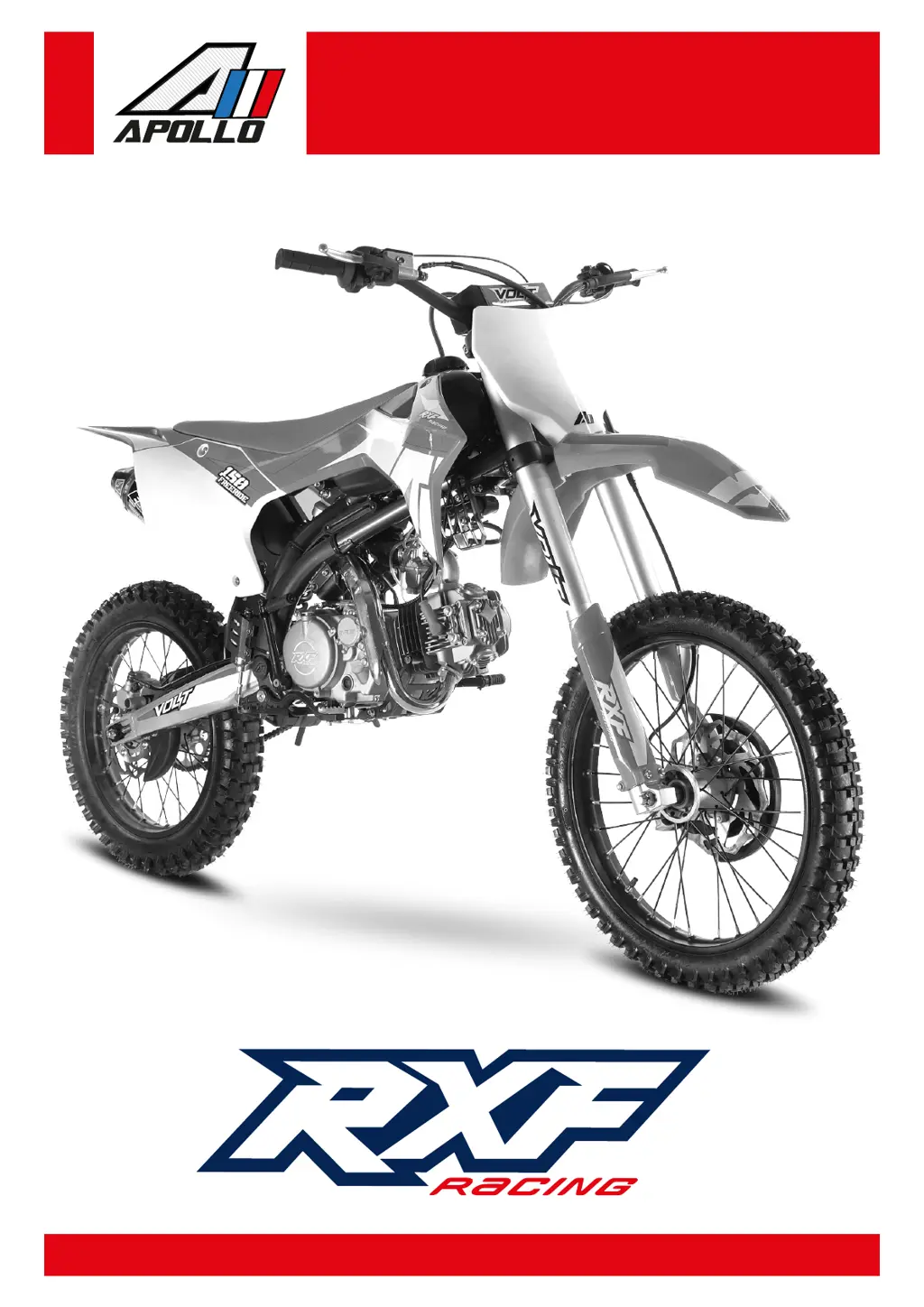
Apollo RXF FREERIDE 125 - User Manual

Apollo RXF FREERIDE 125
92 pages
Print Icon
To Next Page IconTo Next Page
Loading...
/// USER MANUAL
RXF FREERIDE 125 / FREERIDE 140 / FREERIDE 150
FREERIDE S 190
APOLLOMOTORS.FR

Table of Contents

Questions and Answers

Summary

1. Location of Important Labels

1.1 Canada

Identification of important labels specific to Canada.

1.2 Europe

Identification of important labels specific to Europe.

1.3 Oceania and South Africa

Identification of important labels for Oceania and South Africa.

2. Safety Advice

2.1 Intended Use and Owner Responsibility

Defines intended use and highlights owner's role in safe operation.

2.2 General Safe Riding Practices

Guidelines for safe riding, protective apparel, and hazard awareness.

2.6 Carbon Monoxide Hazards

Awareness of carbon monoxide risks and prevention.

2.7 Loading and Modifications

Advice on motorcycle loading and risks of aftermarket parts.

3. View of Vehicle

3.1 View of Vehicle, Front Left (Example)

Identifies key components of the vehicle from the front left view.

3.2 View of Vehicle, Front Right (Example)

Identifies key components of the vehicle from the front right view.

4. Controls and Operation

4.1-4.4 Handlebar Controls

Description of clutch, brake, throttle, and kill switch functions.

4.5-4.7 Starting and Power Controls

Operation of starter, ON/OFF switch, and service counter.

4.8-4.12 Fuel and Starting Systems

Procedures for fuel tank, fuel tap, choke, and kick starter.

4.13-4.15 Foot Controls

Explanation of foot brake, shift lever, and side stand usage.

5. Preparing for Use

5.1 First Use

Crucial safety and preparation steps for initial motorcycle operation.

5.2 Running in the Engine

Important procedure for breaking in a new engine.

6. Riding and Operation

6.1 Pre-Ride Checks & Starting

Essential pre-ride checks and procedures for starting the engine.

6.4-6.6 Riding, Braking, and Stopping

Techniques for riding, safe braking, and stopping the motorcycle.

6.7 Transport and Refueling

Guidelines for transporting the motorcycle and safe refueling.

7. Maintenance

7.1 Informations

Overview of the importance of periodic inspection, adjustment, and lubrication.

7.2 Owners Tool Kit

Details on the tools provided for basic maintenance and minor repairs.

7.3 Periodic Maintenance and Adjustment

Schedule of maintenance tasks and intervals.

8. Suspension Adjustment

8.1 Suspension Setup Basics

Understanding basic chassis settings and rider weight impact.

8.2-8.4 Shock Absorber Adjustments

Adjusting spring preload and rebound damping for shock absorbers.

8.5-8.8 Front Fork Adjustments & Cleaning

Adjusting front fork damping, cleaning dust sleeves, and changing handlebar position.

9. Brake System Maintenance

9.1-9.3 Brake Disc & Fluid Checks

Inspecting brake discs, checking and adding brake fluid.

9.4-9.6 Brake Linings & Lever Adjustment

Checking/changing brake linings and adjusting foot brake lever position.

10. Wheels and Tires

10.1-10.4 Wheel Removal & Installation

Procedures for removing and installing front and rear wheels.

10.5-10.7 Tire & Spoke Checks

Inspecting tire condition, air pressure, and spoke tension.

11. Chassis Service

11.1-11.5 Front Fork and Triple Clamp Service

Procedures for fork legs, protectors, and triple clamp service.

11.8-11.10 Steering Head Bearing Service

Checking, adjusting, and greasing the steering head bearing.

11.15-11.26 Drivetrain & Air Filter Maintenance

Maintenance of shock absorber, seat, air filter, engine sprocket, and chain.

11.27-11.31 Frame, Cables & Grips Checks

Inspecting frame, swingarm, cables, and handlebar grips.

12. Engine Operation & Maintenance

12.1-12.2 Throttle Cable Service

Checking and adjusting play in the throttle cable for smooth operation.

12.3-12.4 Carburetor Idle Adjustments

Importance and procedures for setting carburetor idle speed.

12.7-12.9 Engine Oil Service

Procedures for checking, changing, and adding engine oil.

13. Electrical System

13.1 Removing the Battery

Procedure for safely removing the motorcycle battery.

13.2 Installing the Battery

Procedure for correctly installing the motorcycle battery.

14. Cleaning, Care

14.1 Cleaning the Motorcycle

Guidelines for proper cleaning and care to maintain appearance and value.

15. Storage

15.1 Bike Storage

Procedures and recommendations for long-term motorcycle storage.

16. Troubleshooting

17. Technical Data

17.1 Engine Specifications

Engine specifications including displacement, bore, stroke, and compression.

17.1.1 FREERIDE 125 Engine Data

Specific engine data for the Apollo FREERIDE 125 model.

17.1.2 FREERIDE 140 Engine Data

Specific engine data for the Apollo FREERIDE 140 model.

17.1.3 FREERIDE 150 Engine Data

Specific engine data for the Apollo FREERIDE 150 model.

17.1.4 FREERIDE S 190 Engine Data

Specific engine data for the Apollo FREERIDE S 190 model.

17.2 Carburetor Settings

Carburetor settings for various Apollo motorcycle models.

17.2.1 FREERIDE 125 Carburetor Settings

Carburetor settings for the Apollo FREERIDE 125.

17.2.2 FREERIDE 140 Carburetor Settings

Carburetor settings for the Apollo FREERIDE 140.

17.2.3 FREERIDE 150 Carburetor Settings

Carburetor settings for the Apollo FREERIDE 150.

17.2.4 ELITE S 190 Carburetor Settings

Carburetor settings for the Apollo ELITE S 190.

17.3 Fuel Capacity

Total fuel tank capacity specifications.

17.4 Chassis Specifications

Key chassis dimensions and specifications.

17.5 Tire Specifications

Tire sizes and recommendations.

Apollo RXF FREERIDE 125 Specifications

General IconGeneral
CoolingAir-cooled
Transmission4-Speed, Manual Clutch
Starting SystemElectric and kick start
Seat Height870 mm
Displacement125 cc
Cooling SystemAir-cooled
Fuel SystemCarburetor
Front Tire70/100-17
Rear Tire90/100-14
EngineSingle cylinder, 4-stroke
Front BrakeDisc
Rear BrakeDisc
Engine TypeSingle cylinder, 4-stroke
Rear SuspensionMono-shock

Related product manuals