Need help?
Do you have a question about the Argo AUR210CL Series and is the answer not in the manual?
Detailed technical specifications for each model's unit.
Specifications for indoor unit components like PCB, fan, transformer.
Specifications for indoor unit components like overload relays, capacitors, relays.
Specifications for outdoor unit components like fan motor, safety devices.
Cooling operating temperature ranges for indoor and outdoor units.
Heat pump cooling/heating operating temperature ranges for indoor/outdoor units.
Physical dimensions of the indoor unit.
Physical dimensions of the outdoor unit.
Cooling performance curves based on ambient and indoor temperatures.
Cooling performance curves for heat pump models.
Heating performance curves for heat pump models.
Refrigerant flow path for cooling-only models.
Refrigerant flow path for heat pump models.
How room temperature is controlled in cooling mode.
How room temperature is controlled in heating mode.
Function to prevent the indoor heat exchange coil from freezing.
Function to prevent overheating of the indoor heat exchange coil.
Dehumidification function using cooling cycle at low level.
Auto mode switching between cooling and heating.
Operation to remove frost from the outdoor heat exchanger.
Timing sequence for defrosting mode operation.
Wiring diagrams for cooling-only models.
Wiring diagrams for heat pump models.
Initial checks before performing detailed troubleshooting.
Troubleshooting steps when the air conditioner does not operate.
Troubleshooting for circuit breaker tripping issues.
Troubleshooting for condensate drainage system malfunctions.
Troubleshooting for no outdoor unit or compressor operation.
Troubleshooting when only specific parts of the unit do not operate.
Troubleshooting for indoor fan, outdoor fan, or compressor motor failures.
Troubleshooting operational abnormalities in heat pump models.
Troubleshooting mode switching and indoor PCB issues.
Troubleshooting indoor PCB fuses and temperature setting issues.
Troubleshooting poor or excessive cooling or heating performance.
Troubleshooting for defective temperature sensors (TH1, TH2).
Specified refrigerant quantities for various models and configurations.
Procedures for vacuuming indoor and outdoor units.
Procedures for measuring insulation resistance of electrical parts.
Procedures for checking fuse continuity and motor capacitors.
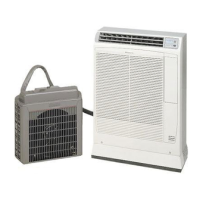
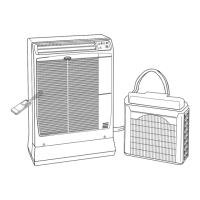
This document serves as a technical data and service manual for the Argo Ulisse series of room air conditioners with remote condensers. The series includes the Ulisse 10 (AUR210CLXXX), Ulisse 13 (AUR213CLXXX), and Ulisse HL (AUR310HLXXX) models. The Ulisse 10 and 13 are cooling-only versions (R407C refrigerant), while the Ulisse HL is a heat pump version (R407C refrigerant).
The Ulisse air conditioners offer several operational functions:
Room temperature is controlled by cycling the compressor ON and OFF based on readings from the room temperature sensor in the remote control unit. The remote control unit transmits temperature and other information to the indoor unit's controller every 3 minutes.
This function prevents the indoor heat exchange coil from freezing. If the compressor has been running for 10 minutes or more and the indoor heat exchange coil temperature falls below -1°C, the control circuit stops the compressor for at least 6 minutes.
This function prevents overheating of the indoor heat exchange coil during heating operation.
Dry operation utilizes the cooling cycle to remove moisture from the air without significantly lowering the room temperature. The air conditioner automatically cycles ON and OFF based on room temperature.
In auto mode, the microprocessor calculates the difference between the set temperature and the room temperature to automatically switch between cooling and heating modes.
When frost on the outdoor heat exchanger reduces unit capacity during heating, the microcomputer-controlled temperature sensing system detects the temperature drop gradient and initiates defrosting. During defrosting, indoor and outdoor fan motors stop, only the compressor operates, and the system temporarily switches to cooling operation mode.
| Model | Capacity (Cooling) BTU/h (W) | Capacity (Heating) BTU/h (W) | Power Input (Cooling) W | Power Input (Heating) W | C.O.P. (Cooling) W/W | C.O.P. (Heating) W/W | Net Weight (Indoor/Outdoor) kg |
|---|---|---|---|---|---|---|---|
| AUR210CLXXX | 9500 (2650) | N/A | 980 | N/A | 2.70 | N/A | 44 / 9.5 |
| AUR213CLXXX | 12500 (3670) | N/A | 1300 | N/A | 2.82 | N/A | 44 / 15 |
| AUR310HLXXX | 9820 (2800) | 10700 (3140) | 940 | 950 | 2.98 | 3.31 | 44 / 15 |
The manual provides systematic charts for diagnosing common issues:
Detailed instructions for reloading the R407C refrigerant charge, including specific quantities for standard units and units with 2m or 4m extension kits.
 General
| Brand | Argo |
|---|---|
| Model | AUR210CL Series |
| Category | Air Conditioner |
| Language | English |

 To Next Page