This document is an operator's manual for an Ariens Automatic Tractor, model A19A42, a 42" automatic tractor. It provides comprehensive instructions for safe operation, assembly, maintenance, and troubleshooting of the riding lawn mower.
Function Description
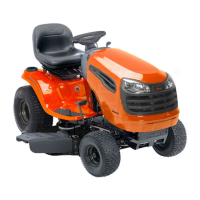
The Ariens Automatic Tractor is a ride-on lawn mower designed for cutting grass and can also be used with various attachments. It features an internal combustion engine and an automatic transmission for ease of use. The tractor is equipped with safety features such as an operator presence sensing switch, which shuts off the engine if the operator leaves the seat with the attachment clutch engaged or without setting the parking brake. It also includes a Reverse Operation System (ROS) that allows the mower or other powered attachments to operate while in reverse, though this is strongly discouraged for mowing. The cruise control feature allows for setting a desired forward speed without continuously holding the drive pedal.
Important Technical Specifications
- Gasoline Capacity and Type: 2.5 Gallons (9.46 L) of unleaded regular gasoline. Gasoline containing up to 10% ethanol (E10) or 10% MTBE is acceptable; exceeding these limits will void the warranty.
- Oil Type (API: SG-SL): SAE 10W30 (above 32°F/0°C) or SAE 5W30 (below 32°F/0°C).
- Oil Capacity: 51 oz. (1.96 L) with filter; 60 oz. (1.77 L) without filter.
- Spark Plug: Champion RC12YC with a gap of .030" (.76 mm).
- Charging System: 13 Amps @3600 RPM.
- Battery: 28 Amp/Hr, minimum 230 CCA, Case Size U1R.
- Blade Bolt Torque: 45-55 FT. LBS. (62-75 Nm).
- Mower Cutting Height Range: Approximately 1" to 4".
- Maximum Recommended Operation Angle: 15 degrees for slopes.
Usage Features
- Controls: The tractor includes an attachment lift lever (A) for raising and lowering attachments, a brake pedal (B) for braking and starting the engine, a parking brake (C) to lock the pedal, a throttle/choke control (D) for engine speed, an attachment clutch lever (E) for engaging mower blades, an ignition switch (F) for starting/stopping, a reverse operation system (ROS) "ON" position (G), a light switch (H), a cruise control lever (J), forward drive pedal (K), reverse drive pedal (L), and a freewheel control (M) for disengaging the transmission.
- Starting the Engine: Requires the freewheel control to be engaged, the operator seated, the brake pedal depressed, the parking brake set, and the attachment clutch disengaged. The throttle control is moved to the choke position for starting, then to fast.
- Moving Forward/Backward: Controlled by forward (K) and reverse (L) drive pedals. Speed increases with pedal depression.
- Mowing: Operate at full throttle for best performance. Mower blades are engaged via the attachment clutch lever. Cutting height is adjusted using the attachment lift lever. Gauge wheels should be slightly off the ground when the mower is at the desired cutting height.
- Slope Operation: Mow up and down slopes, not across, and avoid slopes greater than 15 degrees. Maintain a low ground speed and avoid sudden changes in speed or direction.
- Cruise Control: Used for forward travel on smooth, straight surfaces. Engage by pulling the lever up while depressing the forward drive pedal, then releasing the lever and foot. Disengage by depressing the brake pedal or tapping the forward drive pedal.
- Towing: Only recommended attachments should be towed, and at the lowest possible speed on slopes.
Maintenance Features
- Maintenance Schedule: A detailed schedule outlines tasks for before each use, every 8 hours, 25 hours, 50 hours, 100 hours, every season, and before storage.
- Engine Oil: Check level before each use and every 8 hours. Change oil every 50 hours or annually. Replace the engine oil filter every season or every other oil change (if used more than 100 hours).
- Air Filter: Service more often in dusty conditions to ensure proper engine function.
- Air Screen: Keep free of dirt and chaff to prevent overheating.
- Spark Plugs: Replace at the beginning of each mowing season or every 100 hours.
- Fuel System: Use fresh, clean, regular unleaded gasoline. For storage, empty the fuel tank and carburetor or use a fuel stabilizer.
- Battery: Keep clean, terminals tight, and small vent holes open. Recharge periodically. Disconnect cables for long-term storage.
- Mower Blades: Keep sharp and replace if bent or damaged. Blade bolt torque is 45-55 FT. LBS.
- Mower Deck Leveling: Ensure tires are properly inflated. Adjust side-to-side and front-to-back for optimal cutting results. The front tip of the blade should be 1/8" to 1/2" lower than the rear tip.
- V-Belts: Check for deterioration and wear after 100 hours and replace if necessary.
- Brake Operation: Check frequently and adjust as required. The tractor should stop within five feet at highest speed in highest gear.
- Tires: Maintain proper air pressure as indicated on the tire sidewalls.
- Cleaning: Clean the tractor, engine, and battery regularly. The deck washout port can be used to clean the underside of the mower deck with a garden hose.
- Storage: Prepare the tractor for storage at the end of the season or if unused for 30 days or more, including cleaning, inspecting/replacing belts, lubricating, securing fasteners, and proper fuel/battery management.


 To Next Page
 General