
 Need help?
Do you have a question about the Ariston Velis Evo 80L and is the answer not in the manual?
Installation responsibility, manufacturer liability, qualified personnel, and packaging hazards are detailed.
Child safety, appliance usage by restricted individuals, and safe interaction with the appliance are covered.
Appliance flushing procedures, power cord replacement, and mandatory safety valve installation are outlined.
Ensures safe operation through periodic maintenance, safety device checks, and scald hazard warnings.
Frost protection drainage, flammable material proximity, and appliance placement precautions are detailed.
Explains the thermal disinfection cycle to prevent Legionella bacteria and associated burn warnings.
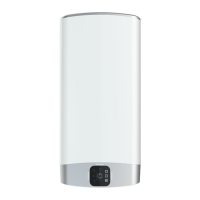
Provides an overview of the water heater's key components with a visual diagram.
Details product specifications, energy consumption, and smart function benefits for efficiency.
Lists conformity with electrical safety standards, EC directives, and environmental regulations.
Covers building regulations for unvented systems, required accessories, and dielectric junction importance.
Provides installer guidelines, contact information, and water supply pressure requirements.
Specifies electrical supply requirements and general installation best practices for installers.
Details vertical installation, environmental considerations, wall mounting support, and maintenance clearance.
Addresses plumbing warnings regarding expansion vessels, pressure reducing valves, and safety valve outlets.
Outlines regulations for discharge pipework, tundish placement, and visibility requirements.
Guides on pipe sizing, resistance calculations, and ensuring safe discharge points.
Presents a table for sizing copper discharge pipes and includes a worked example for clarity.
Explains the appliance draining procedure and critical electrical safety requirements, including earthing.
Details power supply requirements and cable specifications, including color coding.
Provides detailed wiring diagrams for both the Velis Evo and Velis Evo WiFi models.
Covers electrical system verification, general commissioning checks, and water supply testing.
Details leak testing, safety valve operation checks, and user demonstration procedures.
Guides on replacing appliance parts, reassembly, and component torque specifications.
Outlines the periodic maintenance schedule for heating elements and anodes.
Offers user safety advice, placement considerations, and basic appliance operation guidance.
Explains temperature adjustment, function activation, and the ECO EVO learning mode.
Describes special functions like Shower Ready and Anti-Freeze protection.
Covers thermal disinfection for Legionella and the process for fault diagnostics using LEDs.
Details the steps for creating an Aqua Ariston NET account and configuring Wi-Fi connectivity.
Explains the app's features and how to interpret Wi-Fi connection status indicators.
Provides troubleshooting steps for common issues like cold, hot, or insufficient hot water delivery.
Addresses safety device trickling and offers essential advice on professional repair services.
Informs about the WEEE Directive and provides guidance on proper disposal of electronic waste.
Includes dimensional diagrams and plumbing schematics for installation planning.
Details the specifications for wall mounting brackets and required clearances.
This document provides comprehensive assembly and operation instructions for an unvented water heater, emphasizing safety, proper installation, and maintenance. The device is designed to provide hot water for domestic use, incorporating features for energy efficiency and user convenience.
The unvented water heater is an appliance designed to heat and store water for domestic use. It operates by heating water to a temperature below boiling point and is connected to a mains water supply. A key feature of this water heater is its unvented design, which means it operates under mains pressure, providing hot water at a consistent flow rate to multiple outlets simultaneously.
The device includes a thermal disinfection cycle function, enabled by default, to prevent the growth of Legionella bacteria. This cycle heats the water to 60°C for a specified period, typically when the product is switched on, restarted after a power outage, or every 30 days if the water temperature consistently remains below 55°C. This ensures hygienic water delivery.
For enhanced energy efficiency, the water heater is equipped with an "ECO EVO" function. This intelligent software program learns user consumption patterns over time, minimizing heat loss and maximizing energy savings. It adapts water heating schedules to the user's actual needs, ensuring a minimum reserve of hot water is always available while optimizing energy consumption. The learning process typically takes a week initially, with maximum efficiency achieved after four weeks.
A "Shower Ready" function is also available on some models, designed to minimize water heating time. This feature indicates when enough hot water is available for at least one shower (40 liters of mixed hot water at 40°C), regardless of the user's set temperature.
The anti-freeze function provides automatic protection against damage caused by very low temperatures (below 5°C), even when the product is turned off during winter. For this function to operate, the product must remain plugged into the mains power.
The water heater offers a user-friendly interface for temperature adjustment and function activation. Users can switch the appliance on/off using a dedicated button and set the desired water temperature between 40°C and 65°C using "+" and "-" buttons. During the heating phase, LEDs on the control panel indicate the temperature reached, with subsequent LEDs flashing progressively until the set temperature is achieved. If the temperature drops, the heating reactivates automatically, and the LEDs resume their progressive flashing.
The "ECO EVO" function can be activated by pressing its corresponding button, which will illuminate. While in ECO EVO mode, manual temperature selection is still possible, but changing the temperature will temporarily disable the ECO EVO function. It can be reactivated by pressing the ECO button again. The system retains learned consumption levels even if the product is turned off and on, provided it remains connected to the mains power for up to four hours. To voluntarily reset the acquired data, users can hold down the "ECO" button for more than 5 seconds.
For models with Wi-Fi functionality, users can connect the water heater to their home network via a dedicated app. This allows for remote control and monitoring of the device. The Wi-Fi button on the control panel is used to activate Wi-Fi (blinking slow) and create an Access Point (blinking fast) for initial setup. The app guides users through account creation, product registration, and connection to the home network, providing remote access to functions like on/off, manual mode, program mode, ECO mode, power settings, temperature selection, remaining time, and number of showers. LED indicators on the Wi-Fi button provide status updates (blinking slow for connected to home network, blinking fast for Access Point mode, steady on for connected and ON, off for module OFF).
Maintenance of the unvented water heater should only be performed by professionally qualified personnel. Before any maintenance work, it is crucial to disconnect the appliance from the mains power.
Regular maintenance includes descaling the heating element, which should be done approximately every two years, or more frequently if the water is very hard. This helps ensure proper functioning and efficiency. Magnesium anodes, present in most models (except those with stainless steel boilers), should be replaced every two years. However, an annual check is recommended if the water is corrosive or rich in chloride. Replacing anodes involves removing the heating elements and unscrewing them from their brackets.
The bypass pipe should be inspected in case of obstruction, which involves removing two rings. After any routine or extraordinary maintenance, it is recommended to fill the tank with water and drain it completely to remove any residual impurities. Only original spare parts supplied by the manufacturer's authorized service centers should be used for replacements.
The electrical parts, including the power board, control panel, and rod carrying sensors, can be accessed by removing the cover. Specific instructions are provided for disconnecting cables and removing components, with emphasis on careful handling to avoid damage, especially to plastic flaps during control panel removal. During reassembly, all components must be returned to their original positions, and the flange gasket should be replaced every time it is disassembled. It is critical not to reverse the heating elements, as this can cause appliance malfunction; work on one heating element at a time.
For troubleshooting, if the water comes out cold, checks should include the presence of voltage, the circuit board, heating parts, bypass pipe, and sensor holder rods. If the water comes out boiling hot, the circuit board, amount of scale, and sensor holder rods should be checked after disconnecting the electricity supply. Insufficient hot water delivery may indicate issues with mains water pressure, the cold water intake pipe deflector, the hot water pipe, or electrical components. Water trickling from the pressure safety device is normal during heating but persistent trickling may require checking device calibration and mains water pressure. The appliance outlet should never be obstructed. In case of persistent problems, users are advised not to attempt repairs themselves but to contact a qualified technician.
 General
| Capacity | 80 Liters |
|---|---|
| Installation | Wall-mounted |
| Voltage | 230 V |
| Energy Efficiency Class | B |
| Weight | 29 kg |
| Type | Electric |
| Frequency | 50 Hz |
| Thermostat | Electronic |
| Power | 1500 W |
| Mounting | Vertical |
| Shape | Rectangular |
| Material | Titanium Enamelled Steel |


 To Next Page