EasyManua.ls Logo

Arlec Automatic 4000 - User Manual

Arlec Automatic 4000
6 pages
Print Icon
To Next Page IconTo Next Page
Loading...
Instruction Manual
Automatic
44000000
Battery Charger
Important! Please read these instructions carefully before use.
BC906
Due to continuous research and development the specifications herein are subject to change without notice.
Question and Answer IconNeed help?

Do you have a question about the Arlec Automatic 4000 and is the answer not in the manual?

Summary

Important Notes

Specifications

Guarantee

Proof of Purchase

Retain receipt for service or warranty claims.

Connecting the Charger to the Battery

Ammeter

Protection

Charging the Battery

Boost Charging

Charges batteries to a higher float voltage for quick starting.

Charging Batteries in Golf Buggies, Wheelchairs, etc, Using Boost Mode

Ideal for daily-use batteries, recharge after each use.

Automatic Charging

Testing Batteries

Testing Sealed and Non Sealed Batteries

Methods for testing battery state of charge using voltmeters.

Safety Information

Overview

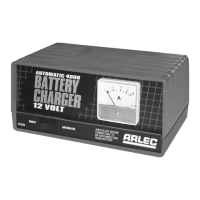
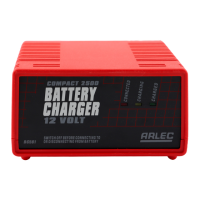
The Arlec Automatic 4000 Battery Charger (model BC906) is a 12-volt battery charger designed for automotive lead-acid batteries with capacities ranging from 20 to 80 amp-hours. This device offers switchable charging characteristics: 'Boost' and 'Automatic' modes, catering to different charging needs and battery types.

Function Description:

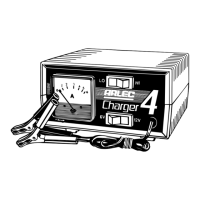
The primary function of the Arlec Automatic 4000 Battery Charger is to charge 12-volt lead-acid batteries. It features an ammeter that provides a visual indication of the charge accepted by the battery. When a battery is fully discharged, the ammeter needle may initially show a full-scale deflection, which will gradually move down the scale and stabilize near the charger's continuous current rating as the battery charges. This indicates that the battery is approaching a fully charged condition.

The charger incorporates a fully automatic circuit breaker in its output circuit to protect against overload, short circuits, and reversed connections. If the circuit breaker operates due to prolonged charging in excess of the maximum continuous rating, it will automatically switch the charger ON and OFF until the battery achieves a satisfactory charge. This "cycling" behavior, where the ammeter needle falls to zero and jumps back up at short intervals, is normal and does not harm the charger or battery. However, if this cycling persists for more than 4 hours, it may indicate a faulty battery that should be checked by a hydrometer or an automotive electrician.

Important Technical Specifications:

  • Input Voltage: 240V 50Hz
  • Output Voltage: 12V DC Nominal
  • Continuous Output Current: 4 amps
  • Float Voltage on Automatic Mode: 13.8V
  • Float Voltage on Boost Mode: 14.8V
  • Battery Capacity Range: 20 to 80 amp-hours (for lead-acid batteries)
  • Protection: Thermal overload protection, electronically voltage limited, double insulated.

Usage Features:

Charging Modes:

  • 'Boost' Mode: This mode is designed for charging frequently used batteries overnight. It automatically charges batteries to a higher float voltage (14.8V) than the 'Automatic' mode. In many cases, a battery charged in 'Boost' mode will be able to start a car after a short period. This mode is ideal for batteries used daily, such as those in wheelchairs, or several times a week, like in golf buggies. Batteries used in these applications should be recharged after each use. Typically, a 30-ampere wet cell battery in a golf buggy will be charged in 12-15 hours using 'Boost' mode. However, it is not recommended for sealed/low maintenance batteries. When using 'Boost' mode, do not charge for longer than 24 hours to prevent overcharging.
  • 'Automatic' Mode: This mode is suitable for situations where batteries are left on charge for long periods and is particularly recommended for sealed and low maintenance type batteries. In 'Automatic' mode, the charger automatically reduces the charging current as the battery becomes charged and then provides just enough current to maintain the battery in a charged condition. This allows batteries to be left on charge continuously without risk of damage from overcharging. The float voltage in this mode is 13.8V. This feature is ideal for charging most sealed batteries and is especially useful for batteries installed in boats, golf buggies, caravans, or lawn mowers that are used intermittently.

Connecting the Charger to the Battery:

The charger's output leads are fitted with color-coded battery clips: red for the positive (+) battery terminal and black for the negative (-) battery terminal. Users must ensure the clips bite firmly and that polarity is correct. Ideally, the battery should be disconnected and removed from the vehicle before charging. If this is not possible, connect the battery terminal not connected to the chassis first to the charger. The other connection is then made to the chassis, keeping away from the battery and fuel line. Only after connecting, should the mains supply to the charger be switched on. After charging, switch off the mains supply, then remove the chassis connection and finally the battery connection, in that order.

Testing Batteries:

As a guide, a battery is considered to have reached 60% or 90% capacity when the ammeter drops below 1 amp, depending on whether the 'Automatic' or 'Boost' mode was used, respectively. For a more precise determination of the battery's state of charge, the following voltage guidelines can be used (after the battery has not been charged or discharged for at least 15 minutes):

  • 20% - 40% capacity: 12.00V to 12.25V
  • 40% - 60% capacity: 12.25V to 12.50V
  • 60% - 80% capacity: 12.50V to 12.75V
  • 80% - 100% capacity: 12.75V and above Batteries with filler caps can also be tested with a hydrometer for higher accuracy, as individual cells can be checked. Alternatively, most battery retailers or automotive electricians can test the battery. Arlec also offers an inexpensive electronic device, the BT964 Battery Tester, which connects to the battery to test its state of charge, confirm the car's charging circuit operation, and indicate if the battery maintains sufficient voltage during engine cranking.

Maintenance Features:

The manual emphasizes the importance of proper battery maintenance during charging. Before charging, users should remove battery filler caps and check the electrolyte level. If necessary, top up with distilled water until the electrolyte is 6mm above the top of the plates. Do not replace the filler caps until the charging program is complete.

Safety Information:

Working with lead-acid batteries is dangerous due to the emission of explosive hydrogen gas, known as 'gassing' (especially from non-sealed types). This gas can ignite explosively in confined spaces. Therefore, it is crucial to:

  • Always charge batteries in a well-ventilated area, away from flammable liquids and gases.
  • Never use the charger in the rain or expose it to water from hoses or sprinklers.
  • Keep sparks and naked flames (e.g., cigarettes, lighters, matches) away from the battery at all times.
  • Never smoke or light a cigarette near a battery.
  • Exercise extreme care with metal objects and tools, including jewelry like rings and watch bands, as contact with battery terminals can cause sparks or severe heat burns.
  • Do not allow tools to drop on the battery or place them temporarily on top of it.
  • Wear protective eye glasses when testing or working on or around a lead-acid battery.
  • If battery acid contacts skin or clothing, flush immediately with large amounts of water.
  • In case of accidental eye contact with battery acid, flush eyes for at least five minutes with clean water, keeping them open, and seek immediate medical attention. Do not use eye drops or other medication unless instructed by a doctor.
  • Ensure the charging area is well ventilated.
  • Never test or charge a battery in a confined area.
  • The charger is not intended for use by young children or infirm persons without supervision. Children should not be allowed to play with the charger.
  • If the mains cord is damaged, it must only be replaced by an Authorized Service Agent.
  • Always adhere to the battery manufacturer's recommendations when charging batteries.

Guarantee:

Arlec provides a 24-month guarantee against defects in materials and workmanship from the date of purchase, provided the product is used according to Arlec's recommendations and within specified voltage and current limits. Arlec will, at its option, repair, replace, or credit any defective product. The guarantee is void if repairs, alterations, or modifications are undertaken by unauthorized agents. To claim warranty, the purchase receipt must be returned with the product. This guarantee is in addition to consumer rights under the Trade Practices Act and State consumer protection legislation. Users should retain their receipt for all service or warranty claims.

Arlec Automatic 4000 Specifications

General IconGeneral
BrandArlec
ModelAutomatic 4000
CategoryBattery Charger
LanguageEnglish

Related product manuals