EasyManua.ls Logo

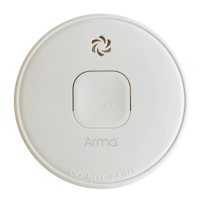
ARMA NV866H-LSW - User Manual

Default Icon
2 pages
Print Icon
To Next Page IconTo Next Page
Loading...
LONGLIFE 10 YEAR BATTERY
OPERATED PHOTOELECTRIC
SMOKE ALARM WITH
WIRELESS INTERCONNECT
MODEL : NV866H-LSW
MAIN FEATURES:
Photoelectric Sensor for Slow Smouldering Fires
Wireless Interconnection Using Radio Link (Self Learn
pairing)
Long life integrated Lithium Battery
Hush Feature
Power & Alarm Test Button
Low Battery Warning
Loud 85db alarm signal
Supplied with wall plugs & screws
Pre-warning fault signal
This instruction leaflet contains importantinformation on
the correct installationand operation of your smoke
alarm. Read this leafletfully before attempting
installation and retain for future reference.
Horn Level : 85 Decibels at 3 metres
Max. Wireless interconnection
: 20 units
Transmitting& Receiving Distance : 50m(Outdoor)
30m (Indoor)
Battery Life : 10 years
Approval: Certified toBS EN14604:2005
LOCATING THE SMOKE ALARM
This smoke alarm is a photoelectric alarm with built-in
wireless interconnection. It can transmit and receive
withother smoke alarms.
If your dwelling is on a single storey, for minimum protection
you should install an alarm in the hallway between the living
areas (incl. kitchens) and sleeping areas. Place it as near to
the living areas as possible and ensure the alarm is audible
when the bedrooms are occupied. See Figure 1 for
examples. An alarm should be installed in every bedroom
within 3m of the door.
If your dwelling is multi-storey, for minimum protection one
alarm should be fitted at the bottom of the staircase with
further alarms fitted on each upstairs landing. This includes
basements but excludes crawl spaces and unfinished attics.
See Figure 2 for examples.
NOTE: For maximum protection an alarm should be fitted in
every room (except kitchen, bathroom and garage). DO NOT
FIT AN ALARM IN THE KITCHEN or BATHROOM, as cooking
fumes or steam may trigger the alarm.
DO NOT FIT ALARM IN A GARAGE OR ATTIC, as exhaust
fumes or dust are likely to set it off.
POSITIONING THE SMOKE ALARM
Ceiling Mounting
As hot smoke rises and spreads out, it is advisable to mount
on a ceiling in a central position. Avoid areas where there is
no air circulation. e.g. corners of rooms and keep away from
items which may prevent the free flow of air. Place the unit
at least 300mm from any light fitting or decorative object
which might obstruct smoke / heat entering the alarm. Keep
at least 300mm away from walls. See Figure 3i.
Wall Mounting
Do not mount close to corners. Put the top edge of your
smoke alarm between 150 and 300mm below the ceiling.
Keep at least 300mm from room corners. See Figure 3i.
On a Sloping Ceiling
In areas with sloping or peaked ceilings install your Smoke
Alarm 900mm from the highest point measured horizontally
because “dead air” at the apex may prevent smoke from
reaching the unit. See Figure 3ii.
Areas to be avoided include the following:
Situations where the temperature may fall below 10°C
or rise above 40°C.
Humid areas such as bathrooms, kitchens, shower
rooms where the relative humidity may exceed 90%.
Near a decorative object, door, light fitting, window
molding etc., that may prevent smoke or heat from
entering the alarm.
Fume filled environments such as garages. Exhaust
gases may cause false alarms.
Adjacent to or directly above hot components such as
radiators or wall vents that can affect the direction of
air currents.
In very dusty or dirty environments such as workshops
or attics.
Locate unit at least 1m away from fluorescent light
fittings as electrical “noise” and/or flickering may
affect the unit.
Do not locate in insect infested areas. Insects and
contamination on the Smoke Alarm sensor can cause
false alarms.
BEDROOM
BATHROOM
BEDROOM
BEDROOM
BEDROOM LIVING ROOM
HALL
KITCHEN
BATH
ROOM
LIVING
ROOM
HALL
KITCHEN
BASEMENT
LANDING
BED
ROOM
FIGURE 1 SINGLE STOREY DWELLING
FIGURE 2 –2/3 STOREY DWELLING
SPECIFICATIONS
Power Source : 3V Lithium battery (built in)
Operation Current : <20mA operation (In Alarm)
Operation Temperature : 0oC-40oC
Ambient Humidity : 10%-90%
PAIRING THE SMOKE ALARMS
It’s best to gather all the alarms together on a table. Firstly,
activate all alarms by attaching them to their mounting plates.
Turn clockwise to activate battery.
Select one Alarm to be the First Alarm
1. Press the black button on the back and hold for 5 seconds.
The LED on the front will go RED indicating that this alarm is
now in Pairing Mode. You now have a 30 second window to
complete pairing of more alarms.
On the Remaining Alarms
1. Press black button on the back and hold for 2 seconds
and then release. The LED on the front will FLASH
RED. This alarm is now paired.
2. Repeat with each remaining alarm before the 30
second window elapses. If you are pairing say 10
more alarms but you only manage to pair 6 during the
30 second window, the remaining 4 can be paired
separately using the same process. The first 6 will
remain paired.
3. If you wish, you can check pairing while the alarms are
still on the table before you install them (see TESTING
YOUR SMOKE ALARM).
INSTALLATION
Attach the upper smoke alarm unit firmly into the
mounting bracket.
Place the mounting plate on the wall, and use the screws
supplied to secure the mounting bracket.
Having established the mounting location ensure that
there are no electrical wiring or pipe work in the area
adjacent to the mounting surface.
Take the mounting bracket and mark the two mounting
holes’ locations.
Drill holes in the positions marked.
Insert wall plugs into the drilled holes.
Screw mounting bracket to mounting surface. DO NOT
OVER TIGHTEN.
Assemble detector onto the mounting plate by aligning the
two projections (A1) and (A2) on the mounting plate with
the two keyhole slots in the detector.
Question and Answer IconNeed help?

Do you have a question about the ARMA NV866H-LSW and is the answer not in the manual?

Summary

Positioning the Smoke Alarm

Ceiling Mounting

Guidance on mounting smoke alarms on ceilings for optimal smoke detection.

Wall Mounting

Instructions for wall mounting smoke alarms to ensure proper placement and airflow.

Sloping Ceiling Placement

Advice on positioning smoke alarms on sloping or peaked ceilings to avoid dead air pockets.

Pairing the Smoke Alarms

Select First Alarm

Instructions for designating a primary alarm unit for the wireless pairing process.

Pair Remaining Alarms

Procedure for pairing subsequent smoke alarms to the primary unit within a time limit.

Installation

Mounting Bracket Installation

Steps for securing the mounting bracket to the wall, including marking and drilling.

Detector Assembly

How to connect the smoke alarm unit to its installed mounting plate securely.

Testing and Operation

Test & Hush Button Function

Description of the combined button used for testing alarm functions and activating the hush mode.

Testing Procedure

Procedures for weekly testing to verify the correct functionality of the smoke alarm system.

Alarm Management and Safety

False Alarm Handling

Steps to take when the smoke alarm triggers without an actual fire or smoke.

Fire Incident Response

Critical procedures for evacuation and contacting emergency services during a fire incident.

False Alarm Prevention

Identifies common triggers for false alarms and methods to prevent them.

Maintenance and Important Safeguards

Regular Maintenance

Guidance on regular cleaning and upkeep to ensure the smoke alarm operates correctly.

Essential Safety Precautions

Essential safety advice and precautions to be followed for effective and safe operation of the smoke alarm.

Warranty Information

Overview

The Arma NV866H-LSW is a long-life 10-year battery-operated photoelectric smoke alarm with wireless interconnectivity. It is certified to BS EN14604:2005 and carries the CE mark (2797-CPR-638573).

Function Description

This smoke alarm utilizes a photoelectric sensor, making it effective for detecting slow smouldering fires. Its key feature is wireless interconnection, allowing it to transmit and receive signals from other smoke alarms in a group. When smoke is detected, the unit emits a loud pulsating alarm until the air clears or the Hush button is pressed. The wireless function operates in sleep mode during normal operation, waking up approximately every 16 seconds to receive transmissions from other alarms.

The device includes a Hush or Silence feature, activated by pressing and holding the test button for approximately 1 second. This temporarily silences unwanted alarms for 10 minutes, during which the red LED flashes every 10 seconds to indicate reduced sensitivity. After 10 minutes, the alarm will give two short beeps and reset to normal sensitivity. If smoke density increases during the hush period (e.g., from a fire), the unit will revert to alarm mode.

A pre-warning fault signal is indicated by the LED on the front cover lighting up when there is no fire or smoke accident. This suggests dust inside or a malfunction, prompting the user to replace the unit.

Important Technical Specifications

  • Power Source: 3V Lithium battery (built-in)
  • Battery Life: 10 years (integrated, non-replaceable)
  • Horn Level: 85 Decibels at 3 metres
  • Operation Current: <20mA operation (In Alarm)
  • Operation Temperature: 0°C-40°C
  • Ambient Humidity: 10%-90%
  • Max. Wireless Interconnection: 20 units
  • Transmitting & Receiving Distance: 50m (Outdoor), 30m (Indoor)
  • Sensor Type: Photoelectric

Usage Features

  • Wireless Interconnection: Allows multiple alarms to communicate, forming a network for enhanced safety. Pairing is initiated by pressing and holding the black button on the back of the "first alarm" for 5 seconds until its front LED turns RED, indicating a 30-second pairing window. Subsequent alarms are paired by pressing their black buttons for 2 seconds until their front LED FLASHES RED.
  • Long-Life Integrated Lithium Battery: Provides 10 years of operation without battery replacement.
  • Power & Alarm Test Button: Used for weekly testing of the alarm's functionality and for activating the Hush feature.
  • Low Battery Warning: The alarm emits a short 'beep' once every 40 seconds when the battery is nearing the end of its life. This warning will persist for at least 30 days. If the red indicator light (LED) does not flash every 40 seconds, the entire smoke alarm unit should be replaced. Interconnected units will also chirp for a few seconds once an hour if another unit in the system has a "dead" battery.
  • Loud 85dB Alarm Signal: Ensures audible notification in case of fire.
  • Pre-warning Fault Signal: Indicates potential issues like dust accumulation or malfunction, prompting replacement.
  • Hush Feature: Temporarily silences nuisance alarms for 10 minutes.

Installation Guidelines

  • Ceiling Mounting: Recommended in a central position, at least 300mm from light fittings or decorative objects, and at least 300mm from walls.
  • Wall Mounting: Top edge of the alarm should be between 150mm and 300mm below the ceiling, and at least 300mm from room corners.
  • Sloping/Peaked Ceilings: Install 900mm horizontally from the highest point to avoid "dead air" spaces.
  • Placement in Dwellings:
    • Single Storey: Install in the hallway between living and sleeping areas, as close to living areas as possible, ensuring audibility in bedrooms. An alarm should be installed in every bedroom within 3m of the door.
    • Multi-Storey: Install one alarm at the bottom of the staircase and further alarms on each upstairs landing (including basements, excluding crawl spaces and unfinished attics).
    • Avoid: Kitchens, bathrooms, garages, attics (due to fumes/steam/dust), areas with extreme temperatures (<10°C or >40°C), high humidity (>90%), near decorative objects that obstruct airflow, fume-filled environments, hot components (radiators, wall vents), dusty/dirty environments, insect-infested areas, and within 1m of fluorescent light fittings.

Maintenance Features

  • Regular Cleaning: Clean the smoke alarm monthly using a mains-powered vacuum cleaner with a brush attachment, gently cleaning around the front grilled section and sides. Avoid water, cleaners, or solvents.
  • Replacement: Replace the smoke alarm immediately when the battery is low or if it fails to operate correctly.
  • Troubleshooting False Alarms: If frequent nuisance alarms occur, try relocating the device. If the problem persists after vacuuming, the unit can be returned to the retailer with proof of purchase.

Important Safeguards

  • Test the smoke alarm weekly.
  • Do not smoke in bed.
  • Keep matches and lighters away from children.
  • Store flammable materials safely.
  • Maintain emergency equipment (fire extinguishers, escape ladders).
  • Plan and practice escape routes regularly.
  • Ensure escape routes remain clear of obstructions.
  • Batteries should not be exposed to excessive heat.

The product is a sealed unit and cannot be repaired; tampering will invalidate the warranty. It is suitable for single-occupancy private dwellings only and not intended for multi-occupancy or commercial/industrial use. Waste electrical products should be recycled.

ARMA NV866H-LSW Specifications

General IconGeneral
BrandARMA
ModelNV866H-LSW
CategorySmoke Alarm
LanguageEnglish

Related product manuals