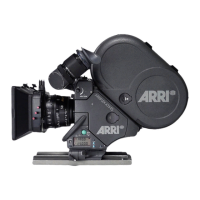
The ARRIFLEX 16 St is a mirror reflex motion picture camera designed for professional use with 16 mm film stock. It is a robust and versatile system, suitable for a wide range of filming applications. The camera housing is constructed from a sturdy seawater- and tropical-proof cast aluminum alloy, ensuring durability and reliability in various environmental conditions.
Function Description
The core of the ARRIFLEX 16 St is its mirror reflex system, which provides a bright and clear viewfinder image. A 180° rotary mirror shutter, partially transparent, splits the light beam, directing a portion to the film plane and a portion to the viewfinder. This design ensures that the light beam reaching the film is unhindered, while the viewfinder receives a continuous image, even during filming. The mirror rotates at half the speed of the film movement, completing one full turn for every two frames, allowing for continuous viewing and accurate framing. The shutter is divided into two segments, ensuring smooth, vibration-free running and precise shutter rotation.
The camera features a pull-down claw mechanism and registration pin for precise film transport and stability. The pull-down claw engages in the film perforation from the front, advancing the film in its vertical track. The registration pin then engages the film plate, ensuring accurate frame positioning. The beautifully balanced interaction of these components guarantees excellent film gate performance and a steady, sharp image.
Important Technical Specifications
- Film Stock: Standard 16 mm film.
- Weight: Approximately 5.2 kg (11 1/2 lb) with motor and 400 ft auxiliary magazine (without lenses).
- Shutter: 180° rotary mirror shutter, providing an exposure time of 1/48 sec at 24 frames per second.
- Film Gate: Precisely centered and flat, with a spring-loaded rear pressure pad and a fixed side rail on the claw side.
- Lenses: The camera is designed to be used with ARRIFLEX-mount lenses. It features a divergent three-lens turret, allowing for quick lens changes. The distance between the lens flange and the film plane is exactly 35 mm. The shortest focal length available is 5.7 mm.
- Viewfinder: Interchangeable viewfinder eyepiece with individual diopter adjustment. A hinged lens cover and automatic closure mechanism protect the film from undesired light entry through the viewfinder.
- Motors: The ARRIFLEX 16 St can be equipped with various interchangeable motors:
- Variable Speed Motor (Cat.-No. 1160): 8 V battery operation with built-in rheostat for camera speeds between 4 and 48 frames per second. Manually regulated, it allows for quick speed changes.
- Governor Controlled Motor (Cat.-No. 1161): 8 V battery operation with fixed camera speed of 24 or 25 frames per second.
- Synchronous Motors: Available for 42 V, 50 cps (Cat.-No. 1163), 60 cps (Cat.-No. 1164), and 115 V, 60 cps (USA, Cat.-No. 1165) operation. These motors are designed for synchronous sound recording and can be powered by a power supply unit.
- Batteries: 8 V lead batteries are recommended. Specific models include:
- ARRI Light Weight Battery, Type "PERMANENT": 8 V, 3.5 Ah, weighing 1.43 kg, sufficient for approx. 1500 ft of film.
- ARRI Special Wet Cell Lead Battery: 8 V, 7.5 Ah, weighing approx. 5 kg, sufficient for approx. 4500 ft of film.
- ARRI Dryfit Batteries: 8 V, 2.6 Ah, weighing approx. 2 lbs. These batteries are maintenance-free and can be charged in any position.
- Magazines: The camera supports 100 ft daylight-loading spools and 200 ft and 400 ft auxiliary magazines. The auxiliary magazines take about 400 ft of color or 500 ft of black-and-white film.
Usage Features
- Lens Insertion: Lenses are inserted by pressing two locking latches and pushing the lens into the turret. The lens is secured by tightening the locking ring.
- Matte Box Mounting: The matte box is mounted by pushing its foot into the shoe on the camera and tightening a screw. Filters can be inserted into the filter holder.
- Finder Eyepiece Mounting: The finder eyepiece is placed on the centering guide, and the union nut is tightened.
- Motor Installation: The motor is inserted into the motor compartment, and the centering pin fits into the recess. The motor lock is tightened in a clockwise direction.
- Power Connection: The motor cable is connected to the battery or power supply unit. For synchronous motors, specific power supply units are used, and attention must be paid to voltage and frequency.
- Film Loading (Daylight-Loading Spool): Approximately 2 ft of film is pulled off the spool. The knurled knob is held, and the spool is pushed onto the upper friction spindle. The film is looped around the upper sprocket, inserted into the film gate, and then looped around the lower sprocket. The empty take-up spool is placed on the lower friction spindle.
- Film Loading (Auxiliary Magazines): The cover plate of the auxiliary magazine is removed. The film is loaded emulsion side inwards. The film reserve indicator on the drive side of the magazine is calibrated for black-and-white film; for color film, the scale value should be reduced by about 1/5.
- Operation: The camera is held by the handgrip, with the thumb grip and mirror reflex shutter bulge. The middle finger operates the focusing lever, and the index finger operates the locking lever and release button.
- Diopter Adjustment: The finder eyepiece closure is opened, and the rubber eyecup is moved. The lens aperture is opened, and the motor inching knob is turned to light the ground glass. The diopter adjustment control is used to achieve optimum sharpness.
- Lens Settings: Focusing is done using the focusing lever, checking sharpness through the finder eyepiece. The aperture setting ring is turned until the desired f-stop is over the index mark.
- Turret Rotation: The turret is rotated using the wing-type grips until the desired lens is in the taking position.
- Zero-Setting Counters: The footage and frame counters are set to "0" using the knobs.
- Releasing and Switching Off: The release button is pressed for continuous running. For short takes, both the release button and locking lever are pressed simultaneously.
- Reverse Operation: The knurled forward-reverse switch is turned to "R" (Reverse), and the release button is pressed. If an auxiliary magazine is mounted, the magazine motor must also be switched to reverse.
- Buckle Switch: This switch is activated automatically at the end of the film or if the film does not run smoothly. It resets by opening and closing the pressure roller carrier.
Maintenance Features
- Cleaning: Regular cleaning is essential for optimal performance.
- Film Gate: Remove film chips and emulsion dust with a soft hair brush or other soft object. The pressure plate of the film gate should be cleaned after depressing the two springs.
- Lenses and Mirrors: Avoid touching optical surfaces with fingers. Anti-reflex coatings are sensitive. Dust should be removed with a soft hair brush or air from a rubber bulb. Smears and fingerprints should be cleaned with a dry, lint-free cloth. Special lens-cleaning tissue can also be used. For stubborn dirt, chemical solvents like pure benzene or petroleum ether can be used.
- Lubrication: Oil should be used sparingly. Excess oil can damage the drive mechanism and optical surfaces. ARRIFLEX cameras are designed for easy lubrication. The special oiler is pressed with the thumb to open the oil channel. All mechanical parts run in ball bearings, so general lubrication is not necessary until the lubricant applied during assembly has been used up. A complete cleaning and lubrication of the entire drive mechanism is advisable after approximately 160,000 feet of film have been run or at the latest after 3 to 4 years.
- Defective Operation:
- Film Chips/Dust/Sand: These are common causes of defects and can be removed with a brush, plastic stick, or lint-free cloth.
- Battery Check: Check if the battery is charged, if terminals are free from oxide, and if the cable is connected correctly. A test lamp or voltmeter can be used.
- Frame Not Held Steady: This is often caused by wrong loop formation during film transport.
- Poor Frame Steadiness/Irregular Perforation Spacing: Negative stock can indicate these issues. The spring-loaded side guide rail at the film gate should compensate for minor irregularities.
- Scratched Film: Scratches on the emulsion or glossy side can be caused by polish on the hard-chromed film channel or pressure plate.
- Fog or Reflections: Bright sunlight or spotlights can penetrate small cracks and openings. Strong light can cause fogging. The mirror reflex system may permit stray light that fogs the film if the eye is not pressed close enough against the rubber eyecup.
- Insufficient Brilliance or Sharpness: Backlight can dazzle the eyes. The matte box is effective against stray light. Lenses, filters, and plane glass screens can impair image quality. Incorrect focal length or unsharp images can result from deformation of the turret or if heavy lenses are used without a lens support.
- Filming at Low Temperatures: Extreme low temperatures can cause increased operating stress. Lubrication should be done with cold-resistant lubricants. Batteries should be kept warm and charged.
- Carrying and Storage Cases: Sturdy cases are available for safe transport and storage, protecting the camera from dust and moisture.

 Need help?
 General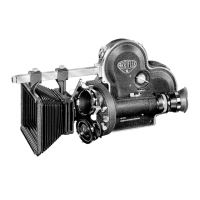

 To Next Page