ARTURIA – PROPHET V - MANUAL
7
1 Introduction
1.1 Prophet History
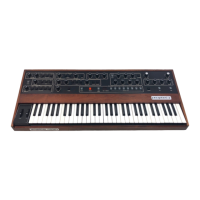
Prophet 5:
"In 1978 Sequential Circuits consisted of Dave Smith, former Moog clinician John Bowen, and
businesswoman Barb Fairhurst. They were a self-funded outfit that started out in the confines
of Smith's San Jose, California, garage selling a digital sequencer and a generic synth
programmer. It was that year at the winter NAMM (National Association of Music Merchants)
show that they introduced their Prophet-5, which was exactly the kind of instrument, with
exactly the kind of sound and features that musicians needed."
(Excerpted with permission from the book Vintage Synthesizers by Mark Vail, Copyright Miller
Freeman, Inc)
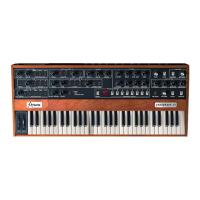
Described at the time as "5 Minimoogs in one box,” the Prophet 5 literally stole the show as the
first commercially available and viable polyphonic synthesizer. This comparison to the Minimoog
probably came about more from its physical appearance than it did from its structure (which
was closer to that of the ARP).
The Prophet-5 rocketed Smith's garage operation to stunning heights. Over the next five or six
years, Sequential Circuits (who eventually just shortened their name to Sequential) would
become the largest American manufacturer of Synths.
The Prophet 5 contained five individual voices. For its principal sound sources each voice
contained two VCOs (voltage controlled oscillators), OSC A and OSC B, and a white noise source
which could be mixed into a resonant low-pass VCF (voltage controlled filter). The filter
modified the voice timbre under control of its four-stage envelope generator. The filter could
also be driven to resonance and could serve as a sound source. Following each filter was a VCA
(voltage controlled amplifier), controlled by a four-stage envelope generator, which shaped the
voice amplitude. Supplementing the basic voices was polyphonic modulation (POLY-MOD) signal
routings within each voice that allowed OSC B and the filter envelope generator to function as
modulation sources applied to OSC A frequency/ pulse width, or the filter frequency. Finally,
there was a single LFO (low-frequency oscillator) and a pink noise source which could be mixed
in to modulate all five voices, as adjusted by the MOD wheel. The keyboard was a 5 octave
Pratt-Reid note on/note off affair with no touch response.
"The Prophet-5 sustained six revisions (or revs). Rev 1 was the original design. Rev 2 was a
refinement of the original design and largely transparent. Rev 3, however, was a vastly different
synthesizer than Revs 1 and 2. Introduced to Rev 3 were new voltage controlled IC's (CEM), an
improved ADC, DAC, and a different control voltage distribution scheme. More sophisticated
editing and tuning routines were designed, and to improve serviceability, voice trimmers were
reduced from 80 to 45. Some believe that the Rev 3 synthesizers are slightly inferior (sonically)
to their predecessors by revealing an absence in the lower frequencies. While this may be true,
the majority of the Rev 3 synthesizers are far more operationally stable than their Rev 1 and Rev
2 counterparts."
(Courtesy Matt Bassett)


 To Next Page
 Loading...