ARTURIA – PROPHET V - MANUAL
72
6 The basics of subtractive synthesis
Subtractive synthesis appeared at the end of the 1960’s, giving birth to the first analog
synthesizers: Moog, Sequential Circuits (the Prophet Series), ARP, EMS, Oberheim, Roland (SH or
Jupiter series), Yamaha (CS series) and Korg (MS and PS series). During the 1980’s, the purely
analog additive synthesis model of the first keyboards was progressively replaced by wave table
oscillators (Prophet VS) or sample based instruments.
As an owner of the Prophet V, you now have access to a synthesizer with immense sonic
generation possibilities, where subtractive synthesis is coupled with the analog oscillators of the
Prophet 5 and the wave table sounds of the Prophet VS.
THE BASICS
Of all the forms of audio synthesis, subtractive is one of the oldest, and to this day, the most
frequently employed by sound designers and musicians alike. This is due to the simplicity with
which complex sounds can be created, over the more unwieldy forms of synthesis techniques,
such as additive or granular, to name but two. As a basic overview to subtractive synthesis, one
may consider any sound created either in nature or on your synthesizer of choice, as consisting
of a number of sine waves, or harmonics grouped together. In subtractive synthesis, we start
with a harmonically rich sound such as a saw wave, and through filtering, we remove the sine
waves (or harmonics) that we do not want. This as you can imagine is a lot more complex than
turning a filter control knob!
6.1 THE THREE MAIN ELEMENTS
6.1.1 The Oscillator or VCO
The oscillator or VCO (Voltage Controlled Oscillator) is the starting module (with the noise
module which is often classed among the oscillators) for the creation of a sound on an analog
system.
It will generate the initial sound signal. We can think of the oscillator like a violin string that
once stroked or plucked, vibrates to create its sound.
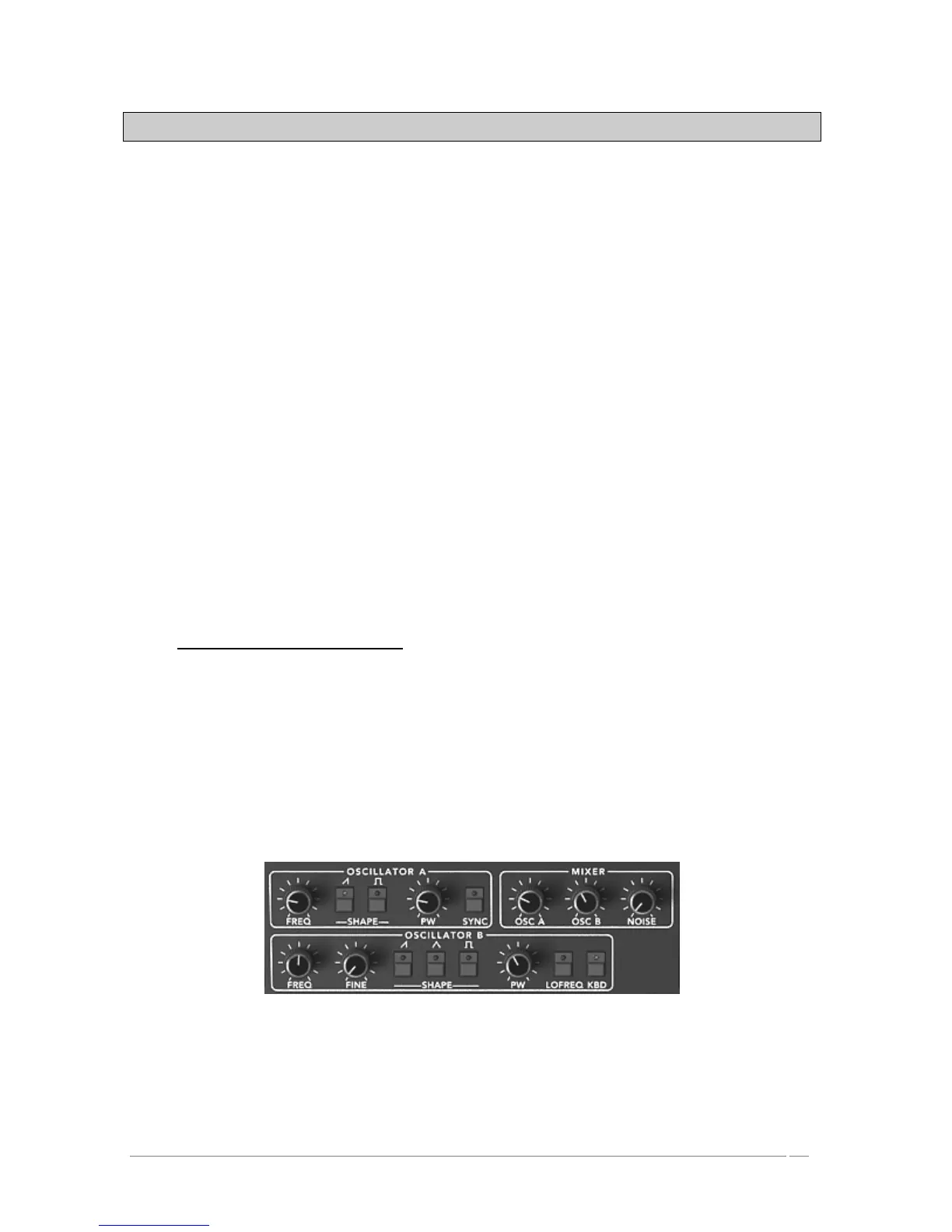
Oscillator Section on the Prophet 5




 To Next Page