ARTURIA – PROPHET V - MANUAL
76
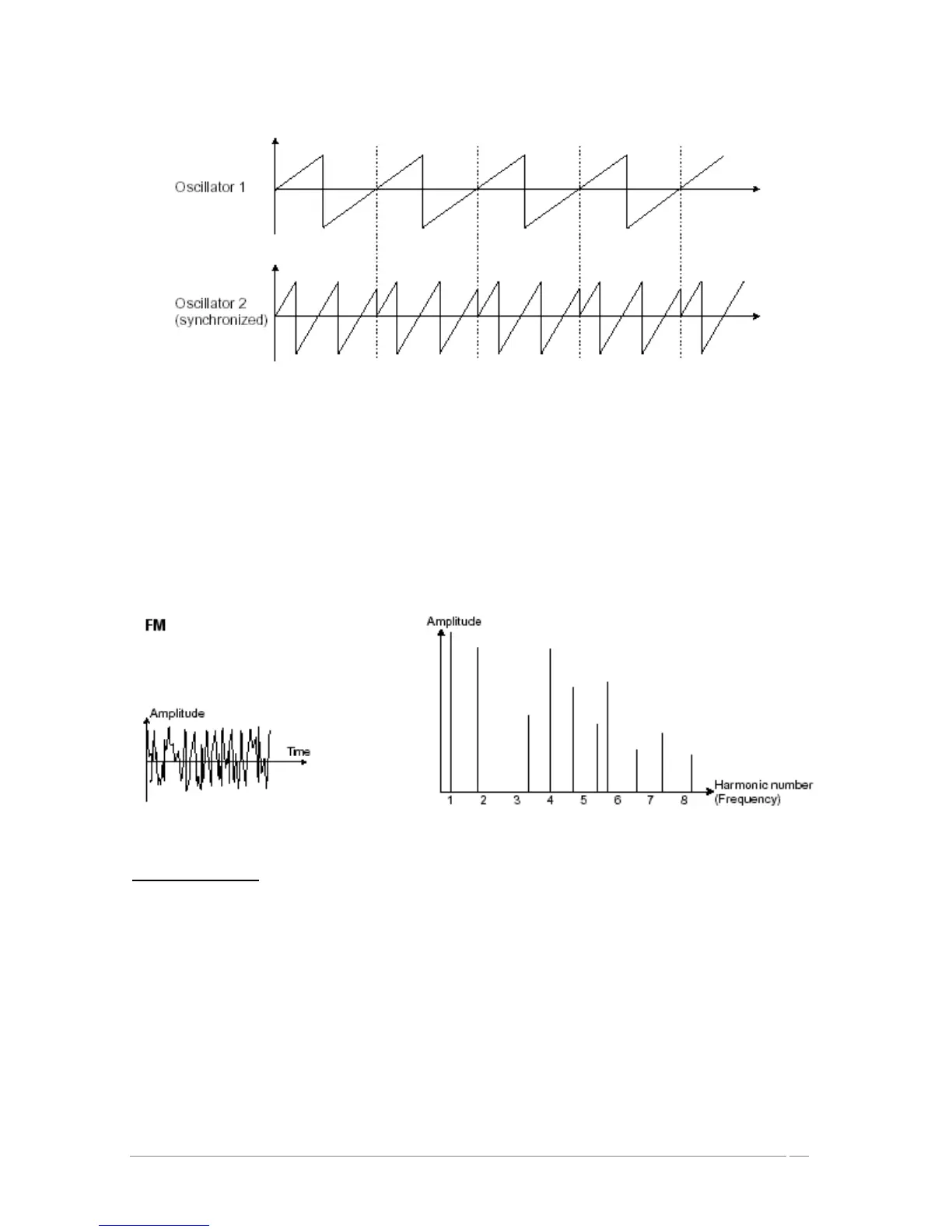
In the above image, oscillator2 is synchronized with the first and tuned to with double the tonality. The
resulting waveform is unique in that it cannot be created by standard synthesis techniques such as
layering or filtering.
Frequency modulation (FM) can be created between 2 oscillators by connecting the audio
output from a first sinusoidal oscillator to the modulation input of a second oscillator. On the
Prophet V, if you turn the modulation rate ring, you will obtain a sound richer in harmonics. If
you introduce a square or sawtooth signal, the result can be quickly distorted… but interesting
for enharmonic sonorities like bell sounds or special effects for example.
The Noise Module
The noise signal spectrum has all frequencies at an equal volume level, often referred to as
“white noise”. For this reason, the noise module is used to create different noises like the
imitation of wind or special effects. White noise is the richest of noises. Pink noise is also
regularly present on synthesizers. It is less rich in the high frequencies than white noise.
Also note that the audio output of noise can also be used as a modulation signal (especially
when strongly filtered) to create random cyclic variations.
On hard-wired synthesizers, the noise module is either integrated into the oscillator (its audio
output being placed to compliment the waveform outputs), or within the mixer directing the
signals towards the filter.














 To Next Page