ARTURIA – PROPHET V - MANUAL
78
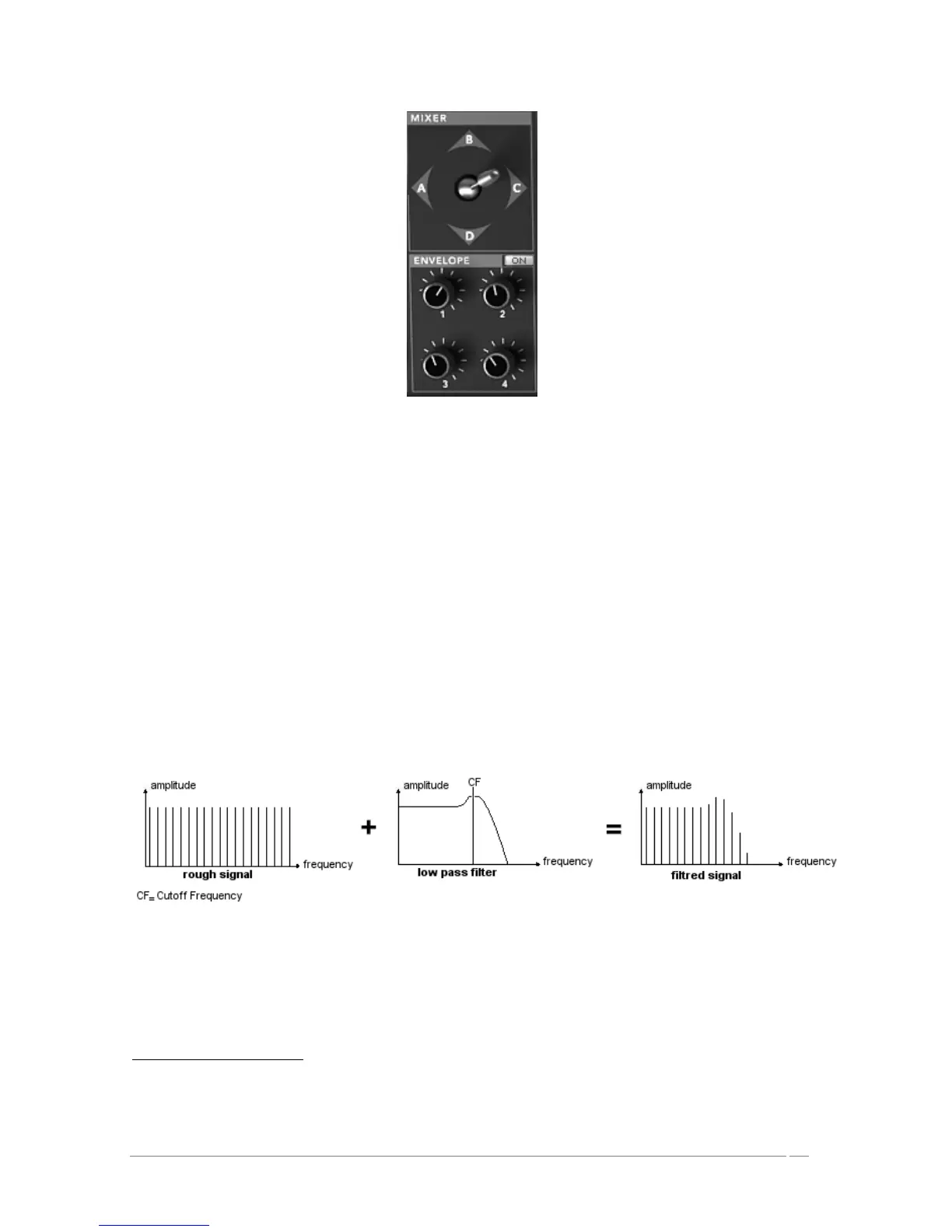
The Mixer of the Prophet VS and its envelope
6.1.3 The filter or VCF
The audio signal generated by an oscillator (the waveform) is next generally directed to a filter
module or VCF (Voltage Controlled Filter). It is this module that we use to control the sound by
filtering (by removing or subtracting certain frequencies, which explains the name given to this
type of synthesis) the harmonics situated around a cut-off frequency. It can be considered to be
a sophisticated equalizer that reduces, depending on the filter type, the high or low frequencies
of a sound.
The removal of undesirable frequencies at the cut-off frequency is not done suddenly but
progressively, depending on the filtering slope. This filtering slope is expressed in decibels per
octave (or dB/Oct). The filters used in classic analog synthesizers have 24 dB/Oct or 12 dB/Oct
slopes.
The Prophet V offers several types of slope:
The removal of undesirable frequencies at the cut-off frequency
On the Prophet 5 and VS, you have access to a type of filtering with a 24 dB/Oct slope. Let’s
have a look at some of its properties:
The low-pass filter (LPF)
The low-pass filter (LPF) progressively removes high frequencies above the assigned frequency
limit (the cut-off frequency) and allows the sound below the cut-off to pass through unchanged.



 To Next Page