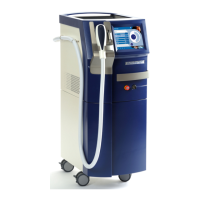
Technical data
14 1590 99 002_1 - 21. February 2011
STANDBY mode
The STANDBY mode prevents the unintentional or inadvertent activation of the laser. If the device is
in the STANDBY mode, laser emission cannot be activated. The user can only start the emission, if
the READY button has been pressed.
The system switches to STANDBY in the following situations:
after the first start of the device,
if the User presses one of the buttons for selecting the laser parameters,
if the system has been in the READY mode for a longer period of time without the laser
released,
if the User presses the STANDBY key when the system is in the READY mode.
Automatic shut-down
The device is equipped with an automatic shutdown system. If a specific problem arises, the system
will automatically change into the following safe mode:
The laser beam shutter is closed, the laser discharge is interrupted and the footswitch is deactivated.
The screen shows a fault message identifying the specific error (see chapter Fehler! Verweisquelle
konnte nicht gefunden werden.: Fehler! Verweisquelle konnte nicht gefunden werden..).
Remote door interlock contact
The system is equipped with a remote interlock contact that may be connected to the entrances to
the laser room. If the remote interlock contact is open (e.g. if the door is opened), the laser emission
will be interrupted automatically and the device will change to the STANDBY mode.
Acoustic signal
The laser emission is indicated by an acoustic signal during the period of emission.
Warning labels
The device carries several warning labels (see chapter ). These labels must always
be clearly readable and replaced immediately when damaged.
Contact the Technical Service immediately in such cases.
The manufacturer will only guarantee the safety, reliability and performance of the device,
if:
1. the device has been used in accordance with the instructions given in this manual (on the
safety measures and the use of the system),
2. the installation, assembly, extensions, changes, repair and maintenance works have been
performed by persons being authorized and qualified for them, and
3. the electric system at the place of installation complies with the requirements placed by the
EN/IEC and the local regulations.


 To Next Page
 Loading...