62 GG Surveyor GPS+GLONASS Reference Manual
The above results are for tests using Ashtech GG-Pro antennas. Similar results are not
guaranteed with different antennas.
While the receiver is busy fixing integers, it gives a float solution.
Operation under trees, or in other areas with frequent blockage of satellites signals
will lead to significantly degraded results.
As well as the two reliability settings for fixed solutions, there is a setting for pure
floating-point mode ($PASHS,CPD,AFP,0). In this mode, the receiver always gives a
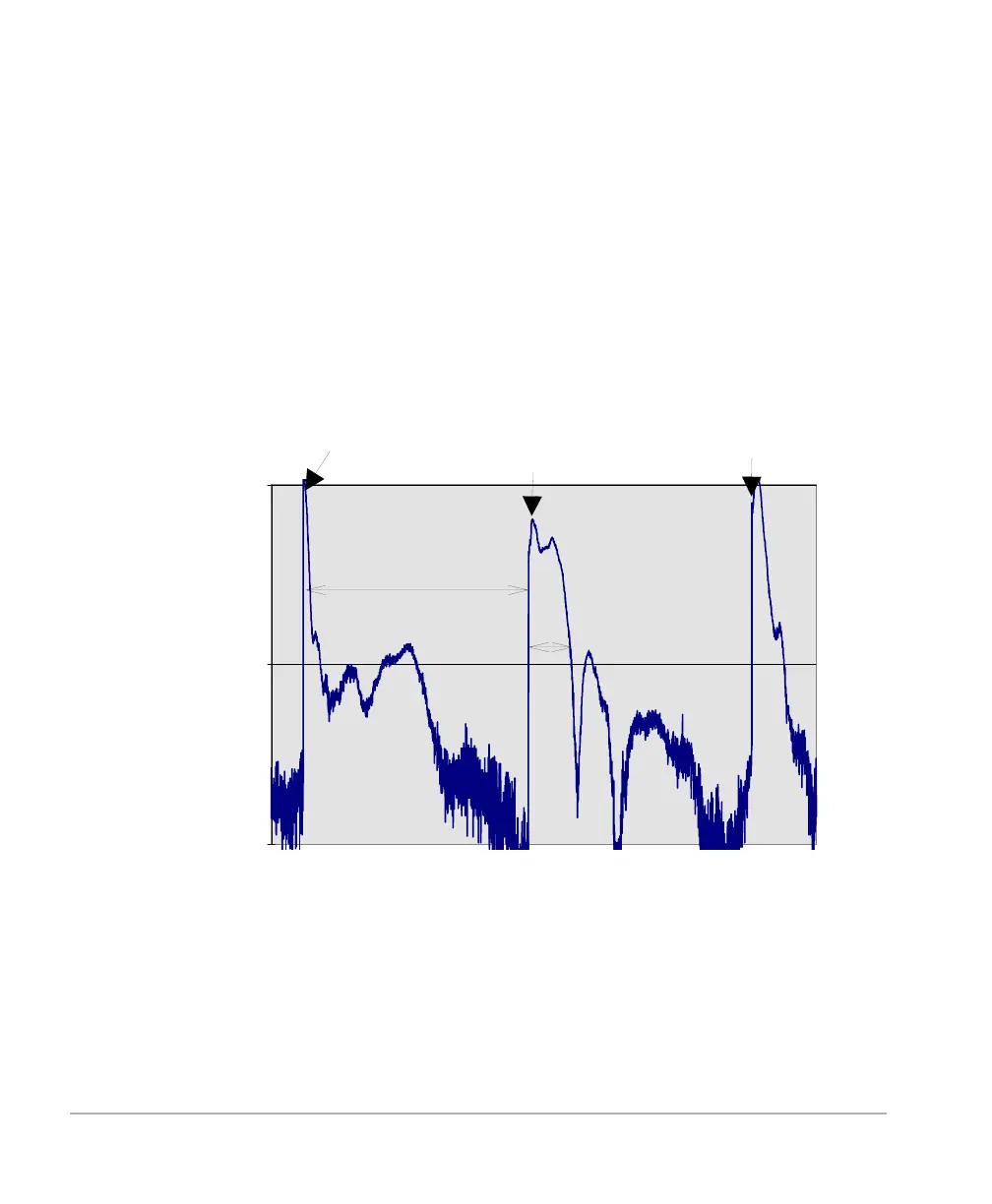
floating point solution. The accuracy of the floating point solution converges to
decimeter level in approximately ten minutes (depending on the baseline length and
the number of satellites in view, covergance time increases with increasing baseline
lengths and decreasing number of satellites). Figure 5.3 shows typical behavior of the
floating point solution following start-up or obstruction-and-reacquisition for a short
baseline with eleven to thirteen satellites in view.
Monitoring Accuracy
Besides fixed/float status, position accuracy is the most important consideration when
using the GG Surveyor for real time carrier phase positioning. The primary means of
monitoring CPD “fixed” and CPD “float” accuracy is the GST message (see NMEA
section for full description). Each GST message contains a UTC time tag which
Figure 5.3: Convergence of Float Solution Following Reset
0.01
0.1
1
Horizontal error (m
30 minutes
reset
reset
reset


 To Next Page