
 Need help?
Do you have a question about the Astro Pneumatic Tool 7897 and is the answer not in the manual?
Guidance on preventing personal injury and chemical exposure during tool use.
Instructions to read before installing, operating, servicing, or repairing the tool.
Details about the ball joint service tool and master adapter set.
Information regarding the 1-year limited warranty and unpacking procedures.
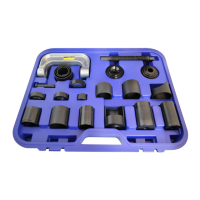
Visual representation of all components within the tool set.
A comprehensive list of all parts included in the ball joint service tool set.
Procedure for removing and installing brake anchor pins using the tool.
Instructions for servicing U-joints on cars and light trucks with the C-frame press.
Steps to remove press-fit ball joints without removing the control arm.
Steps to install a replacement ball joint into the vehicle control arm.
The Astro Pneumatic Tool Company Model 7897 is a comprehensive Ball Joint Service Tool and Master Adapter Set designed for automotive repair and maintenance. This versatile tool kit is primarily used for the removal and installation of press-fit type ball joints on a wide range of vehicles, including cars and light trucks. A key advantage of this set is its ability to facilitate ball joint service without requiring the removal of the control arm from the vehicle, which can significantly reduce repair time and complexity.
Beyond ball joint service, the core C-frame press included in the kit is also capable of servicing U-joints on most cars and light trucks. This dual functionality makes the Model 7897 a valuable addition to any mechanic's toolkit, offering solutions for multiple common suspension and drivetrain repairs. Additionally, the C-frame press can be utilized for the removal and installation of brake anchor pins, further expanding its utility in brake system maintenance.
The primary function of the Model 7897 is to provide a robust and efficient method for servicing press-fit ball joints. This involves both the removal of old, worn-out ball joints and the installation of new replacement units. The kit achieves this through a C-frame press mechanism, which, when combined with various receiving tubes and adapters, applies controlled force to press components in or out.
For ball joint removal, the C-frame press is positioned over the control arm, and a suitable receiving tube is placed beneath the ball joint. As the forcing screw is tightened, the ball joint is pressed out of its seating. A critical note for certain vehicles is the presence of spot-welded upper ball joints, which require the weld to be cut before attempting removal. This highlights the importance of pre-inspection and understanding vehicle-specific requirements.
For ball joint installation, the process is reversed. After cleaning and lubricating the control arm's inner diameter, the new ball joint is inserted as straight as possible. The C-frame press, along with appropriate receiving tubes and adapters, is then assembled to press the new ball joint firmly into place. Careful alignment of all components and continuous tightening of the forcing screw are essential to ensure proper seating.
The C-frame press's utility extends to U-joint service. For disassembly, the press is positioned around the drive shaft yoke, and the forcing screw is tightened to remove the first bearing. The press is then repositioned to remove the second bearing. For assembly, the yoke area is cleaned, and the replacement bearings are aligned and pressed into the yoke using the C-frame press, followed by the reassembly of external or internal lock rings.
Brake anchor pin removal and installation also leverage the C-frame press. After removing any lock ring retainers, the press is placed over the brake spider, and the forcing screw is tightened to extract the anchor pin. This demonstrates the tool's adaptability for various pressing tasks within automotive repair.
The Model 7897 is designed with several features to enhance its usability and safety. The kit includes a comprehensive set of receiving tubes and adapters, ensuring compatibility with a wide range of press-fit upper and lower ball joints found on many GM, Ford, and Dodge 2 and 4-wheel drive pickups, vans, and sport utility vehicles through 1997. This extensive coverage minimizes the need for additional specialized tools.
A key usage feature is the inclusion of a live center forcing screw plug, which helps in applying force efficiently and accurately. The entire set comes in a blow-molded case, providing organized storage and easy transport, which is crucial for mechanics working in different locations or needing to keep their tools tidy.
Safety is a paramount consideration in the design and recommended usage of this tool. Users are cautioned about potential exposure to dust and microscopic particles containing chemicals known to cause cancer, birth defects, or reproductive harm, emphasizing the necessity of wearing appropriate safety equipment and clothing. This includes ANSI approved goggles, which are specifically recommended.
The instructions stress the importance of selecting the correct accessories of the appropriate size and design for each specific job. Working in a clean, safe, well-lit, organized, and adequately equipped area is also highlighted as a crucial safety practice. Furthermore, users are advised not to begin repairs without ensuring the vehicle is in a secure position and will not move, preventing accidents during operation.
The application chart provided with the tool is a valuable usage feature, guiding users on which specific adapters and receiving tubes to use for different vehicle models and ball joint positions (upper or lower), and whether the task is removal or installation. This chart simplifies the selection process and helps prevent incorrect tool usage.
While the Model 7897 is a robust tool, proper maintenance is essential to ensure its longevity and continued performance. The instructions implicitly suggest maintenance practices through their emphasis on cleaning and lubrication. For instance, before installing a new ball joint, users are instructed to clean the control arm and coat its inner diameter with a suitable lubricant. This practice not only aids in the installation process but also helps prevent corrosion and wear on both the vehicle component and potentially the tool's contact surfaces.
The general advice to work in a clean and organized area also contributes to tool maintenance by preventing dirt and debris from accumulating on the tools, which could lead to wear or malfunction. After use, storing the components in the provided blow-molded case protects them from damage, loss, and environmental exposure, thus extending their lifespan.
The warranty information provided also touches upon maintenance aspects. While it primarily covers defects in material or workmanship, it also mentions that failures caused by accident, alteration, or misuse are not covered. This implies that proper handling and adherence to the intended use are crucial for the tool's durability and for maintaining warranty eligibility. Any repair to the product by unauthorized service representatives voids the warranty, underscoring the importance of professional service if repairs are needed.
In essence, the maintenance of the Model 7897 largely revolves around careful handling, proper storage, and following the recommended operational procedures, including cleaning and lubrication of vehicle components during service, which indirectly benefits the tool itself by ensuring smooth operation and preventing undue stress.
 General
| Product Type | Air Hammer |
|---|---|
| Operating Pressure | 90 PSI |
| Weight | 3.5 lbs |
| Type | Air Hammer |
| Blows Per Minute | 3000 BPM |
| Piston Diameter | 0.75 inch |
| Air Inlet Size | 1/4 inch NPT |
| Capacity | 1/2 inch |
| Stroke Length | 2-5/8 inches |

 To Next Page