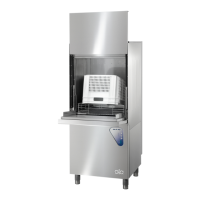
This document describes a series of rack-conveyor dishwashers, specifically the ATR series, designed for washing dishes, glasses, cutlery, and trays. The manual covers installation, use, and maintenance of these appliances.
Function Description
The ATR series dishwashers are designed for continuous washing operations, where racks of items are conveyed through different washing and rinsing zones. The machines are modular, allowing for the connection of multiple units to form a complete washing line. They feature various washing cycles and temperature controls for optimal cleaning. The system includes a main wash, a pre-wash (optional depending on the model), and a final rinse. Detergent and rinse aid dispensers are integrated, with pre-set dosages for optimal performance. The machines are equipped with safety systems to prevent overflow, protect against electrical faults, and ensure proper operation.
Important Technical Specifications
The ATR series includes several models: ATR2700, ATR3200, ATR3800, ATR4300, ATR4900, and ATR5400. These models vary in size, capacity, and power consumption.
General Technical Features:
- Hourly Production: Ranges from 80-115 racks/hour for ATR2700 to 190-245 racks/hour for ATR5400.
- Electrical Feeding: 230V~3 / 400V~3N / 50 Hz.
- Max Absorbed Power: Varies by model and configuration (e.g., ATR2700: 27.3 kW (230V) / 33.3 kW (400V); ATR5400: 37.7 kW (230V) / 49.7 kW (400V)).
- Wash Tank Capacity: 85 L for all models.
- Rinse Tank Capacity: 12 L for all models.
- Boiler Capacity: 10+10 L for all models.
- Water Pressure: 2-4 bar.
- Water Hardness: 8-14 °F.
- Cold Water Inlet Temperature: 50-60 °C.
- Water Consumption: 330 L/h.
- Basket Dimensions: 500x500 mm.
- Net Weight: Ranges from 300 kg for ATR2700 to 345 kg for ATR5400.
- Noise Level: <70 dB (A) (according to DIN 45635).
Hydraulic Connections:
- Drain: Ø 40 mm.
- Hot Water Inlet (A, B, B'): ¾" GAS.
- Cold Water Inlet (C): ¾" GAS.
- Electrical Connection (E): Specific connection for the electrical supply.
Dimensions (Overall):
- ATR2700ED/ES: Length 1570 mm, Width 800 mm, Height 1580-2040 mm.
- ATR3200ED/ES: Length 1870 mm, Width 800 mm, Height 1580-2040 mm.
- ATR3800ED/ES: Length 2170 mm, Width 800 mm, Height 1580-2040 mm.
- ATR4300ED/ES: Length 2470 mm, Width 800 mm, Height 1580-2040 mm.
- ATR4900ED/ES: Length 3070 mm, Width 800 mm, Height 1580-2040 mm.
- ATR5400ED/ES: Length 3370 mm, Width 800 mm, Height 1580-2040 mm.
The "ED" models typically refer to entry-side loading, while "ES" models refer to exit-side loading, or variations in the configuration of the washing modules.
Usage Features
Installation:
- Joining Modules: The dishwasher is delivered in multiple parts. Front panels must be removed, and gaskets inserted to connect the modules. The units are then aligned horizontally using adjustable feet. Steel edge covers are inserted, and electrical connections are made. The drain hose and water supply pipes (hot and cold) are connected.
- Water Connection: Flexible pipes are used for water connections. The drain hose should be connected to a suitable drain waste system with a siphon. An interception valve with a fine filter is recommended for the water supply.
- Detergent and Rinse Aid Dispensers: If equipped, these are pre-calibrated. Connect them to their respective tanks and ensure the liquids are low viscosity to prevent clogging.
- Working Tables and Splash Guards: Supporting legs and lower shelves are fixed with welded brackets. Working tables are joined to the appliance using threaded inserts. Splash guards and steam exhausters can be installed on the exit side; the exhauster requires a duct for condensation return.
- Electrical Connection: The appliance requires a 400V 3-phase or 230V 3-phase electrical supply. A main switch on the wall is necessary. The electrical connections are made to the terminal board, ensuring proper grounding.
Control Panel:
The control panel varies based on the number of wash tanks (1, 2, or 3).
- Buttons: Tank selection, speed selection, main switch, general machine start.
- LED Indicators: Wash cycle, anomaly, rack conveyor speed, draining cycle, machine on, selected tank temperature, boiler temperature, water filling.
- Temperature Display: Shows water temperature in the selected tank and boiler.
Washing Cycle:
- The appliance automatically fills with water to the set level.
- The display shows the water temperature.
- The red lamp (7) indicates the washing cycle is in stand-by status.
- The green lamp (7) indicates the washing cycle is active.
- The rack conveyor starts automatically when the washing cycle is ready.
- The conveyor speed can be adjusted (slow, medium, fast) via the control panel.
Rinsing Cycle:
- Starts automatically when a rack is at the rinse zone.
- The rinse aid dispenser activates during the rinse cycle.
- The cycle ends when the last rack exits the rinse zone.
Maintenance Features
Preliminary Steps:
- Verify water supply and drain connections.
- Ensure detergent and rinse aid dispensers are connected and filled.
- Check the position of the detergent probe (if present).
- Verify the correct position of filters on pump aspirations and superficial filters.
- Open the water cock.
Daily Maintenance (End of Working Day):
- Drain water from the tank.
- Clean the internal part of the tank, removing solids from the bottom.
- Check and clean the washing arms and filters.
- Remove and clean the filters carefully.
- Turn off the tap of filling water when the appliance is not working.
Stainless Steel Parts Cleaning:
- Clean all stainless steel parts accurately using soaped water or common degreasing products.
- Avoid abrasive powders or iron wool.
- When cleaning, avoid water sprays on the appliance outer parts to prevent damage to electrical appliances.
Periodic Maintenance:
- Periodically check the openings of the rinse jets and remove any possible blockages.
- Descale and disinfect the tank using products normally available on the market.
- Clean the washing arms by removing plastic plugs at their ends.
- Remove the feeding pipe from the solenoid valves and check their intake filter.
- If the appliance is not used for a long time, empty the pump scroll completely through its plug.
- Empty the boilers and wipe all stainless steel surfaces with a cloth soaked in Vaseline oil to provide a protective film.
Safety Systems:
- Overflow Pipe: Prevents excessive water in the rinse cycle.
- Break Tank: Equipped with an overflow pipe to prevent drained water from entering the wash tank.
- Safety Locking System: Prevents the washing cycle from starting until the water in the tanks and boilers is at the right temperature.
- Inspection Doors: Prevent operation if the inspection doors are open.
- Torque-Limiting Device: Stops the conveyor in case of obstacles.
- Limit Switch: Stops the washing cycle and conveyor if a rack is at the exit table for too long.
- Washing Pumps and Gear Motor: Equipped with amperometric control to detect anomalies.
- Thermal Cut-offs: In the boilers, prevent overheating.
- Anomaly Lamp: Indicates issues in the inverter.
- Fuses: Protect electrical components.
- Protective Boxes: All electrical components are placed inside boxes to protect against water splashes or accidental contact.
Spare Parts:
Only original spare parts should be used. The manufacturer is not responsible for damages resulting from faulty electrical connections or non-original parts.
Disposal:
The appliance and its packaging materials (plastic bags, polystyrene, cardboard, etc.) must be disposed of according to current legislation in the EU, contributing to reuse, recycling, and environmental protection. The symbol of a crossed-out wheeled bin indicates that the device should not be disposed of with normal household waste.

 Need help?
 General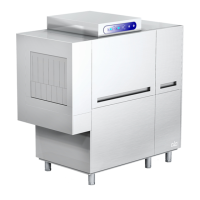

 To Next Page