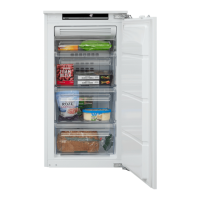
This document provides instructions for the ATAG KU1190C freezer, an appliance designed for household use. It is intended for both freezing fresh food and for long-term storage of frozen food, with storage durations up to one year depending on the food type.
Function Description
The ATAG KU1190C is a freezer appliance with distinct compartments for freezing and storage. It features a control unit for temperature settings and functions, and a condensate tray. The appliance is equipped with a thermostat knob (A) that serves multiple purposes: switching the appliance on/off, adjusting the temperature, and activating the super freeze function. Signal lights indicate when the super freeze function is active (B), when the appliance is powered (C), and when a high temperature alarm is engaged (D).
Important Technical Specifications
The appliance's operational temperature range is dependent on its climate class, which is indicated on the rating plate.
- SN (subnormal): from +10°C to +32°C
- N (normal): from +16°C to +32°C
- ST (subtropical): from +16°C to +38°C
- T (tropical): from +16°C to +43°C
The appliance requires a minimum room space of 1 m³ per 8 grams of refrigerant. The amount of refrigerant is specified on the rating plate inside the appliance. It must be connected to a grounded power mains in compliance with effective standards and regulations, and can withstand short-term voltage deviations of up to +/- 6%. The maximum amount of fresh food that can be frozen at once is specified on the appliance rating plate. Exceeding this amount can compromise freezing quality and deteriorate already frozen food.
Usage Features
- Switching On/Off: To switch on, rotate the thermostat knob (A) clockwise towards the thicker end of the marking. To switch off, rotate knob (A) back to the position where the arrow aligns with the symbol (power remains, signal light C stays on).
- Temperature Adjustment: Rotating knob (A) towards the thicker end of the marking results in a lower (cooler) temperature, while rotating towards the thinner end results in a higher (warmer) temperature. The recommended setting is halfway between the thinner and thicker ends. Environmental temperature changes may require adjusting the thermostat.
- Freezer Boost Function: This function is ideal for initial startup, before cleaning, or when freezing large quantities of food. To activate, rotate knob (A) to the '*' position (signal light B will illuminate). After the freezing process, return knob (A) to the desired setting. If not manually deactivated, the function automatically switches off after approximately two days, and the freezer temperature returns to the most recent setting.
- High Temperature Alarm: A flashing signal light (D) indicates a high temperature within the appliance. This alarm automatically deactivates once the temperature drops to a safe level. A 24-hour delay is built into the alarm operation upon initial startup to prevent unnecessary activation before the appliance reaches its adequate temperature.
- Freezing Fresh Food: For optimal freezing, activate the super freeze function 24 hours before placing fresh food into the freezing compartment. Ensure fresh food does not contact already frozen items. For smaller quantities (up to 1 kg), adjusting the thermostat knob is not necessary. After 24 hours, frozen food can be moved to other parts of the freezer, and the freezing process can be repeated by returning knob (A) to the middle position, then to '*' after 5 seconds.
- Storage of Industrially Frozen Food: Always follow the manufacturer's instructions regarding temperature and expiry dates. Select food with undamaged packaging, stored at -18°C or lower. Avoid food covered in frost, as this indicates partial defrosting and inferior quality. Protect food from thawing during transport to maintain quality and storage time.
- Frozen Food Storage Time: Recommended storage times vary by food type:
- Fruit, beef: 10-12 months
- Vegetables, veal, poultry: 8-10 months
- Venison: 6-8 months
- Pork: 4-6 months
- Minced meat: 4 months
- Bread, pastry, ready-to-eat meals (lean): 3 months
- Entrails: 2 months
- Smoked sausage, fatty fish: 1 month
- Defrosting Frozen Food: Defrosted or thawed food spoils quickly due to reactivated bacteria. Consume partially or completely defrosted food as soon as possible. Partial thawing can reduce the nutritive value of food, especially fruits, vegetables, and ready-to-eat meals.
- Drawer Removal: Drawers are protected against accidental pulling out. To remove a drawer, pull it out fully, then lift the front and pull it out completely.
Maintenance Features
- Packaging and Transport: Remove all packaging materials and protective parts before use. After transport, allow the appliance to rest in a vertical position for approximately 2 hours before connecting to the power mains to prevent operational faults in the cooling system.
- Cleaning: Before cleaning, always unplug the appliance from the power mains. Use a soft cloth with water or a mild soap solution for exterior cleaning. Avoid abrasive substances, acids, solvents, or cleaners containing high alcohol content, especially on plastic parts. The interior can be cleaned with lukewarm water and some vinegar.
- Defrosting the Appliance (Conventional Freezer): Defrost when a 3-5 mm layer of frost or ice has built up. 24 hours before defrosting, activate the super freeze function to pre-cool food. Remove all food and protect it from thawing. Switch off the appliance and unplug the power cord. Do not use defrosting sprays, knives, or sharp objects to remove frost, as these can damage plastic parts or cooling pipes. To speed up defrosting, place a pot of hot water on the glass shelf. Empty and clean the condensate tray. After cleaning, switch the appliance back on and return food once the desired temperature is reached.
- Condenser Unit Cleaning: To vacuum dust from the condenser unit, remove the cabinet kickplate, release the latch in the switchboard openings, pull out the plate, remove the condensate tray, and then use a vacuum cleaner. Reassemble in reverse order.
- Power Cord Replacement: If the power cord is damaged, it must be replaced by a service technician or other adequately trained person.
- Long-Term Disuse: If the appliance will be out of use for an extended period, switch it off, unplug it, empty, defrost, clean, and leave the door ajar.
- Environmental Protection: Dispose of obsolete appliances at an authorized home appliance collection center. Packaging materials are environmentally friendly and recyclable.
Important Notes and Warnings
- This appliance can be used by children aged 8 and above, and by persons with reduced physical, sensory, or mental capabilities, or lack of experience and knowledge, provided they are supervised or instructed on safe use and understand the hazards. Children should not play with the appliance, and cleaning/maintenance should not be performed by children without supervision.
- Keep ventilation openings clear of obstruction.
- Do not use mechanical devices or other means to accelerate defrosting, other than those recommended by the manufacturer.
- Do not damage the refrigerant circuit.
- Do not use electrical appliances inside food storage compartments unless recommended by the manufacturer.
- Ensure the appliance is installed as instructed to prevent instability hazards.
- The appliance must not be used outdoors or exposed to rain.
- After installation, the appliance plug must be readily accessible.
- Do not store explosive substances (e.g., aerosol cans with flammable propellants) inside the appliance.
- If the rating plate language is not suitable, replace it with the supplied one.
- If troubleshooting steps do not resolve an issue, contact an authorized service center with the appliance's type, model, and serial number.
Cooling systems, including compressors and fans, generate some noise. Noise levels depend on installation, proper use, and appliance age.
- Initial operation after connecting may be louder due to compressor operation or liquid flow, which is normal and will quiet down over time.
- Unusual or loud noises can result from improper installation:
- Ensure the appliance is level and stable on a solid base.
- Ensure the appliance is not in contact with walls or adjacent furniture.
- Verify interior equipment is firmly in place and that noise is not caused by loose cans, bottles, or other containers.
- Increased workload (frequent door opening, large amounts of fresh food, intensive freezing/cooling functions) can temporarily increase noise.



 To Next Page
 General