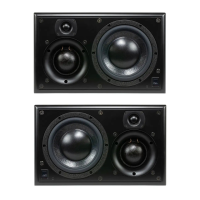
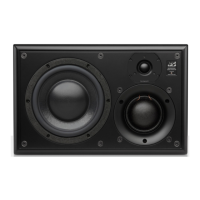
PASSIVE
The SCM20PSL loudspeakers are equipped with a “bi-wire” connection panel to enable separate wiring/amplication of the mid-bass driver and
tweeter. The connection panel is shown in Diagram 7 below.
Terminals can accommodate either stripped bare cable ends, 4mm banana plugs or spade terminals. Do not use ferrules on the bare wire ends as
the diculty in compressing them can cause poor link bar connection. Always use a good quality speaker cable with 2.5mm
2
minimum cross-sectional
area per conductor (79 strand). For cable runs longer than 5m use a signicantly heavier gauge cable. Consult your dealer or consultant for specic
cable recommendations. Ensure that the positive and negative terminals on each connection panel are connected to the corresponding positive and
negative terminals on the amplier.
If you are using conventional speaker cable with a single pair of conductors and a single integrated or power amplier, rst check that the link bars
are in place between the vertical pairs of terminals. Connect the positive conductor of your speaker cable to either of the red terminals. Connect
the negative conductor to either of the black terminals.
A lack of bass output and very wide unstable stereo imagine is most likely caused by the left and right loudspeakers being connected out of phase.
If the system displays these characteristics, please check the polarity of the wiring.
DIAGRAM 7
The choice of partnering amplier to power the SCM20PSL loudspeakers will have considerable inuence on the performance of the system.
Consider the following when selecting an amplier:
• With any passive loudspeaker there is a trade-o between low frequency extension and sensitivity. These monitor’s extended low frequency
response means the sensitivity is relatively low, although this is countered by the 8Ω impedance. It is therefore advisable to select a power amplier
of relatively high-power output capabilities. An amplier capable of delivering 75W-300W into 8Ω is recommended.
• Use of an underpowered amplier will result in the premature distortion of the system and increased risk of damage due to voice coil overheating
• Valve or solid-state ampliers with high output impedances should be auditioned carefully, to establish that their characteristic reduced damping
factor at low frequencies is acceptable.
• Thanks in part to Super Linear technology and the underhung voice coil construction, these monitors not only demonstrate extremely low distortion
at all levels, but also a greatly enhanced eective dynamic range. This exceptional distortion performance, combined with a very wide dispersion
will ruthlessly reveal deciencies in ancillary equipment. It is advisable, therefore, to audition the loudspeakers with your proposed amplier and
ancillary system.
If you wish to bi-wire or bi-amp, remove the linking bars, between vertical pairs of terminals. The upper horizontal pair of terminals are connected to
the tweeter. The lower horizontal pair are connected to the bass driver. The connection panel for bi-wire conguration is shown in Diagram 8 below.
For bi-amp systems it is
VITAL that the two ampliers used have equal gain. If you use amps with dierent gain, this will modify the frequency response
of the loudspeaker. The two amps can have dierent maximum power outputs and it is best to use the more powerful amp to drive the bass section.
Amplification
5.2
Connection
5.1
DIAGRAM 8
HF Negative (Black)
HF Positive (Red)
Bass Negative (Black)
Bass Positive (Red)
SCM20PSL/PSLT SECTION FIVE


 To Next Page
 Loading...