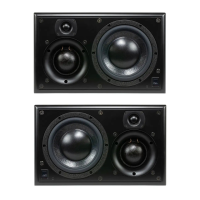
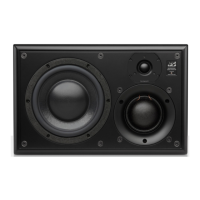
The SCM20ASL Limited Edition is a compact 2-way
high-performance active loudspeaker, featuring the
ATC SB75-150SL Super Linear Bass/Mid driver and the
ATC SH25-76S ‘S- spec’ Dual suspension tweeter. The
bass driver operates in a 20-litre cabinet and the drivers
are powered by a dedicated 2-way active Class A-B
power amplier, capable of delivering a combined 250W,
to deliver exceptional clarity and dynamics.
This Limited Edition product is limited to just 150 pairs,
all nished with a high gloss polyester lacquer in the ATC
colour of Pantone 282c and featuring silver anodised
metalwork and a hand wrapped Royal Blue leather bae
from German leather specialists Eissmann Individual.
The room in which a loudspeaker is placed can be
thought of as a lter, altering the acoustic response at the
listening position from that of the loudspeaker. The
position of the loudspeaker in a room will inuence how
it interacts with the space and therefore is often critical to
achieving the best performance at the listening position.
Speaker positioning is important because at low
frequencies the room will have a strong inuence due to
room modes/resonances. Room modes manifest
themselves in an uneven distribution of acoustic energy
within the room, which can lead to either too much
or too little bass at the listening position. A room with
a well-controlled low frequency response (controlled
reverb time) will have a far smaller inuence on the
performance of the loudspeaker and will be less sensitive
to positioning. Applying acoustic treatment in a domestic
setting is not always possible or desirable but if considered
it should be noted that, typically, a combination of
resonant membrane traps and porous absorbers are
needed to control the low frequency. The resonant
membrane traps are eective at treating the low bass,
typically below 80Hz and the porous absorbers
frequencies above this. Porous absorbers such as those
made from foams, breglass or rockwool are not eective
at absorbing low bass energy without a very large air
space between them and the wall behind which reduces
useable space within a room.
To minimise problems a free-standing loudspeaker should
be kept away from corners where possible. Avoid placing
the loudspeaker mid-way between any two parallel
walls. Where the loudspeaker is to be installed directly
into a heavy, rigid non-absorbent wall (ush/sot
mounted), an increase in LF eciency and LF extension
should be expected. In-wall loudspeakers are in the
optimum position for exciting room modes between
the mounting wall and the opposite wall. The
requirement for adequate bass trapping in the rear
wall in this instance can be even more critical.
Typically, best results come from mounting the
speakers on suitable speaker stands. Stands should be
heavy, rigid, and non-resonant. The stand height
should be selected so that the speaker acoustic centre
is at, or just above ear level (see diagram 1).
Position the loudspeakers so they form an equilateral
triangle with the listening position (see diagram 2).
With this layout, the distance between the loudspeakers
will be equal to the distance from one speaker
to the listening position.


 To Next Page
 Loading...