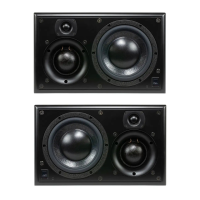
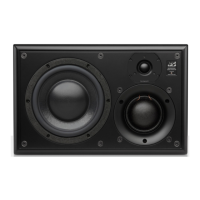
The ATC C4 Sub Mk2 is a high-performance 12”/300mm
active subwoofer, designed from the ground up to
deliver the exceptional levels of performance required to
partner ATC’s active and passive loudspeaker range.
Its performance and features make it ideally suited to
use within stereo, multi-channel surround and
immersive audio systems.
The sub features a sealed-box (innite bae) design,
chosen for its balance of sub-bass extension and driver
control. The cabinet is heavy and inert to minimise
cabinet colouration.
The SS75 -314 S C driver employed has been meticulously
optimised to reproduce the lowest 3 octaves of the
audio band within the design of the C4 Sub Mk2
subwoofer system. It employs a short-coil operating in
an exceptionally long magnetic gap to deliver high
sound pressure levels with very low levels of distortion.
The C4 Sub Mk2’s convection cooled amplier is
mounted in the rear of the cabinet. Two balanced Inputs
enable connection to mono or stereo sources.
A pair of buered, un-ltered balanced Outputs provide
connection to partnering active monitor loudspeakers,
ampliers or to daisy chain multiple subs. 21dB range
of gain control, three low pass frequency settings, polarity
switch and a 180 degree continuously variable Phase
setting allow the user to optimise the subwoofer for
use with a very wide range of partnering loudspeakers.
The low pass lter can also be set to ‘O’ (320Hz)
should the user wish to use the C4 Sub Mk2
with external processing.
The amplier features fault monitoring of amp panel
temperature and power amplier DC oset:- either fault
condition is indicated via illumination of a single red
LED mounted on the amp panel.
When in use, the subwoofer Output can be muted using
a single latching footswitch connected via a ¼”/6.35mm
jack. The mute function does not aect the Outputs to
the primary loudspeakers, only the Output from the sub
itself. Additional subs can be muted using the same
single footswitch via connection to the mute ‘Thru’ jack.
The room in which a loudspeaker is placed can
be thought of as a lter, altering the acoustic response
at the listening position from that of the loudspeaker.
The position of the loudspeaker in a room will inuence
how it interacts with the space making it critical to
achieving the best performance at the listening position.
Positioning is particularly relevant to subwoofers because
at low frequencies the room will have a strong inuence
due to room modes/resonances. Room modes manifest
themselves in an uneven distribution of acoustic energy
within the room, which can lead to either too much
or too little bass at the listening position. A room with a
well-controlled low frequency response (reverb time)
will have a far smaller inuence on the performance
of the subwoofer and will be less sensitive to subwoofer
positioning. Applying acoustic treatment in a domestic
setting is not always possible or desirable but if
considered it should be noted that typically, a combination
of resonant membrane traps and porous absorbers
are needed to control the low frequency. The resonant
membrane traps are eective at treating the low bass,
typically below 80Hz and the porous absorbers
frequencies above this. Porous absorbers such as those
made from foams, breglass or rockwool are not
eective at absorbing low bass energy without a very
large air space between them and the wall behind.
For this reason, they are a poor choice of absorber
for the subwoofer bandwidth.
To minimise problems a free-standing subwoofer should
be kept away from corners where possible. Avoid placing
the subwoofer mid-way between any two parallel walls.
The C4 Sub Mk2 is supplied with 4 x steel spikes which
can be tted to the threaded holes in the base of the
subwoofer. The spikes are optional and can be tted to
ensure the subwoofer is seated rmly when positioned
on a soft carpeted oor. Without the spikes tted,
the subwoofer will sit on the 4 x xed rubber feet, which
is ideal for hardwood/concrete ooring.
Start with the subwoofer positioned next to one of
the stereo monitors and at the same distance from the
listening position. When installing two subwoofers, start
with one by each of the stereo monitors. In most cases
these guidelines will give the best results, however all
rooms vary, and it is a good idea to experiment with both
listening and speaker positions until a good compromise
is reached. When working on optimising the positioning,
only change one variable at a time. Positioning the
subwoofer in the centre of the room, equidistant from the
two side walls and between the left and right stereo pair
must be avoided. In the majority of cases, this position will
result in large irregularities in the frequency response.
Multiple subs will excite the room from multiple locations
and will often give a more even in-room response.
Also, a pair of subs can be placed with the same physical
relationship to the pair of main speakers and the
listener. Please see page 30 for recommendations on
how to set the amplier lters and level.
Two or three cable connections are required for each
subwoofer: one for mains power and one or two for the
audio signal. The mains cable is specically supplied to
comply with local statutory safety requirements and
alternatives should not be substituted. If you intend to use
your subwoofer in an alternative territory, please contact
ATC for advice. Always earth the mains connection.
The signal cable(s) and plug(s) should be of a good
quality and XLR terminated. Poor cable and plug quality
will compromise the performance of your subwoofer.
The signal Input pin conguration is shown in Diagram 5.
If two signal connections are made to the subwoofer
(i.e. a stereo pair) the left and right signals will be summed
by the amplier, increasing the eective input level to
the amplier stage by 6dB.


 To Next Page
 Loading...