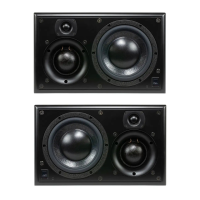
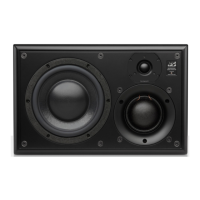
High technology material nishes are used in this product.
The surfaces are durable and with a little care can be
kept as good as new even under conditions of heavy use.
Normally, a dry duster will be all that is required to
keep the nishes clean.
Heavy soiling can be cleaned from the cabinet using a
cloth slightly moistened with a non-abrasive household
cleaner. Please avoid using any chemical cleaning
or polishing agent on the leather surfaces as they
may cause damage.
There are no components within the speakers that
can be considered expendable, or that would benet
from regular maintenance. There is no requirement
for any kind of routine service work and there is
no schedule for preventative maintenance. There are no
user-replaceable parts within the speaker, and in the
unfortunate event of any malfunction, repair should be
referred to either the supplying dealer or consultant,
the relevant importer, or ATC. ATC has every condence
in the quality of each product that it manufactures.
All ATC products are guaranteed against any defect
in materials or workmanship for a period of two years
from the date of purchase. Within this period, we
will supply replacement parts free of charge provided
that the failure was not caused by misuse, accident
or negligence.
Purchasers who complete the Product Registration
process, either by returning a completed Warranty Card
to ATC or by registering the product at www.atc.audio,
will have their warranty period extended up to a period
of six years from the date of purchase.
This guarantee does not limit statutory rights.
Loudspeaker Technology Ltd
Gypsy Lane, Aston Down
Stroud, Gloucestershire
GL6 8HR
United Kingdom
Telephone +44 (0)1285 760561
Email: info@atc.audio
Website: www.atc.audio
Acoustic Transducer Company is the trading
name and is the registered trade mark of
Loudspeaker Technology Ltd.
Care & Maintenance Safety WarningsWarranty Contact
32
1 Read instructions – all the safety and operating instructions should be read before the appliance is operated.
2 Retain these instructions – the safety and operating instructions should be retained for future reference.
3 Heed warnings – all warnings on the appliance and in the operating instructions should be adhered to.
4 Follow instructions – all operating and other instructions should be followed.
5 Water and moisture – the appliance should not be exposed to dripping or splashing and no objects such as vases, should be placed on the appliance.
6 Ventilation – a minimum 0f 80mm is required at the rear of the appliance to ensure sucient ventilation. The ventilation should not be impeded by covering the appliance with items such as
table-cloths, curtains etc. Further, the appliance should not be built into an installation, such as a bookcase or cabinet, that may impede the ow or air around the appliance.
7 Heat – the appliance should be situated away from heat sources such as radiators, stoves or other appliances that produce heat.
8 Power sources – the appliance is of Class1 construction and shall be connected to a MAINS socket outlet with a protective earthing connection.
9 Power cord protection – power supply cords should be routed so that they are not likely to be walked on or pinched by items placed upon or against them, paying particular attention to
cords at plugs, convenience receptacles and the point where they exit the appliance.
10 Cleaning – the appliance should be cleaned only as recommended by the manufacturer.
11 Unattended periods – the power cord of the appliance should be unplugged from the outlet when left unused for a long period of time.
12 Object entry – care should be taken so that objects do not fall into the appliance.
13 Damage requiring service – the appliance should be serviced by qualied service personnel when:
i. the power supply cord or the plug has been damaged
ii. objects have fallen or liquid has been spilled into the appliance
iii. the appliance has been exposed to rain or other serious liquid exposure
iv. the appliance does not appear to operate normally or exhibits amarked change in performance
v. the appliance has been dropped or the cabinet damaged
14 Servicing – the user should not attempt to service the appliance beyond those measures described in the operating instructions. All other servicing should be referred to qualied service
personnel.
15 Grounding or polarisation – precautions should be taken so that grounding or polarisation means for the appliance are not defeated.
16 The Mains disconnection switch is located on the rear panel. Pressing the switch downwards will turn the unit on. The unit can be turned o by upward pressure on the switch. Please allow
enough room around the unit to ensure the switch is readily operable when the unit is in use.


 To Next Page
 Loading...