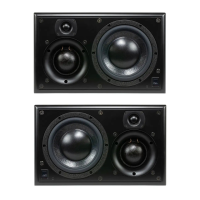
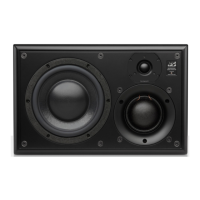
ATC’s rst loudspeaker system, the 3-way
S50, was released in the late 70s and
by the late 80s had evolved into the SCM50
(which is still in production today). Both
models were mid-size 3-way systems which
were too large for many, making it clear
that a smaller 2-way system was needed if
ATC were to engage with a far greater
number of potential customers, both in the
professional and consumer Hi-Fi markets.
As a result, in 1987 Billy Woodman began
the development of a new 150mm/6” mid-bass
driver that would become the heart of a
new loudspeaker and
ATC’s rst 2-way
design, the SCM20. Whilst the nished system
may have been simpler than the existing
3-way designs, mid-bass drivers for 2-way
loudspeakers present a challenge due
to the bandwidth they need to cover and the
conicting requirements of bass and mid-
range reproduction, so there was signicant
development work to complete.
The earlier development of the ATC 3” soft
dome midrange and specically the large
voice coil it employed, highlighted the
importance of power handling & dynamic
range so this new mid-bass driver started
with a 75mm/3” voice coil, operating in ATC ’s
favoured short-coil-long-gap (underhung)
conguration, but with a much longer
20mm magnetic gap, suited to the large cone
excursions required for good bass
reproduction. The result was a huge
175mm/7” diameter motor assembly
weighing 8.4kg/18.5lbs which was costly
to build and challenging to handle but
resulted in far superior linearity than most
mid-bass drivers available at the time.
In 1993, three years after the launch
of the rst SCM20 and based on customer
feedback, ATC released a oor-standing
version of the speaker, the SCM20T.
This was a relatively low-key addition to
the product range to satisfy Hi-Fi market
aesthetics rather than a performance
upgrade. The larger cabinet would, however,
provide a housing for improvements that
would arrive ve years later.
Since the invention of the moving coil
loudspeaker, designers had been looking for
ways of improving the sonic performance
of loudspeaker systems. Very few companies
put more emphasis on this than ATC
and, in 1996, through a combination of timing,
the right material coming to market
and ATC’s engineering skill, a breakthrough
was made with the development of the
Super Linear Magnetic System. This new
loudspeaker technology reduced the level
of ux modulation in the motor drive
system and, in turn, delivered a reduction
in distortion. The resulting acoustic
signal featured greatly improved clarity
and resolution.
Following the huge improvements the
SL technology brought to the SCM20 would
always be challenging but in 1998, the
active loudspeaker technology developed
for the larger SCM50A/100A trickled
down and the active SCM20ASLT was born,
boasting an integrated 2-channel
Amp-Pack with active crossover lters
and 250W continuous power on tap
(200W bass, 50W high frequency), all housed
in the oor-standing Tower cabinet.
THE BACK STORY
TO THE SCM20ASL LE
1990 FIRST SCM20
RELEASED WITH ATC
150mm/6” S B75-150SC
BASS DRIVER AND
VIFA D27 1” SOFT DOME
TWEETER
1993 FLOOR-STANDING
SCM20T ‘TOWER’
MODEL LAUNCHED
1996 SCM20SL
UPDATED WITH BASS
DRIVER UPGRADE
TO ‘SL’ SPEC AND
REVISED CROSSOVER
SCM20
HISTORY
04


 To Next Page
 Loading...