EasyManua.ls Logo

Ateis VELOX LV100 - User Manual

Ateis VELOX LV100
2 pages
Print Icon
To Next Page IconTo Next Page
Loading...
L20-LV100-5100(v1.0)
1154e/01
GENERAL DESCRIPTION
INSTALLATION
REMOTE OUTPUT CAPABILITY
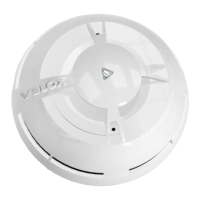
This type of detector (Figure 1) continuously samples the air and the temperature variation in the protected area to provide the earliest
warning of fire and yet offers a high level of false alarm rejection.
The VELOX digital communication protocol employed by the monitoring control panel provides high rates of information exchange in
combination with comprehensive features that ensure fast and secure responses.
This device benefits from a “Double Dust Trap” incorporated into the design of the smoke entry ports, hence limiting potential
contamination and extending periods between maintenance without compromising sensitivity of response.
These detectors are designed for open area protection and must only be connected to control panels that use the VELOX proprietary
analogue-intelligent addressable communication protocol for monitoring and control.
The centrally positioned red LED indicator provides 360° visibility and thus does not require any orientation during installation.
Remote output capability is available as a standard feature so a remote indication lamp or a compatible platform sounder (check power
requirements) may be wired to the base terminals.
If other equipment is connected to the remote output, its supply current must be eventually limited by using an adequate resistor.
Consult the TECHNICAL SPECIFICATIONS table and assess the external device current absorption’s value.
Note: Before installing this device please thoroughly read this leaflet and refer to the applicable European Standards and National
Codes of Practice (e.g. BS5839-1:2002 for UK) for guidance on location, spacing and acceptable use. Also seek guidance from the control
panel instructions to ensure appropriate design criteria and configuration specifications are followed.
LV100
ANALOGUE ADDRESSABLE PHOTOELECTRIC SMOKE DETECTOR LITE
TECHNICAL SPECIFICATIONS
Power supply * from 18 V (min) to 40 V (max)
Average standby current consumption 70 uA @ 24 V
Remote output max current consumption
(externally limited)
20 mA
Operating temperature range -30 °C / +70 °C (no icing)
Humidity 95% RH (no condensation)
Height (standard base included) 54 mm
Diameter 110 mm
Weight (standard base included) 130 g
This photo and heat detector must be used in combination with VELOX control panels employing the VELOX communication protocol.
The location of detectors should follow recognised national or international application codes of practice.
The detector can be mounted on VELOX adaptor base or VELOX deep adaptor base.
Bases supplied with a metal shorting clip installed between the two negative terminals allow more flexibility when connecting detectors
to the loop and permits the continuity of the loop cabling to be tested after installation and prior to the detectors being fitted.
Connections to the base terminals are polarity sensitive thus please
check by referring to the wiring diagram in Figure 2 !
SETTING THE ADDRESS
Detectors can be addressed using a special hand-held programming unit.
Addresses may be selected from a range from 1 to 240 each device on the loop must have a unique address.
SENSITIVITY SETTINGS
A choice of a sensitivity modes are available which can be set via the hand-held programming unit
Figure 1 - View of the detector on its base *Product operates down to 15V, but without LED indication
Figure 2 - VELOX adaptor base and VELOX deep adaptor base loop wiring
TAMPER DETECTION
ANTI-TAMPER MECHANICAL BLOCK FEATURE
A fault condition is triggered on the VELOX control panel if a detector, on the loop, is removed from its mounting base.
The detector may be locked onto its base by removing
the small plastic element on the base’s detector blocking
hook by using a suitable tool (e.g. a small screwdriver) in-
serted through the access hole on the side of the mount-
ing base (Figure 3).
To remove the detector from the base, if mechanically
blocked, insert a suitable tool (e.g. a small screwdriver)
through the access hole on the side of the mounting base
(Figure 3).
1. Position the detector cen-
trally on its mounting base
(ensure it is level).
2. Rotate clockwise applying
gentle pressure. The detector
will drop into its keyed loca-
tion.
3. Press more firmly to win the
force of the contacts.
4. Continue to rotate clockwise
a few degrees until the detec-
tor has fully engaged in the
mounting base.
5. When the detector is firmly
engaged verify the alignment
between the detector and the
raised reference marks on the
base (Figure 4).
6. After all detectors and other loop devices have been installed, apply
power to the loop in accordance with the control panel’s installation in-
structions.
7. Test the detectors as described in the section headed “TESTING”.
Mode Sensitvity Description
1
Level 1
LPCB Approved
High sensitivity level
2
Level 2
LPCB Approved
Medium high sensitivity level
3
Level 3
LPCB Approved
Medium low sensitivity level
4
Level 4
LPCB Approved
Low sensitivity level
WARNING
Disconnect loop power before installing the detector.
CAUTION
Dust covers help to protect the devices during ship-
ping and when first installed. They are not intended
to provide complete protection against contamination,
therefore, detectors should be removed before con-
struction, major re-decoration or other dust producing
work is started. DUST COVERS MUST BE REMOVED
BEFORE THE SYSTEM CAN BE MADE OPERATIONAL.
Figure 3 - The anti-tamper block and its handling

Question and Answer IconNeed help?

Do you have a question about the Ateis VELOX LV100 and is the answer not in the manual?

Summary

General Description

Technical Specifications

Installation and Configuration

Remote Output Capability

Provides a standard feature for wiring a remote indication lamp or sounder to the base terminals.

Setting the Address

Detectors can be addressed using a special hand-held programming unit, with unique addresses for each device.

Sensitivity Settings

Offers a choice of sensitivity modes that can be set via the hand-held programming unit.

Anti-Tamper and Tamper Detection

Tamper Detection

A fault condition is triggered on the control panel if a detector is removed from its mounting base.

Testing Procedures

Aerosol (Simulated Smoke) Test

Use approved test aerosols to trigger an alarm message to the control panel, activating the detector's LED.

Maintenance and Care

Warnings and Limitations

Product Warranty

Overview

The VELOX ATEÏS LV100 is an analogue addressable photoelectric smoke detector designed to provide early warning of fire while minimizing false alarms. It continuously samples the air and monitors temperature variations in the protected area. The device utilizes the VELOX digital communication protocol, ensuring high rates of information exchange and fast, secure responses with the monitoring control panel.

Function Description:

The LV100 detector is a photoelectric smoke detector that uses an optical sensing chamber to detect smoke particles. Its design incorporates a "Double Dust Trap" feature in the smoke entry ports, which helps to limit contamination and extend the time between maintenance cycles without compromising sensitivity. The detector is specifically designed for open area protection and must only be connected to control panels that support the proprietary VELOX analogue-intelligent addressable communication protocol. A centrally positioned red LED indicator provides 360° visibility, eliminating the need for specific orientation during installation. The device offers four sensitivity levels, with Level 1 being the highest sensitivity and Level 4 the lowest, all of which are LPCB Approved.

Important Technical Specifications:

  • Power Supply: Operates from 18 V (min) to 40 V (max).
  • Average Standby Current Consumption: 70 µA @ 24 V.
  • Remote Output Max Current Consumption: 20 mA (externally limited).
  • Operating Temperature Range: -30 °C to +70 °C (no icing).
  • Humidity: 95% RH (no condensation).
  • Height (standard base included): 54 mm.
  • Diameter: 110 mm.
  • Weight (standard base included): 130 g.

Usage Features:

  • Installation: The detector can be mounted on either a VELOX adaptor base or a VELOX deep adaptor base. Bases are supplied with a metal shorting clip between the two negative terminals, allowing for loop continuity testing before detectors are fitted. Connections to the base terminals are polarity sensitive.
  • Addressing: Detectors are addressed using a special hand-held programming unit. Addresses can be selected from 1 to 240, with each device on the loop requiring a unique address.
  • Sensitivity Settings: A choice of four sensitivity modes (Level 1 to Level 4) can be set via the hand-held programming unit, allowing for adaptation to different environments.
  • Remote Output Capability: A standard feature that allows a remote indication lamp or a compatible platform sounder to be wired to the base terminals. If other equipment is connected, its supply current must be limited by an adequate resistor.
  • Anti-Tamper Mechanical Block: The detector can be locked onto its base by removing a small plastic element on the base's detector blocking hook. To remove a mechanically blocked detector, a suitable tool (e.g., a small screwdriver) must be inserted through the access hole on the side of the mounting base.
  • Tamper Detection: If a detector is removed from its mounting base while on the loop, a fault condition is triggered on the VELOX control panel.
  • Testing: Detectors should be tested after installation and during periodic maintenance (at least once per year). An aerosol (simulated smoke) test using approved test aerosols is recommended. After each test, at least one minute should be allowed for power stabilization before the next test. If the detector fails to respond correctly, cleaning or replacement may be necessary.

Maintenance Features:

  • Cleaning: Before maintenance, the system should be isolated and disabled. Remove the detector from its mounting base for inspection. Use a small, soft bristle brush to dislodge contaminants like insects, spider webs, or hairs from the smoke entry ports. A small vacuum tube or clean, dry, compressed air can be used to remove small particles from the smoke entry screen area.
  • Exterior Cleaning: The exterior housing can be wiped with a clean, damp, lint-free cloth to remove any surface film that could attract airborne contaminants.
  • Pollution Monitoring: The hand-held programming unit can be used to read the pollution percentage of the chamber, aiding in proactive maintenance.
  • Dust Covers: Dust covers are provided for protection during shipping and initial installation but must be removed before the system is made operational. They are not intended to provide complete protection against contamination during construction or major re-decoration work.

Warnings and Limitations:

  • Lifespan: While the devices use high-quality components, replacement after 10 years of continuous operation is advisable to minimize the risk of reduced performance.
  • System Compatibility: This device must only be used with VELOX control panels.
  • Environmental Factors: Smoke sensors may respond differently to various smoke particles and can be affected by barriers or special environmental conditions.
  • Standards Compliance: Installation and use must comply with national codes of practice and internationally recognized fire engineering standards.
  • Warranty: The device comes with a limited 5-year warranty covering faulty materials or manufacturing defects. The warranty is invalidated by mechanical or electrical damage caused by incorrect handling or usage.

Ateis VELOX LV100 Specifications

General IconGeneral
BrandAteis
ModelVELOX LV100
CategorySmoke Alarm
LanguageEnglish