Need help?
Do you have a question about the Atlas Copco LPD-T and is the answer not in the manual?
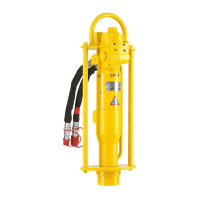
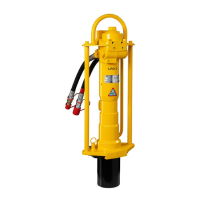
The LPD is a hydraulic-powered post driver designed for driving various types of signposts, wood piles, and steel profiles into the ground. It is intended for professional use only. The LPD post driver can be equipped with either a built-in control valve or a remote control valve. The version with a built-in control valve is designed for use on an Open-Centre hydraulic system, while the version with a remote control valve can be used on either Open-Centre or Closed-Centre hydraulic systems.
The LPD operates by using hydraulic power to deliver impacts, effectively driving posts into the ground. The hydraulic system provides the necessary force for efficient operation. The accumulator body, valve housing, cylinder, and nose part are key components in this process. The handle and trigger allow the operator to control the machine's operation. The lifting bracket facilitates handling and positioning of the post driver.
Before using the LPD, it is crucial to read and understand the safety and operating instructions. Operators must be qualified and trained, physically able to handle the tool's bulk, weight, and power, and always use common sense and good judgment. Approved personal protective equipment, including a protective helmet, hearing protection, impact-resistant eye protection with side protection, respiratory protection (when appropriate), protective gloves, proper protective boots, and appropriate work overall or similar clothing that covers arms and legs, must always be worn by operators and all other persons in the working area.
When installing the LPD, ensure the hydraulic supply meets the requirements outlined in the technical data. Connect the hydraulic hoses, ensuring they are clean and that the quick-release couplings are correctly engaged. The power source should be fitted with a return line oil filter with a filter rating of 10-25μ. The back pressure of the post driver must be as low as possible and not exceed the maximum specified in the technical data to avoid functional disturbances. Oil coolers should withstand a minimum pressure of 10 bar (145 psi) and be equipped with a by-pass valve opening at a pressure of 2 bar (29 psi) in case of pulsations in the return line.
The LPD requires a suitable adaptor for the post being driven. Adaptors can be chosen from the spare parts list or accessories catalogue. These are fixed to the post driver's bottom plate using fasteners. Optional adaptors include a square adaptor (54 mm), a universal adaptor for square (max 62x62 mm), rectangular (max 90x35 mm), and round (max Ø62 mm) posts, and a round adaptor (Ø96 mm).
To start the post driver, first, in cold conditions, warm it up with light use for a few minutes. Place the appropriate adaptor in the front head of the post driver. Remove protective caps from quick-release couplings, clean them, and connect the tail-hoses to the extension hoses of the power source. Insert the post into the post driver, optionally using a drive cap. Lift the post and post driver to a vertical position; for long and heavy posts, two persons may be required. Activate the trigger, grasping the handles when the post driver is within reach. Avoid activating the post driver when it is removed from the post and ground, as this can increase hydraulic oil temperatures and seal wear. Do not invert the post driver without first isolating the hydraulic supply. Stop working immediately if hoses vibrate abnormally. Investigate the work material for hidden cables and pipes (electricity, telephone, water, gas, sewage lines). Only use the machine for its intended purpose.
To stop the post driver, release the trigger and press the post driver against the surface until it stops completely. Switch off the power supply, disconnect the hoses, and fit protective caps on the quick-release couplings. When taking a break, place the machine on the ground to prevent unintentional starting or falling. For longer breaks or when leaving the workplace, switch off the power supply and bleed the machine by activating the start and stop device.
Regular maintenance is essential for the continued safe and efficient use of the LPD. Before any maintenance, clean the machine thoroughly to avoid exposure to hazardous substances. Only authorized parts should be used; unauthorized parts are not covered by warranty or product liability. When cleaning mechanical parts with solvent, ensure satisfactory ventilation and comply with health and safety regulations. For major service, contact the nearest authorized workshop. After each service, check that the machine's vibration level is normal; if not, contact the nearest authorized workshop.
Daily maintenance includes cleaning and inspecting the machine and its functions, conducting a general inspection for leaks, damage, and wear, changing damaged parts immediately, and replacing worn components in good time. Ensure all attached and related equipment, such as hoses and flow dividers, are properly maintained. Clean quick-release couplings before use.
Monthly maintenance involves checking the torque tightness of all fasteners, inspecting the bush in the nose casting for wear or damage, checking wear on the shank of the ramming tool, and spraying the trigger and all contact surfaces with suitable lubricant (for hydraulic post drivers with trigger control valves only).
Periodic maintenance requires the machine to be dismantled, cleaned, and all parts checked after approximately 600 operating impact hours or yearly. This work must be performed by authorized and trained staff.
For storage, disconnect the machine's hoses from the power source, ensure the machine is properly cleaned, and store it in a dry place. When disposing of a used machine, it must be treated and scrapped to maximize material recycling and minimize environmental impact. Before scrapping, the machine must be emptied and cleaned of all hydraulic oil, which should be deposited responsibly.
 General
| Brand | Atlas Copco |
|---|---|
| Model | LPD-T |
| Category | DC Drives |
| Language | English |

 To Next Page