♦ Specified values for the refrigerant circuit pressures, refer to
⇒ “4.4.7 Specified values Vehicles With Expansion Valve and
Fluid Reservoir - Internally Regulated Compressor“,
page 165 .
4.4.7 Specified values Vehicles With Expan‐
sion Valve and Fluid Reservoir - Inter‐
nally Regulated Compressor
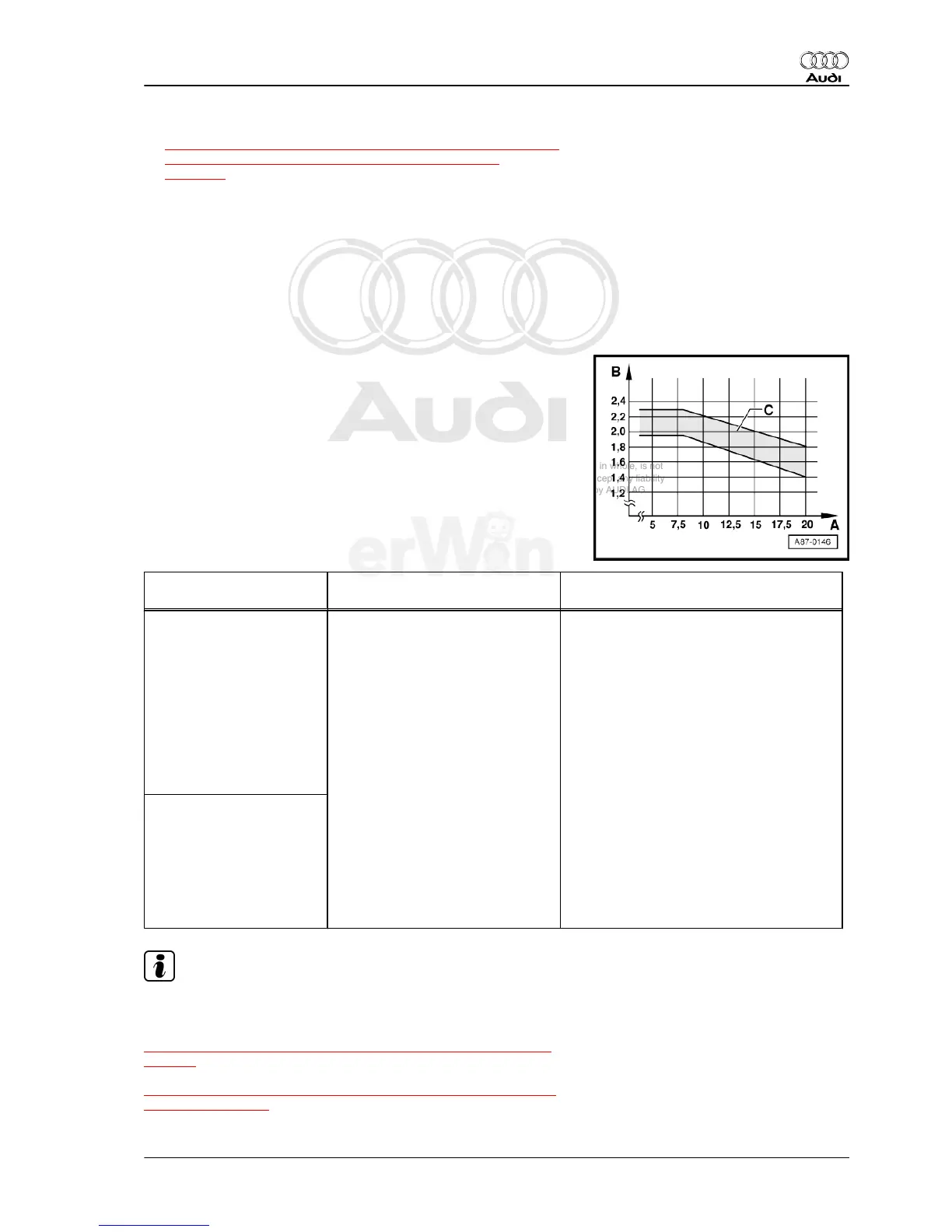
High-pressure side
Increasing from initial pressure (when connecting pressure
gauges) to a maximum of 20 bar.
Low-pressure side
Decreasing from initial pressure (when connecting pressure
gauges) to the value in the graph.
A - High pressure in bar
B - Low pressure in bar
C - Permissible tolerance range
Possible Deviation From
Specification
Possible Cause Of Fault Corrective Action
• High pressure remains
constant or increases
only slightly (above
pressure with engine
stopped),
• Low pressure quickly
drops to value in graph
or below
• Required cooling output
is not attained
Not enough refrigerant in circuit or
expansion valve malfunctioning.
– Extract refrigerant from refrigerant cir‐
cuit
• If quantity of refrigerant extracted rough‐
ly corresponds to specified capacity:
– Replace expansion valve
– Charge the refrigerant circuit
– Repeat test
• High pressure normal
• Low pressure in line with
value in graph
• Required cooling output
is not attained
• If quantity of refrigerant extracted is sub‐
stantially less than specified capacity:
– Localize leak with leak detector and
eliminate
– Charge the refrigerant circuit
– Repeat test
Note
If no malfunction can be found and air conditioner operation is not
OK when test is repeated, clean refrigerant circuit (flush using
refrigerant R134a, refer to
⇒ “1.4.13 Refrigerant Circuit Flushing With Refrigerant R134a“,
page 32 or blow through using compressed air and nitrogen, refer
to
⇒ “1.4.12 Refrigerant Circuit Flushing With Compressed Air and
Nitrogen “, page 29 ).
Audi 100 1991 ➤ , Audi 80 1992 ➤ , Audi A1 2011 ➤ , Audi A2 2001 ➤ , A ...
Refrigerant R134a Servicing - Edition 01.2011
4. Diagnosis and Testing 165



 To Next Page