Need help?
Do you have a question about the AUSRANVIK APR-50B and is the answer not in the manual?
Details power sources for the refrigerator, including DC and AC options.
Explains how to connect the power cable for operation.
Guides on using the refrigerator's control panel and indicators.
Instructions for reversing the door hinges to change opening direction.
This document provides a user manual and product specifications for an AUSRANVIK portable refrigerator, model APR-50B. It outlines the device's functions, usage instructions, safety guidelines, and maintenance procedures.
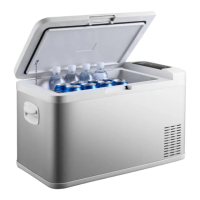
The AUSRANVIK portable refrigerator is designed for efficient cooling and freezing, suitable for both automotive (12/24V DC) and household (110-240VAC) use. Its primary function is to keep food and beverages chilled or frozen, making it ideal for travel, camping, or as an auxiliary refrigerator at home.
The refrigerator incorporates a high-efficiency DC inverter compressor and a conversion module, ensuring reliable and long-lasting performance. It utilizes fluoride-free insulation, contributing to good insulation and low energy consumption.
The device offers a wide range of electronic temperature control, allowing users to set their desired cooling levels. A quick cooling feature enables the refrigerator to reach -4°F (based on a 78°F ambient temperature) rapidly.
An intelligent car battery protection system is integrated to prevent excessive discharge of the vehicle's battery when the refrigerator is in use. The unit also features compressor delay protection, which ensures the compressor does not start immediately after being plugged in, protecting its lifespan.
The refrigerator boasts a dual door opening direction, offering flexibility in placement and access.
The control panel includes an ON/OFF button, a SET button, and UP/DOWN buttons for temperature adjustment and mode selection. When connected to power, the compressor protection program delays the compressor from working for the first three minutes, during which the indicator light is RED, and the display is active, allowing for temperature, working mode, or car battery protection level settings. A long press of the ON/OFF button turns the refrigerator off, and it will not restart until the button is long-pressed again, followed by the three-minute compressor delay.
The compressor starts cooling three minutes after connecting to the power supply. The factory default working mode is MAX (fast cooling), indicated by a RED light, with a default battery protection level of "High." Users can adjust the temperature using the UP or DOWN buttons. When setting the temperature, the digits flash for three seconds without operation before displaying the real interior temperature.
The SET button allows switching between MAX (Fast Cooling) and ECO (Energy Saving) modes. MAX mode provides rapid cooling but consumes more energy, indicated by a RED light. ECO mode conserves energy but takes longer to reach the desired temperature, indicated by a GREEN light.
By pressing the SET and UP (or DOWN) buttons simultaneously, users can switch the battery protection level between High (H), Medium (M), and Low (L).
Advanced settings can be accessed by long-pressing the SET button for six seconds, which makes the display flash "E1." Subsequent presses of the SET button cycle through codes E1 to E5 and F1 to F4, each representing a customizable parameter. The UP or DOWN buttons can be used to change these parameters. For instance, E1 allows calibration of the lower temperature range, E2 for the upper temperature range, E3 for compressor OFF temperature, E4 for compressor KICKS IN temperature, and E5 for compressor retardation time. F1, F2, and F3 allow for temperature display calibration for different temperature ranges (0° to -6°C, -6° to -12°C, and below -12°C, respectively). F4 switches between Celsius and Fahrenheit display. To restore factory default settings, press UP and DOWN buttons simultaneously for six seconds while in E1 code; the display will show "888" before reverting to defaults.
The door opening direction can be adjusted by unscrewing the stainless chain and hinges, then re-installing them on the opposite side of the door and tank.
For food storage, meat should be cut, wrapped tightly, and evenly placed in the freezer. Frozen food should be placed in the freezer as soon as possible. Fresh food should not be mixed with frozen food. Fruits and vegetables should not be placed in the freezer to prevent freeze-drying, and glass containers or sealed liquid containers should be avoided in the freezer to prevent explosion. For the refrigerator section (32°F to 50°F), items like eggs, butter, milk, and bottled drinks are suitable. Fruits and vegetables should be placed in the crisper for moisture retention. Hot food should be cooled before placement to save power, and packaged foods should have space between them for cool air circulation.
Safety instructions emphasize not allowing children to play with or climb on the refrigerator. Before initial use, it is strongly recommended to clean the unit with a soft cloth dampened with warm water and a neutral detergent, then wiped dry. Electrical parts should only be wiped with a dry cloth, and the unit should not be operated if wet. Installation of the DC power source in a boat should be handled by qualified personnel.
The refrigerator's voltage must be within the correct range for the socket and cable used, as indicated on the rating label. No other electrical devices should be placed inside the refrigerator. During transportation, the unit should be sloped less than 45 degrees and handled carefully. For proper ventilation, the refrigerator should be placed level, leaving at least 8 inches at the back and 4 inches on each side. It should not be placed near heat sources or under direct sunlight. The unit should not be sloped more than 30 degrees from level during operation. Water should not be poured out by turning the unit upside down; instead, a dry cloth or sponge should be used to absorb water. If used in a car, alcoholic beverages or drinks should be stored in the trunk.
Troubleshooting guidance is provided for common issues. If the appliance is not working, users should check the power supply connection, plug and socket connection, fuse, ensure the appliance is turned on (by pressing the On/Off button for 3 seconds), and confirm the compressor is not in delay start protection. If food is frozen, the setting temperature may be too low. The sound of water flow is normal, caused by refrigerant circulation.
Defrosting is necessary when frost builds up, reducing cooling performance and increasing power consumption. To defrost, unplug the refrigerator, open the doors, and remove food to a cool place. Use a defrosting shovel to remove ice and frost, or allow it to thaw naturally. Wipe off ice water with a dishtowel before returning food and plugging in the unit. Sharp metal tools should not be used for defrosting to avoid damaging the coil.
For care and cleaning, the refrigerator should be unplugged. Inner and outer surfaces can be wiped with a soft cloth dampened with warm water. Heavy stains can be cleaned with a neutral detergent and then dried with a clean soft cloth. For long vacations or absences, food should be removed, the refrigerator unplugged, cleaned, and doors left slightly open in a ventilated area. Water should not be sprinkled on the refrigerator during cleaning to prevent damage to electrical components and metal parts. Corrosive or deliquescent cleansers (scouring powder, bleach, soap powder, alkaline cleansers, benzene, gasoline, acid, hot water, etc.) should not be used on appearance panels, door gaskets, or plastic parts.
Normal operational sounds include the flow of refrigerant through the evaporator (boiling or gurgling sound). Moisture may form on the outside in rainy or high humidity weather, which can be wiped with a dry cloth. The back panel may be warm due to heat emission from the condenser. The external surface of the compressor may also be warm during operation. The compressor may produce a high hum or pulsating sound when starting or stopping, and a metal hit noise may be heard when the refrigerator is bumped, all of which are considered normal.
 General
| Category | Refrigerator |
|---|---|
| Brand | AUSRANVIK |
| Model | APR-50B |
| Refrigeration Method | Compressor |
| Material | Metal |


 To Next Page