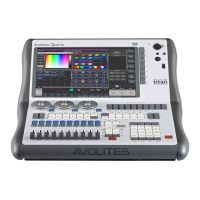
Need help?
Do you have a question about the Avolites Pearl 2008 and is the answer not in the manual?
Guide to connecting and preparing the Pearl console for operation.
Steps for patching dimmers, including range patching and top fader allocation.
Detailed process for patching intelligent fixtures using personality files.
Verifying console patching against physical lighting rig DMX addresses.
Modifying existing patches, including changing DMX addresses and handles.
Procedure for re-patching a fixture to a different DMX address or output line.
Procedure for backing up the console's show data to external storage.
Selecting fixtures and using wheels to control attributes like pan, tilt, and colour.
Detailed explanation of how to modify fixture attributes using wheels and buttons.
Recalling pre-programmed states for attributes like colour, gobo, and position.
Steps to store custom attribute settings as new palettes.
Step-by-step guide to saving custom palette values.
Procedure for applying palette values to selected fixtures.
Applying a palette to all fixtures simultaneously without individual selection.
Procedures for editing palette entries and removing them.
Applying palettes with specified fade times for smooth transitions.
Procedure for choosing and applying shapes to selected fixtures.
Adjusting shape size and speed parameters using console wheels.
Explanation of Highest Takes Precedence (HTP) and Latest Takes Precedence (LTP) channel behavior.
Understanding the Programmer and how attributes are stored in memories.
Explanation of the Programmer and Record by Fixture/Channel modes.
Step-by-step guide to storing a programmed look into a memory.
Step-by-step guide to recording a memory from the current console state.
Description of Highest Takes Precedence (HTP) and Latest Takes Precedence (LTP) channel behavior.
Activating memories via faders, flash, or swop buttons.
Modifying existing memories by making changes and saving them.
Configuring fade-in, fade-out, and LTP times for memories.
Understanding and selecting between fixture-wide or channel-specific recording modes.
Process for amending memory contents and saving changes.
Removing specific attributes or fixtures from a memory without deleting it.
Step-by-step guide for copying memories via Flash or Photocopy.
Configuring fade-in, fade-out, and LTP times for individual memories.
Programming memories safely without altering the current show output.
Step-by-step process for creating chase sequences by defining steps.
Steps to set up lighting for each chase step and save them.
Running programmed chases using playback faders.
Activating chase sequences and understanding HTP/LTP channel behavior.
Adjusting chase speed, crossfade, and direction parameters.
Taking manual control of chase steps using Stop, Go, and wheel functions.
Making real-time edits to chase steps while the chase is active.
Setting timing parameters for chase steps, including global and individual times.
Enabling theatre mode and configuring its startup behavior.
Overview of playback faders and buttons specific to theatre mode operation.
Setting up cue states by defining fixture levels and positions.
Configuring fade-in, fade-out, and wait times for individual cues.
Executing the programmed cue sequence using the Go button.
Overview of tablet features like fixture selection, position control, and attribute manipulation.
Using the tablet's fixture pads to select fixtures on the console.
Controlling fixture pan/tilt by drawing on the tablet's stage area.
Modifying fixture colours and attributes using tablet controls.
Selecting between Normal Run and Takeover Run modes for show operation.
Explanation of Normal Run and Takeover Run modes for show playback.
Performing live adjustments and effects during a show using Takeover Run mode.
Important tips and warnings for ensuring reliable DMX communication.
How the console defines and controls dimmers and fixtures via patching.
Storing fixture and dimmer settings using the console's programming features.
Essential steps for connecting mains power and DMX lines.
Explanation of Program, Run, and System modes and their functions.
Procedures for backing up and retrieving shows using disk drives.
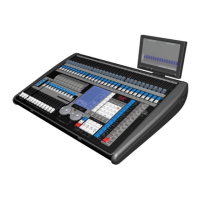
Detailed description of all physical controls on the console's front panel.
Using Swop buttons to select individual or ranges of fixtures for control.
Modifying fixture attributes like pan, tilt, and colour using wheels.
Copying attribute settings between fixtures (Align) and alternating fixture positions (Flip).
Temporarily reducing or turning off fixture intensity without affecting programming.
Teaching the console fixture positions for effective stage tracking.
Steps to record actions into script files, synchronizing with timers or MIDI.
Selecting and testing script files for playback.
Running script files to verify their functionality and timing.
Navigating the user settings menu to customize console behavior.
Managing shows, personalities, and formatting disks via USB or floppy drive.
Updating the console's operating system and managing AVOS functions.
Procedure for upgrading older console software to the Pearl 2008 version.
Loading new software versions from disk or USB.
Details on the ASCII text format and editing process for personality files.
Displaying and configuring exact switch settings for fixture DMX addressing.
 General
| Type | Lighting Console |
|---|---|
| Manufacturer | Avolites |
| Model | Pearl 2008 |
| DMX Channels | 2048 |
| Number of Universes | 4 |
| DMX Outputs | 4 |
| Number of Fixtures | 240 |
| Number of Playbacks | 60 |
| Effects Engine | Yes |
| MIDI Support | Yes |
| VGA Output | Yes |
| USB Port | Yes |
| Display | LCD |
| Memory | Floppy Disk |

 To Next Page