
 Need help?
Do you have a question about the Axis P3224-VE Mk II and is the answer not in the manual?
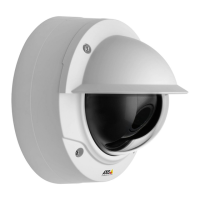
The AXIS P32 Series Network Camera is a versatile surveillance solution designed for both indoor and outdoor environments, offering a range of models including the P3224-LV Mk II, P3224-LVE Mk II, P3224-V Mk II, P3224-VE Mk II, P3225-LV Mk II, P3225-LVE Mk II, P3225-V Mk II, and P3225-VE Mk II. This series is engineered to provide high-quality video surveillance with advanced features for various applications, from monitoring public spaces like train stations to securing indoor areas.
The primary function of the AXIS P32 Series is to capture and stream video over a network, enabling remote surveillance and recording. The cameras are equipped with a network connector (PoE) for simplified installation, allowing both power and data to be transmitted over a single Ethernet cable. An SD memory card slot provides local storage capabilities, ensuring continuous recording even if network connectivity is interrupted. A control button and status LED indicator are integrated for easy device management and status monitoring. The cameras are designed to be part of a larger surveillance system, typically connecting to a surveillance center where video feeds are monitored and managed.
The device offers various capture modes, which consist of different resolutions and corresponding frame rates. These modes influence the camera's field of view and aspect ratio, allowing users to optimize video quality and bandwidth usage based on their specific surveillance needs. The lower resolution capture modes are cropped from the highest resolution, providing flexibility in how the video is presented. The camera also supports view areas, which are cropped parts of the full view. Streaming and storing view areas can help minimize bandwidth and storage requirements. If PTZ (pan, tilt, zoom) is enabled for a view area, users can digitally manipulate the view within that cropped section.
Overlays are a key feature, allowing users to superimpose extra information onto the video stream. This can include timestamps for recordings or custom text messages, which are useful for product installation, configuration, or event-triggered notifications. For instance, the camera can be configured to display "Motion detected" as a text overlay when its video motion detection application triggers an event.
The AXIS P32 Series supports different video compression formats, including Motion JPEG and H.264 (MPEG-4 Part 10/AVC). Motion JPEG provides excellent image quality with access to every individual image, though it consumes considerable bandwidth. H.264, on the other hand, significantly reduces video file size without compromising image quality, leading to lower network bandwidth and storage space requirements. This compression efficiency can be further enhanced through features like Zipstream, dynamic GOP (Group of Pictures), increased compression levels, and dynamic FPS (frames per second).
The cameras are capable of handling scenes with strong backlight through Wide Dynamic Range (WDR) technology. WDR makes both dark and bright areas of an image visible, addressing situations where there's a significant difference in light levels. Users can adjust the local contrast to fine-tune the WDR effect and specify an exposure zone to cover the area of interest.
Accessing the device is straightforward through a web browser by entering its IP address or hostname. For first-time access, users are prompted to set a root password, with recommendations for secure password practices, including using at least 8 characters and changing it regularly. The live view page provides an immediate visual feed, along with control bars for live view and video, product information, user settings, color themes, and a help section. Settings tabs offer a structured way to configure various aspects of the camera.
The device supports different bitrate control options to manage bandwidth consumption. Variable Bitrate (VBR) adjusts bandwidth based on scene activity, guaranteeing constant image quality but requiring storage margins. Maximum Bitrate (MBR) allows setting a target bitrate to handle network limitations, prioritizing either image quality or frame rate. Average Bitrate (ABR) automatically adjusts bitrate over time to meet specified targets and optimize video quality based on available storage, allowing users to define total storage or calculate average bitrate based on retention time.
Event management is a powerful feature, enabling the creation of rules that trigger specific actions when certain conditions are met. For example, a rule can be set to start recording or send an email upon motion detection, or to display an overlay text during recording. These rules can be scheduled, recurring, or triggered by various conditions, providing automated responses to surveillance events.
The AXIS Camera Application Platform (ACAP) extends the camera's functionality by allowing third-party analytics and other applications to be installed. This open platform provides flexibility for users to customize their surveillance solution with advanced capabilities.
Maintenance aspects are designed for ease of use and system reliability. Firmware management is crucial for keeping the device up-to-date with the latest features, bug fixes, and security updates. Axis offers firmware through active tracks (for continuous access to new features) and long-term support (LTS) tracks (for fixed platforms with periodic bug fixes and security updates). Users can check the current firmware version via the device's webpage and upgrade it by downloading the firmware file from axis.com/support. During firmware upgrades, preconfigured and customized settings are generally preserved.
Troubleshooting guidance is provided for common issues, such as problems upgrading firmware (e.g., due to incorrect firmware files), difficulties setting IP addresses (e.g., subnet conflicts), or inability to log in (e.g., incorrect protocol, lost password). The device can be reset to factory default settings by disconnecting power, pressing and holding the control button while reconnecting power, and holding it until the status LED flashes amber. This process resets all settings, including the IP address, to their default values.
For network storage, the device allows configuration to store recordings on a host server, requiring the IP address of the server, the shared location name, and optionally, login credentials. This ensures that recordings are securely stored and accessible.
The device also provides solutions for streaming problems, such as Multicast H.264 accessibility issues (checking router support, TTL values, and network administrator settings) and poor H.264 rendering (updating graphics card drivers). Performance considerations are outlined to help users optimize their system, addressing factors like image resolution, compression levels, CPU load, number of simultaneous viewers, and network utilization. These guidelines help ensure that the camera operates efficiently and delivers the expected performance.
 General
| Form Factor | Dome |
|---|---|
| Bitrate Control | VBR, CBR |
| Operating Conditions | Humidity 10 - 100% RH (condensing) |
| Vandal Resistance | IK10 |
| Pan/Tilt/Zoom | Digital PTZ |
| Model | P3224-VE Mk II |
| Type | Dome |
| Environment | Outdoor |
| Connectivity | Ethernet 10/100 Mbit/s |
| Sensor Type | CMOS |
| Day/Night | Yes |
| Compression | H.264 |
| Onboard Storage | microSD/microSDHC/microSDXC card slot |
| Network Interface | 10/100 Mbit/s Ethernet (RJ-45) |
| Protocols | IPv4, IPv6, HTTP, HTTPS, QoS, FTP, SMTP, Bonjour, UPnP, SNMPv1/v2c/v3, TLS, SSL, DNS, NTP, RTSP, RTP, TCP, UDP, IGMP, ICMP, DHCP, ARP, SOCKS |
| Security | Password protection, IP address filtering, HTTPS encryption, IEEE 802.1X, user access log |
| Power over Ethernet | Yes, IEEE 802.3af Class 3 |
| Ingress Protection | IP66 |



 To Next Page
