PAGE 16
MOWING TIPS:
•Mow header strips at the ends of the lawn and around flower beds first. Make them wide enough that you can turn the
mower around in the already mown section. Then mow back and forth between these header strips overlapping each lap
by about 1/8 the width of the mower’s deck.
•Don’t cut your grass too short, particularly for cool season grasses. Higher heights usually provide for a deeper root
system, looks better, and is less likely to have weeds invading, particularly crabgrass.
•Don’t remove any more than one third of the grass leaf at any one cutting. If circumstances arise that a lawn gets too tall
break it down into several mowings to get caught up with 3 or so days between cuttings.
•NEVER SCALP YOUR LAWN. Scalping severely damages the root system to such a degree that it may die.
•Avoid mowing when the grass is wet or when it’s dark
•Avoid throwing grass clippings into the street and driveway where they can be washed into the sewer system. After
mowing, clean up driveway and walkways.
•When mowing remove only a third with each cutting (except for the first mowing of the season when it’s ok to remove
more). You can safely leave clippings that will quickly decompose and add nutrients back into the soil. Contrary
to popular opinion, grass clippings do not add to thatch buildup. Grass blades are made up of about 75% water.
•Mow your lawn in a different direction with each mowing, especially with lawns of shorter grass types. Altering the
direction ensures a more even cut since grass blades will grow more erect and less likely to develop into a set pattern.
•Keep your mower’s blade sharp, which means having it sharpened several times during the mowing season. Keep
several blades around so you’ll always have a sharp one on hand. Sharp blades cut the grass cleanly and help
mulch clippings into small pieces which break down quickly.
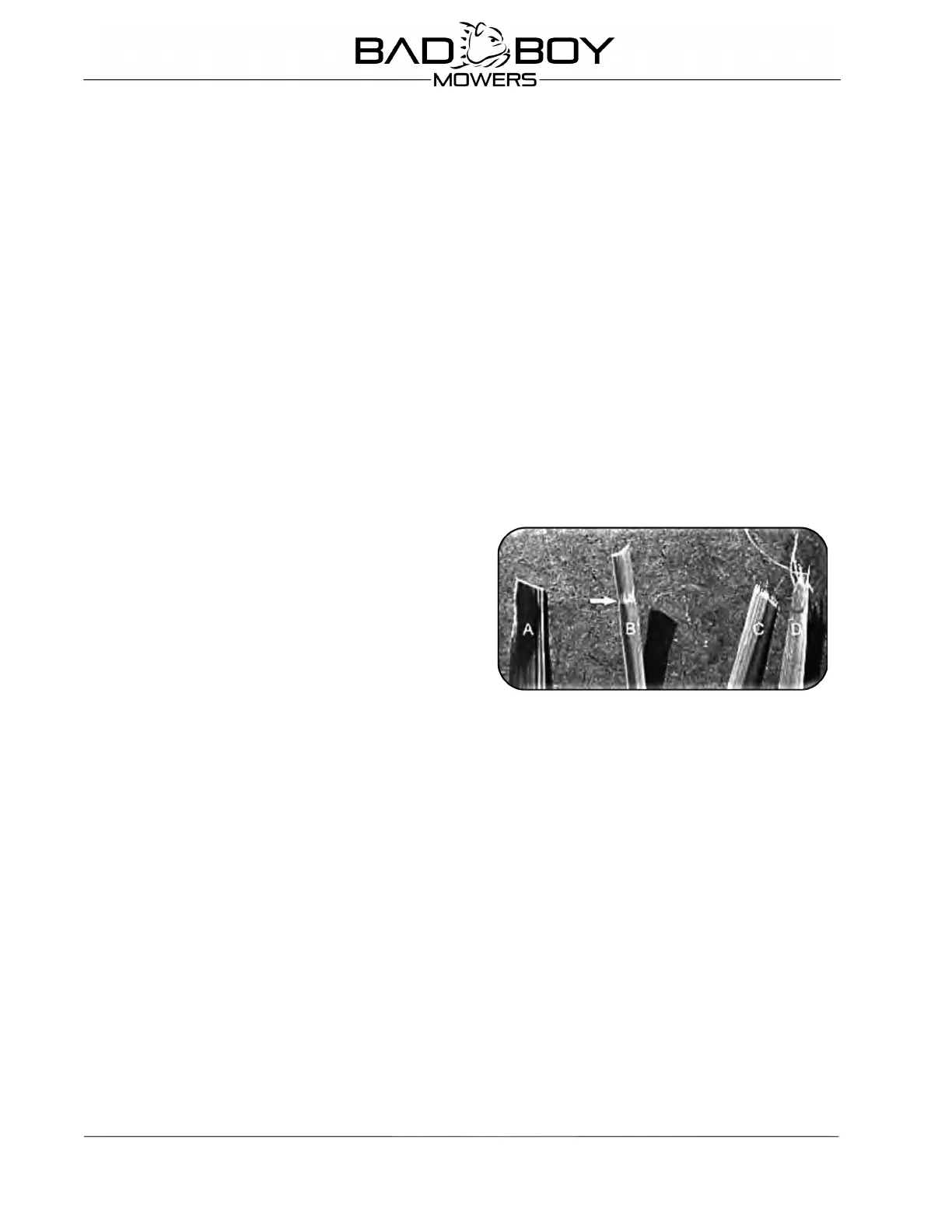
•Leaf blade A demonstrates what a leaf blade should look like
after mowing with a sharp blade.
•Leaf blade B demonstrates a leaf blade that was injured by a
dull mower blade.
•Leaf blade C was cut by the mower but indicates that the
mower blade is not sharp enough. The shredded white tissue
protruding from the leaf blades C and D is the vascular tissue
of the plant.
•Leaf blade D has been mown for quite some time with a dull mower blade.


 To Next Page