Need help?
Do you have a question about the BALAY 3KF4830N and is the answer not in the manual?
Instructions for environmentally friendly disposal of old appliances and packaging.
Crucial guidelines for safe installation, operation, and maintenance of the appliance.
Statutory regulations applicable to domestic and commercial use of the appliance.
Guidance on operating the appliance within specified ambient temperature ranges for optimal performance.
Recommendations for the optimal placement and location of the appliance for proper ventilation and stability.
Instructions for reversing the door opening direction to suit user preference or space constraints.
Details on connecting the appliance safely to the power supply, including voltage and fuse requirements.
Importance of maintaining clear airflow around the appliance for efficient cooling and energy saving.
Pre-operation advice regarding appliance positioning after transport.
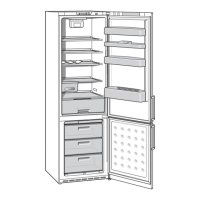
Identification of major components and interior parts of the refrigerator and freezer sections.
Overview of the appliance's control panel buttons and their basic functions.
Detailed explanation of each button on the control panel and their operation.
How to read and set the desired temperature for the refrigerator section using indicators.
Functionality and usage of the super cooling feature for rapid chilling of food.
Operation of the button to set the desired temperature for the freezer compartment.
How to read and set the desired temperature for the freezer section using indicators.
Understanding the function and triggers of the alarm indicator for temperature deviations.
Explanation of the super frost function for maximum freezing capacity and its indicator light.
Step-by-step guide to adjust the temperature for the refrigerator compartment.
Step-by-step guide to adjust the temperature for the freezer compartment.
How to activate the super cooling feature for rapid chilling.
Factors affecting temperature stability and potential causes for too warm or too cold compartments.
Procedure for turning off the appliance using the main switch.
Instructions for safely storing the appliance when not in use for an extended time.
Guidelines for properly storing food to maintain freshness and prevent contamination.
Warning about storing flammable substances, particularly high-proof alcohol.
Recommended placement of various food types within the refrigerator compartment.
How to arrange food and utilize the freezer tray and containers effectively.
Details on adjusting shelves, the chiller compartment, and door fittings.
Tips for inspecting packaging and quality of frozen food before purchase.
Guidance on selecting, preparing, and blanching food for home freezing.
Lists of foods suitable and unsuitable for freezing, plus preparation advice.
Methods and materials for airtight packaging of food before freezing to preserve quality.
Understanding the appliance's limit for freezing large quantities of food quickly.
How to use the fast freeze function for optimal freezing and quality preservation.
Ensuring proper circulation for stored frozen goods for optimal cooling.
Information on permissible storage times for different frozen food items.
Use of the freezer tray for freezing individual items and making ice cubes.
Essential safety steps, including unplugging the appliance and avoiding steam cleaners.
Recommended method for cleaning the appliance interior and exterior with mild detergent.
Special instructions for maintaining the appearance of stainless steel surfaces with a specific cleaning agent.
Tips on optimal appliance placement and avoiding heat sources to save energy.
Advice on door opening duration, food cooling, and using thawed food for cooling.
Importance of cleaning the heat exchanger periodically to maintain efficiency.
Explanation of common noises like humming, bubbling, and clicking as normal functions.
Troubleshooting tips for noises caused by leveling, appliance placement, or loose parts.
Troubleshooting steps if temperature selection indicators do not light up.
Diagnosing issues with the interior light, including bulb replacement and switch checks.
Identifying causes for the alarm indicator, such as blocked vents or improper door closure.
Addressing problems like excessive ice formation on the evaporator impacting cooling.
Locating the E-Nr. and FD-Nr. on the rating plate for appliance identification.
How to find and contact the nearest customer service for assistance with faults.
 General
| Appliance placement | Freestanding |
|---|---|
| Product colour | White |
| Built-in display | No |
| Fridge interior light | Yes |
| Lamp type | LED |
| Number of shelves/baskets in fridge | 4 |
| Number of vegetable drawers | 1 |
| Egg balcony | Yes |
| Bottle rack | Yes |
| Number of shelves/baskets in freezer | 3 |
| No Frost system | No |
| Multi-Airflow system (fridge) | No |
| Fresh zone compartment | No |
| Climate class | SN-T |
| Noise level | 39 dB |
| Width | 600 mm |
| Number of Doors | 2 |
| Cooling System | Static |
| Type | Combi |

 To Next Page