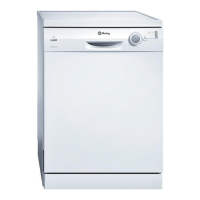
Need help?
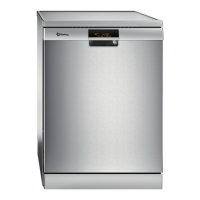
Do you have a question about the BALAY 3VS950IA and is the answer not in the manual?
Check packaging and appliance for transit damage; dispose of packaging responsibly.
Refer to the "Installation" chapter for correct setup and connection.
Use dishwasher only for domestic dishes; do not lean on door; beware of hot water.
Use childproof lock; keep children away from appliance, detergents, and rinse aid.
Description of the childproof lock is at the back of the envelope.
Diagram of control panel with numbered parts; individual positions referred to in text.
Diagram of appliance interior with numbered parts; individual positions referred to in text.
How to set the language in the display window from L:01 to L:19.
Setting the amount of salt dispensed from H:00 to H:07 based on tap water hardness.
Refill salt before switching on; use only dishwasher salt.
How to switch off salt refill indicator or water softening system.
Salt may be omitted for certain water hardness levels with combined detergents.
Adjusting rinse-aid dispense amount from r:00 to r:06 for optimal results.
How to switch off the rinse-aid refill indicator if impaired.
Lists items not suitable for dishwasher, e.g., wood, delicate glass, plastic, copper.
Causes and recommendations for preventing glass and utensil damage.
Proper placement of utensils for secure loading and optimal cleaning.
Recommendation to unload from bottom up to prevent dripping.
Illustrates placement of cups and glasses in the top basket.
Illustration of bottom basket loading for pans.
Instructions for placing cutlery and long items safely.
How to fold spikes to improve arrangement of items in the basket.
Securely holds lightweight plastic accessories like cups and lids.
Arranging long knives and other utensils horizontally; removing shelf for taller items.
Adjusting upper basket height for more space in upper or lower basket.
Tables showing basket height settings for different appliance heights.
Procedure to lower or raise the top basket using side levers.
Information on using tablets, powder, or liquid detergents, and combined detergents.
Explains the graduated dispenser for powder or liquid detergent.
How the dispenser opens automatically and distributes detergent.
Advice on dosage, using combined detergents, and optimal results.
Safety warnings and notes on detergent use, e.g., tablet dissolving.
How to select a program based on utensil type and soiling.
Where to find conditions for running comparability tests.
Reduces running time by 20-50% at increased consumption.
Saves water, energy, and time when washing fewer items.
Increases temperature during rinsing for better hygiene status.
For mixed loads; intensifies spray pressure in lower basket.
Increased temperature and extended drying phase for better drying.
Consumption values based on normal conditions and water hardness H:04.
Measures water turbidity to adjust program; saves water.
Indicates the remaining time of the selected program on the digital display.
Provides program sequence and additional info; how to disable.
Delays program start in 1-hour steps up to 24 hours.
Indicates program end with 0:00 display and acoustic signal; how to change this feature.
Steps to switch off the appliance after the program and remove utensils.
How to switch off temporarily and resume the program.
How to cancel the current program and reset the appliance.
Program cannot be changed after START; requires reset.
Final rinse uses higher temperature for better drying; how to switch on/off.
Interior light turns on when door is opened; how to switch it on/off.
Regular inspection and maintenance to prevent faults.
Checking spray arms, cleaning appliance with suitable detergents.
Checking refill indicators and refilling if necessary.
How filters keep foreign objects from the pump; system consists of coarse, fine, and microfilters.
Steps to unscrew, remove, clean, and re-install the filter system.
Limescale and contaminants can block nozzles; how to check and clean them.
How to unscrew spray arms and clean them under running water.
What to do if foreign objects block the waste water pump.
Procedure to remove the pump cover, scoop out water, and clean.
Guide to locating causes of common faults.
Checks for fuse, plug, or door issues when appliance is off.
Issues like sluggish spray arms, blocked spray arms, or difficult door opening.
Problems with door closure, changing settings, and detergent dispenser.
Water left, refill indicator issues, and 'check water supply' display.
Foam formation, appliance stops, noise, and spray arm issues.
Covers causes for food residue and incomplete removal of tea/lipstick.
Addresses white deposits on utensils and dull, discoloured glasses.
Covers streaks, plastic discolouration, and rust spots on cutlery.
Explains reasons for utensils not drying properly.
How to contact customer service and information to provide.
Locating appliance (1) and FD (2) numbers on the rating plate (33).
Steps for installation: delivery, appliance setup, water, electrical connections.
Prioritizing safety during installation, power disconnection, and protective systems.
Avoiding heat sources, ensuring plug accessibility, and optional covers.
Connecting the waste-water hose to the siphon correctly.
Connecting the fresh-water hose to the tap, ensuring it's not kinked.
Specifies required water pressure, inlet rate, and temperature.
Steps to empty, drain, and transport the dishwasher.
How to protect the appliance from frost.
Sorting plastic waste and following safety instructions.
Following safety instructions for disposal of old appliances, WEEE directive.
Illustrations and steps for switching child-proof lock on and off.
How to use the spray head for cleaning large items; never operate without it or top basket.
 General
| Type | Freestanding |
|---|---|
| Product type | Dishwasher |
| Installation type | Freestanding |
| Number of place settings | 13 |
| Noise level | 44 dB |
| Dimensions (H x W x D) | 84.5 x 60 x 60 cm |
| Water consumption | 9.5 L |
| Programs | 6 |
| Display | Yes |
| Annual Water Consumption | 2660 L |
| Drying Efficiency Class | A |
| Delay Start | Yes |
| Half Load | Yes |
| Size | Full-size |

 To Next Page