
 Need help?
Do you have a question about the Ballistic 650 and is the answer not in the manual?
Explains the responsibilities of vessels with and without the right of way.
Covers guidelines for meeting, crossing, and overtaking other boats.
Guidance for navigating narrow waterways and around bends.
Rules concerning the right of way for fishing and sailing vessels.
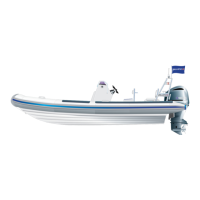
Describes the Ballistic 6.5 meter as an ideal family boat, emphasizing stability and performance.
Details how to open, close, and operate the boat's inflation valve.
Explains how to connect the pump to the valve and the inflation process.
Covers deck draining trunks and hull drain plugs for water removal.
Explains the operation and types of bilge pumps for removing bilge water.
Provides a list of essential checks before trailering the boat.
Offers advice and tips for successfully backing a trailer.
Details the duration of the warranty for different parts of the boat.
This document is the owner's manual for a Ballistic® 6.5 Metre Rigid Inflatable Boat (RIB), a vessel designed for both leisure and high-performance use. It serves as a comprehensive guide for safe operation, maintenance, and care, aiming to provide owners with the necessary information to maximize their enjoyment and ensure the longevity of their craft.
The manual begins with an introduction that congratulates the owner on their purchase and emphasizes the importance of understanding the boat's features and operational guidelines. It highlights that the Ballistic® RIB is a "pacesetter" in its category, known for its stability, safety, and speed across various conditions. Owners are encouraged to read the manual thoroughly and familiarize themselves with the craft before use, especially if they are new to this type of vessel. The document also stresses the owner's responsibilities for their own safety, that of passengers, and other water users, recommending boating safety courses and adherence to maritime rules.
A key section addresses the manufacturer's certification, stating that Ballistic® Boats adhere to guidelines established under the Federal Boat Safety Act, ensuring compliance with relevant laws. It strongly advises that all rigging, installation, and prep work be performed by an authorized Ballistic® distributor to maintain product integrity and warranty validity.
The "Design Category" section classifies the Ballistic® 6.5 Metre as a Category C – "INSHORE" craft. This means it is designed for voyages in coastal waters, large bays, estuaries, lakes, and rivers, where conditions up to and including wind force 6 and significant wave heights up to 2 meters may be experienced. It explicitly warns against operating the boat in severe weather conditions to prevent serious injury or death. The "CIN Serial Plate (EN ISO 10087)" information explains the importance of the Hull Identification Number (HIN) for identification and correspondence, noting its location on the transom and its permanent lamination inside the boat.
"General Safety Information" provides crucial guidelines for safe operation. It recommends that operators be over 18 years old with valid skipper's licenses and emphasizes the supervision of minors. Essential safety practices include always wearing an approved personal life jacket, adhering to all boating laws, and never operating under the influence of alcohol or drugs. The manual also details specific safety measures, such as switching off engines when swimmers are near, attaching the engine stop switch lanyard to oneself, and checking throttle, steering, and shift lever operation before starting. A comprehensive list of mandatory safety equipment for a Category C vessel is provided, including personal flotation devices, fire extinguishers, distress flares, sound signaling devices, a marine VHF radio, magnetic compass, navigation lights, mooring equipment, a capsize container, space blankets, a pump, a tube repair kit, a canvas, a bilge pump, a first aid kit, a tool kit, an oar or paddle, basic spares, a tow rope, and a market trailer and equipment.
The "Basic Boating Rules" section outlines international waterway rules, which are condensed for convenience. It defines "stand on vessel" (the vessel with the right of way) and "give way vessel" (the vessel that must yield), explaining their respective duties to avoid collision. Specific rules for "MEETING" (head-on approach), "CROSSING" (paths intersecting), and "OVERTAKING" (passing another vessel) situations are detailed, guiding operators on how to navigate safely in each scenario. "Other Special Situations" covers rules for "NARROW CHANNELS AND BENDS," "FISHING VESSEL RIGHT OF WAY," and "SAILING VESSEL RIGHT OF WAY," providing context for specific navigational challenges and priorities. An illustrative diagram helps explain buoy and channel markers, emphasizing the "Red, right, returning" principle for upstream travel. The manual also advises consulting local boating authorities for specific regulations and encourages additional training for all operators.
"ACCIDENT REPORTING" outlines the legal requirement for boat operators to file a report with state boating law enforcement agencies in cases of loss of life, personal injury requiring medical attention, significant property damage, or complete loss of a boat.
The "Boat Model" section describes the Ballistic® 6.5 Metre as "The Perfect Family RIB," highlighting its design ethos of stability, safety, and speed. It positions the 6.5 Metre as an ideal choice for families due to its cost-effectiveness, economical operation, easy storability, and towability by a standard family saloon car. The boat's performance and excitement are emphasized, suitable for various activities like relaxing, wakeboarding, snorkeling, or simply spending time with family and friends, with ample space for gear. It notes that the 6.5 Metre retains the exceptional handling characteristics of its larger 7.8 Metre sister, and its long-range fuel tank allows for adventurous trips. The high-performance deep V hull is designed for both leisure and high-speed cruising.
The "Inflation and deflation procedure" provides detailed instructions for maintaining the inflatable tubes. It explains that Ballistic® uses high-quality Italian valves designed for safety and comfort. The procedure for operating the valve—taking off the cap, opening by pushing and turning anti-clockwise, and closing by pushing and turning clockwise—is clearly described. For pumping, the manual instructs to connect the pump, turn clockwise, and inflate until firm, to a maximum of 0.3 Bar. It stresses the importance of inflating all chambers equally to prevent damage to bulkheads. A caution is included regarding over-inflation, which can cause structural damage, especially when the boat is exposed to direct sunlight out of the water. Recommended pressure values are given: 0.33 bar (4.8 PSI) maximum and 0.28 bar (4.1 PSI) minimum for the boat, 0.4 bar for the keel, and 0.8 bar for the high-pressure bottom. The deflation procedure involves removing the cap, pushing the plunger, and twisting it left to keep it open until the craft is deflated.
"Pressure relieve valves" explains that all Ballistic® vessels are fitted with these valves (unless otherwise specified) for peace of mind and problem-free boating. It's important to periodically check that these valves are not leaking and are functioning correctly. A critical warning states: "NEVER TRY TO USE PRESSURE RELIEF VALVES AS INFLATION / DEFLATION VALVES."
The "Draining" section covers three aspects: "DECK DRAINING TRUNKS," "BILGE PUMPS," and "HULL DRAINING PLUGS." Ballistic® Boats feature two 76mm flexible draining trunks that can be released via fixed transom cleats. Electric bilge pumps are used to remove water from the bilge, designed to be non-sparking, and fitted with float switches for automatic operation. A backup pump is recommended, with the primary at the lowest point and the secondary slightly higher. Ballistic® RIBs are standard-fitted with a minimum of one automatic 500 GPH electronic bilge pump. Hull draining plugs are located at the lowest point of the transom and should be periodically removed to empty water between the deck and hull. Owners are warned never to open the hull drain plug when on the water and to ensure it is closed before launching.
"Batteries" provides guidelines for battery installation and maintenance. Ballistic® RIBs (except 4.3 models) come with two batteries as standard. Owners are advised to use marine batteries with minimal maintenance. To reduce fire risk, batteries must be in a ventilated compartment separate from fuel tanks. They are placed in watertight boxes to protect terminals and prevent acid leakage. Periodic cleaning and lubrication of terminals are recommended. A battery switch is advisable for safety. Instructions for removing and mounting batteries (disconnecting negative then positive, and connecting positive then negative, respectively) are provided. When recharging, precautions against explosive gases, corrosive acids, and electrical currents are necessary. For storage, batteries should be removed, stored in a cool, dark place, cleaned with a baking soda and water mixture, and terminals lubricated. For longer storage, specific gravity should be checked monthly, and batteries recharged if low. A wiring diagram illustrates the electrical connections for various components like AM/FM radio, VHF, GPS, horn, anchor light, running light, and deck light, all connected to a switch panel, batteries, and an isolator.
"Engine installation" states that only Ballistic® registered distributors should perform engine installations. A "danger" warning highlights the risks of overpowering a boat, including severe handling/stability problems, excessive transom weight, and structural damage.
"Fuel Tanks" discusses fuel tank installation and refueling recommendations. Ballistic® RIBs from 6.0 to 7.8 meters are fitted with one or two standard stainless steel fuel tanks. For smaller crafts, portable tanks should be placed on a cushioning base and securely fastened. If portable tanks are in a closed compartment, it must be well-ventilated, free of electrical accessories, and isolated from ignition sources. Fixed tanks integrated into the hull should only be fitted by expert authorized personnel. Refueling recommendations include stopping the engine, turning ignition keys to OFF, removing portable tanks if possible, refueling in open, well-ventilated areas away from heat/sparks, not smoking, not overfilling tanks, securely tightening filler caps, seeking medical attention for accidental petrol ingestion/inhalation/eye contact, and washing skin if petrol spills. The manual stresses to "ONLY USE FRESH PETROL THAT HAS BEEN STORED IN CLEAN CONTAINERS!"
"Getting To Know Your Ballistic®" emphasizes that operating the boat requires acquired skills and practice. Owners should familiarize themselves with controls and safety information, ensuring they do not exceed allowed passenger numbers or total weight.
"Learning To Operate Your Ballistic®" advises performing pre-operation checks, learning in a wide, visible area with light boat traffic, and maintaining distance from other boats and swimmers. The engine stop switch lanyard must always be attached to the operator. All occupants must wear approved life jackets or flotation devices, and other protective apparel like water shoes, eye protection, and gloves are recommended for water sports. Operators should grip the wheel firmly and keep both feet on the deck. When passengers are on board, weight should be balanced, the operator's view should not be obstructed, and passengers must be seated, holding grips, and have both feet on the deck before acceleration.
"Crossing Waves" provides guidance on navigating rough water. It suggests that crossing waves or wakes with the least "jolt" involves adjusting speed and angle. Slower speeds and quartering the wave at an angle are generally effective. It notes that crossing groups of waves is harder than single waves, and quartering can cause the boat to steer away, requiring preparedness to adjust steering.
"Post operation checks" details the steps for post-use maintenance. After trailering, outboard motors should be flushed with fresh water to prevent clogging. The hull, deck, and tubes should be washed with fresh water, and hull drain plugs removed to allow water to drain from the bilge. The engine and bilge should be wiped dry. Metallic parts should be sprayed with rust inhibitor and lubricant, and stainless steel parts washed and buffed dry.
"How to maintain and clean your Ballistic® RIB" explains that cleaning is easy with the right tools and understanding. It notes that Hypalon and PVC require specific cleaners and techniques, warning that incorrect products will invalidate the warranty. Inflatable boats are more delicate than fiberglass or aluminum, so different cleaners are needed. Prohibited cleaning materials include MEK, toluene, acetone, bleach, ammonia, highly alkaline cleaners (PH > 11.5), abrasive scrub pads, or steel wool, as these can damage the fabric and adhesives. Soaps and detergents are discouraged due to sticky residue. The manual advises rinsing soil with cold water and storing the RIB clean and dry. After every trip, the boat and outboard motor should be rinsed with fresh water to remove salt residue. A soft sponge and marine soap (like Clean Green) should be used for the exterior, vinyl seats, deck boxes, and windshield. A biodegradable, PH-balanced marine soap and a medium-stiffness deck brush are recommended for the deck, fittings, hull, and outboard motor. The boat should be thoroughly dried with a soft cloth. Windows should be cleaned with a commercial solution or vinegar and water, and vinyl treated with a commercial vinyl treatment.
"Trailering" emphasizes using a trailer specifically manufactured for the Ballistic® to match its size and weight. The trailer hitch ball must match the coupler size, and the hitch must be rated for the same or higher gross trailer weight (GTW). Bolted or welded hitches are recommended over clamp-on bumper hitches. The hitch's release handle must be latched with a lock pin.
The "TRAILERING CHECKLIST" includes verifying compliance with state laws (license, brake, axle load, safety brake away cable), checking for loose fasteners, damaged parts, tire inflation, wheel bearings, and lug nuts. Tail, brake, and turn signal lights must be operational. The bow of the boat should be secured to the trailer with both the winch line and a separate bow tie-down. Stern cleats should also be secured. A spare wheel and tools are recommended. Wheel hubs should be checked for abnormal heat during travel. The light plug should be disconnected before backing the trailer into water.
"BACKING YOUR TRAILER" advises practicing in an open area, backing up slowly, making small steering adjustments, and turning the towing vehicle's wheels opposite the desired trailer direction. A second person can assist with hand signals.
"Launching your Ballistic®" recommends preparing the boat before using the ramp to be courteous to other boaters. Owners should observe others launching to identify potential problems. A general procedure includes performing pre-operation checks, removing tie-down lines, attaching docking lines and fenders, disconnecting trailer lights, backing the trailer down the ramp until wheels are halfway submerged, setting the parking brake, removing the bowline, backing further until fender tops show, resetting the parking brake, boarding the boat, starting it, warming engines on the trailer, and then backing into the water carefully.
"Loading" describes the process of getting the boat back onto the trailer. It involves disconnecting trailer lights, backing the trailer down the ramp until fender tops are about 3 inches above the waterline, and guiding the boat onto the support rails at the slowest idle speed. Excessive throttle should be avoided to prevent the boat from jumping over the front of the trailer. The boat should be centered on the support rails and headed straight for the bow stop. The winch line should be attached and tightened, but it is not designed to pull the boat onto the trailer and should not be the sole securing line. A separate bow tie-down line is also needed. After loading, the trailer should be pulled up the ramp, and bow and stern tie-downs reconnected, followed by the trailer lights.
The "Warranty" section explains that the Ballistic® comes with several warranties, with specific information found in the component manuals. Ballistic® Boats offers an express limited warranty against defects in materials or workmanship. The "PERIOD OF WARRANTY" states that the hull, deck, and tubes are warranted against major structural defects for five years in pleasure use or one year in commercial applications. All other components are warranted for one year in pleasure use or ninety days in commercial applications. The customer is responsible for proper operation, maintenance, and storage. The owner must notify an authorized distributor of defects within ten days of discovery and make the boat available for inspection and repairs. The warranty does not cover damage from abuse, neglect, racing, modification, abnormal strain, lack of proper maintenance, off-season storage, non-genuine parts, accidents, collisions, contact with foreign materials, submersion, marine organism growth, normal deterioration, or gel coat stress cracks.
"Customer Service" advises owners to take their Ballistic® to an authorized distributor for warranty service, bringing proof of purchase. For warranty questions or problems, the distributor should be contacted first. If further assistance is needed, completed warranty forms can be forwarded to brian@ballisticboats.co.za. The manual concludes with the important reminder: "** ALWAYS PRACTICE SAFE BOATING **".
 General
| Category | Boat |
|---|---|
| Length | 6.5 meters |
| Beam | 2.5 meters |
| Fuel Capacity | 200 liters |
| Material | Fiberglass |
| Engine | Single Outboard, 150-250 hp recommended |

 To Next Page