Need help?
Do you have a question about the Baofeng UV-5RIII and is the answer not in the manual?
Install the antenna by turning it clockwise until it stops, following the provided diagram.
Install the belt clip at the rear of the battery compartment cover as shown in the figure.
Plug the external micro-headset connector into the 'SP. & MIC' jack of the transceiver.
Align battery with guide rails and slide upwards until a 'click' is heard; ensure good contact.
Procedures for charging a new battery before first use and achieving maximum capacity.
Recommendations for optimal battery charging, handling, and replacement.
Strategies to maximize the lifespan and performance of the battery.
Guidelines for storing batteries properly to prevent damage and self-discharge.
A labeled diagram identifying the external parts and features of the radio.
Detailed explanation of the function and operation of each button and control on the transceiver.
Steps for turning the radio on/off and adjusting the volume level.
How to navigate and select desired frequencies or pre-stored channels.
Detailed explanation of each menu item and its available settings.
Steps for navigating and using the shortcut menu for quick access to settings.
Explanation of squelch function for muting background noise and setting sensitivity.
Description of the VOX feature for hands-free transmission activated by voice.
Guidance on selecting wide or narrow bandwidth for transmission to avoid interference.
Explanation of the TDR feature for simultaneously monitoring two frequencies.
Function to automatically control transmission time to prevent overheating.
Explanation of CTCSS/DCS tones for closed user group communication and squelch control.
Description of ANI, also known as PTT ID, for transmitting radio identification.
Configuration of DTMF tones for transmitting codes during transmission.
Methods for controlling scan resume behavior when a signal is detected.
Setting PTT-ID to transmit signal codes upon PTT press or release.
Function to prevent transmission on a busy channel to avoid disrupting other users.
Setting the direction of frequency shift for accessing amateur radio repeaters.
Adjusting frequency offset for repeater access based on input/output frequencies.
Function to activate or deactivate the transmission end tone.
Overall specifications including frequency range, memory channels, and operating conditions.
Specifications related to the radio's transmitting power, modulation, and emissions.
Specifications for the radio's receiving sensitivity, intermodulation, and audio output.
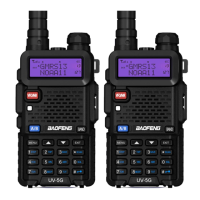
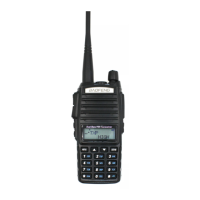
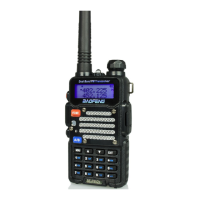
This document describes the Baofeng UV-5RIII Amateur Portable Radio, a dual-band, dual-display handheld transceiver designed for secure, instant, and reliable communications. It offers a comprehensive set of features for both basic and advanced operation, catering to a wide range of users from casual enthusiasts to those requiring more specialized functions.
The UV-5RIII is a versatile radio with a display function menu on its LCD. It supports dual-band operation and dual reception, allowing users to monitor two different frequencies simultaneously. The radio incorporates 105 "DCS" codes and 50 programmable "CTCSS" privacy codes, enabling closed user group communications by ensuring the squelch only opens when receiving signals with matching codes. This feature helps to avoid interference from other users on the same frequency.
A key function is "VOX" (Voice Operated Transmission), which allows for hands-free operation by automatically activating transmission when the user speaks into the microphone. The sensitivity of the VOX gain level can be adjusted to ensure smooth transmission. The radio also includes an alarm function for emergency situations.
For accessing repeaters, the UV-5RIII features a 1750 Hz tone. Users can transmit this tone by pressing and holding the PTT button and then the BAND button, which is essential for establishing long-distance communications through amateur radio repeaters. The "OFFSET" function allows for setting the frequency shift direction and value, crucial for repeater access.
The "PTT-ID" function, also known as Automatic Number Identification (ANI), transmits an ID code when the PTT button is pressed or released. This feature helps identify the transmitting radio, and its settings (BOT/EOT/BOTH) determine when the code is sent. The DTMFST (DTMF Tone of Transmitting Code) function allows for the transmission of DTMF tones, with options to hear or mute the tone during transmission.
The "BCLO" (Busy Channel Lockout) feature prevents accidental interference by disabling the transmitter if a strong signal is already present on the channel, especially useful in areas with multiple stations using different CTCSS or DCS codes.
The radio supports various frequency steps (2.5/5/6.25/10/12.5/25 kHz) and offers selectable broadband (Wide) or narrowband (Narrow) operation. Narrowband is particularly useful in areas with saturated RF signals to avoid interference in adjacent channels. Users can also select between high and low transmit power (5W/1W).
Scanning capabilities include memory channels, all bands, or parts of bands. The "SC-REV" (Scan Resume Method) offers different modes: "TO" (Time Operation) stops scanning for a predetermined time upon detecting an active signal, "CO" (Carrier Operation) stops and remains on the active frequency until the signal disappears, and "SE" (Search Operation) stops and remains on the active frequency after detection.
The "TOT" (Transmission Timer) function automatically controls the transmission time, preventing overheating of the transceiver's power transistors by cutting off transmission after a set duration.
The radio also includes a commercial FM radio receiver (65 MHz ~ 108 MHz) with a search function for FM radio stations. A built-in LED flashlight provides illumination, and a key lock function prevents accidental button presses.
The UV-5RIII is designed for ease of use with its display function menu on the LCD and a programmable keyboard. The knob on top controls both power ON/OFF and volume. The "VFO/MR" button allows switching between frequency mode and channel mode, while the "A/B" button switches the frequency display. The "BAND" button switches between different frequency bands, and when the FM radio is active, it switches between FM radio bands (65-75MHz/76-108MHz).
The keypad includes a "MENU" key for accessing and confirming settings, "▲" and "▼" keys for navigating frequencies/channels and menu parameters, and an "EXIT" key to cancel or clear inputs. Numeric keys are used for entering programming information and sending signal codes in transmission mode.
The "SK-SIDE KEY1/CALL" button activates/deactivates the FM Radio and the alarm function. The "SK-SIDE KEY2/MONI" button turns the flashlight ON/OFF and monitors signals. The "*SCAN" key activates the Reverse function (exchanging reception and transmission frequencies), initiates scanning, and searches for FM radio stations.
The radio features a "SAVE" function for battery saving and a "BEEP" function for keypad tones. The "Squelch" level is adjustable from 0 to 9, allowing users to control when the speaker mutes in the absence of reception, which also helps reduce battery consumption.
The display includes various icons to indicate activated features such as operating channel, CTCSS/DCS activation, frequency offset direction, Dual Watch/Dual Reception, VOX, Reverse function, Wide Band selection, Battery Level, Keypad lock, Low transmit power, Operation frequency, and Signal Strength Level.
Proper installation of accessories is crucial for the radio's performance and longevity. The antenna should be installed by holding its base and turning it clockwise until it stops, avoiding rotation by its top. If an external antenna is used, its SWR (Standing Wave Ratio) should be about 1.5:1 or less to prevent damage to the transceiver's final transistors. It is important never to transmit without an antenna.
The belt clip can be installed at the rear of the battery compartment cover. Users are advised not to use glue to fix the screw on the belt clip, as solvents in glue may damage the battery casing. An external micro-headset can be plugged into the "SP. & MIC" jack.
Battery installation involves aligning the battery with the guide rails on the aluminum chassis and sliding it upwards until a 'click' is heard, ensuring it is parallel and in good contact. For removal, the battery latch at the bottom of the radio's body should be slid in the indicated direction, and the battery slid down and off.
Battery charging should only be done with the manufacturer-specified charger. New batteries require an initial 5-hour charge, and maximum capacity is achieved after three full charge/discharge cycles. The charger's LED indicates the charging status (Standby, Charging, Fully Charged, Error). It's recommended to charge batteries at temperatures between 5°C and 40°C. The radio should be turned off when charging a battery attached to it to ensure a full charge. Wet batteries should be dried with a soft cloth before charging.
To prolong battery life, users should fully charge batteries before long-term storage and recharge Li-Ion batteries after several months to prevent over-discharge. Batteries should be stored in a cool, dry place at room temperature. Dust on battery contacts should be wiped with a clean, dry cloth to ensure proper function and charging.
The manual also provides troubleshooting tips for common issues such as the radio not starting, quick battery drain, no sound from the speaker despite the LED lighting up, communication problems, and unintended transmissions. These tips guide users through basic checks like battery status, volume settings, CTCSS/DCS codes, and VOX sensitivity. For persistent problems, users are advised to contact their distributor, dealer, or service center.
The device is covered by a TWO-YEAR warranty from the date of sale, provided the Warranty Certificate is properly filled out and accompanied by proof of purchase. The warranty covers defective materials and components but excludes faults caused by accident, improper installation, electric shock, or deterioration in external appearance from normal use. Rechargeable batteries are considered consumables and are not covered by the warranty after 15 days from purchase. The warranty is void if the device has been tampered with, if the serial number is altered, or if the product is not used as intended.
 General
| Battery Capacity | 1800 mAh |
|---|---|
| Battery Type | Li-ion |
| Channel Capacity | 128 channels |
| Modulation | FM |
| Display | LCD |
| Operating Voltage | 7.4V |
| Antenna Connector | SMA-Female |
| Operating Temperature | -20°C to +60°C |
| CTCSS/DCS | Yes |
| FM Radio | Yes |
| Frequency Range | 136-174 MHz |
| Dimensions | 110 x 58 x 32 mm |
| Antenna Impedance | 50Ω |
| Channel Spacing | 12.5 / 25 kHz |

 To Next Page