2. Now look through the nder scope. If the object seen through the
telescope is not visible, then release the adjusting screws and move
the nder scope until the object can be seen. Now retighten the
adjusting screw while ensuring that the object remains visible in the
centre or the nder scope. To simplify this procedure use the
adjusting screws to adjust the object in the centre. The nder scope
will move in the direction of the screw in which it is being turned.
All screws can be nally tightened as soon as the setting with the
eyepiece coincides with that of the nder scope.
WHICH MAGNIFICATION? SELECTING THE CORRECT EYEPIECE
Magnication denes the power of a telescope to enlarge an image or to ‘pull it
in’ closer for viewing.
Example:
700mrn focal length = 56 x magnication
12.5mm focal length of eyepiece
The required magnication depends upon the object being observed. The
following general guideline is recommended for this purpose: Ideal viewing
conditions are obtained if the magnication is not more than 15x - 20x the
diameter of the objective lens, i.e. an optimal magnication of 100x - 125x can be
expected with 60 mm diameter objective lens to obser ve most celestial objects. A
lower magnication power is advisable for the observation of stars.
The eld of view is wider so that the object for observation is more easily
localized. The highest magnication power should only be used for particularly
clear observations of the moon an object that is relatively close and exceptionally
bright, so that good detail resolution is achieved at high magnication ratios.
Barlow Lens:
The Barlow lens increases the magnication of the telescope. A 3x Barlow
lens will therefore triple the telescope’s magnication power. Consequently a
56x magnication can be tripled to 168x with a 3x Barlow lens. The highest
magnication power of the Barlow lens should only be used for large and bright
objects such as the moon and the brightest planets, as well as for nights with
optimal observation conditions.
Do not use the Barlow lens and the erecting eyepiece in conjunction with the
angle prism as this produces a particularly low resolution level with the result
that the image can no lon ger be sharply focuses. To use the Barlow lens take the
angle prism out of the tube. Insert the Barlow lens into the focus tube and then
attach the required eyepiece to the Barlow lens, focusing is then completed in the
customary manner.
VERY IMPORTANT GENERAL REMARKS
CAUTION
TO AVOID EYE DAMAGE NEVER LOOK THROUGH THE TELESCOPE INTO
ANOTHER OPTICAL INSTRUMENT, INTO THE SUN OR A LIGHT SOURCE.
NEVER LEAVE THE TELESCOPE UNATTENDED, A CHILD COULD LOOK AT
THE SUN WITH IT AND SUFFER PERMANENT EYE DAMAGE.
Avoid sudden temperature uctuations as the moisture in the air will condense on
the objective lens. Should this happen, then place the objective lens not too close
to a source of heat and allow the moisture to evaporate slowly.
When mounting the parts ensure that the securing screws are not tightened too
rmly. This could damage the parts or the internal thread of the holders with the
result that the screws can no longer be tightened.
www.barska.com
6 7
www.barska.com
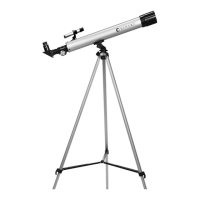
450 Power, 60050 Starwatcher Telescope 450 Power, 60050 Starwatcher Telescope


 To Previous Page
 Loading...