10
FIGURE 15. IMPEDANCE RELAY, LOOKING FOR
REMOTE LINE FAULTS.
Reverse Power Protection
The reverse-power relay (32) in Fig. 16 senses
real power flow into the generator, which will
occur if the generator loses its prime-mover
input. Since the generator is not faulted, CTs on
either side of the generator would provide the
same measured current.
FIGURE 16. ANTI-MOTORING (32), LOSS-OF-FIELD
(40), PROTECTION.
In a steam-turbine, the low pressure blades will
overheat with the lack of steam flow. Diesel and
gas-turbine units draw large amounts of motoring
power, with possible mechanical problems. In the
case of diesels, the hazard of a fire and/or
explosion may occur due to unburnt fuel. There-
fore, anti-motoring protection is recommended
whenever the unit may be connected to a source
of motoring power. Where a non-electrical type of
protection is in use, as may be the case with a
steam turbine unit, the 32 relay provides a
means of supervising this condition to prevent
opening the generator breaker before the prime
mover has shut down. Time delay should be set
for about 5-30 seconds, providing enough time
for the controls to pick up load upon synchroniz-
ing when the generator is initially slower than the
system.
Since motoring can occur during a large
reactive-power flow, the real power component
needs to be measured at low power factors. The
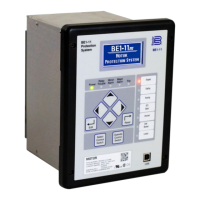
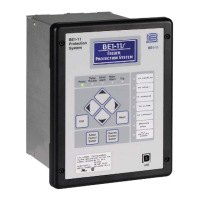
BE1-32R measures real power down to 0.1 pf.
The BE1-951, BE1-1051, and BE1-GPS measure
real power down to below 0.01 pf, depending on
current magnitude.
Fig. 17 shows the use of two reverse-power
relays: 32-1 and 32-2. The 32-1 relay supervises
the generator tripping of devices that can wait
until the unit begins to motor. Overspeeding on
large steam-turbine units can be prevented by
delaying main and field breaker tripping until
motoring occurs for non-electrical and selected
electrical conditions (e.g., loss-of-field and
overtemperature). Relay 32-1 should be delayed
maybe 3 seconds, while relay 32-2 should be
delayed by maybe 20 seconds. Time delay
would be based on generator response during
generator power swings. Relay 32-2 trips directly
for cases of motoring that were not initiated by
lockout relay 86NE — e.g., governor control
malfunction.
FIGURE 17. REVERSE-POWER RELAY 32-1 PREVENTS
LOAD REJECTION BEFORE PRIME MOVER
SHUTDOWN FOR SELECTED TRIPS; RELAY 32-2
OPERATES IF MOTORING IS NOT ACCOMPANIED BY
AN 86NE OPERATION.
Loss-of-Field Protection
Loss of excitation can, to some extent, be
sensed within the excitation system itself by



 To Next Page
 Loading...