
 Need help?
Do you have a question about the Battenfeld UNIROB R10S and is the answer not in the manual?
Manual scope, intended use, and safety precautions for robot system operation.
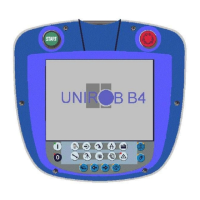
Explains the function of ON/OFF, START/STOP, and INIT buttons on the MCD.
Details the functions of PROG, ROB, SERVICE, PERIPHERY, Move, and PAL buttons on the MCD.
Explains Previous menus, ERROR, Gripper, IMM, BLOCK/MAN, and AUTO/SINGLE buttons on the MCD.
Explains user levels, page numbering, and page indicators on the screen interface.
Describes status bar, PIC to DISK, ERROR symbol, time/date, operating mode, and function keys.
Details the password system and the initial startup display for menu navigation.
Covers sequential programming aspects and how to view robot status.
Describes status pages for grippers, palletising programs, and the alarm list.
Explains how to enter numeric values using the keypad and screen elements.
Details the process and keys for entering alphanumeric data via the keypad.
Describes alphanumeric entry for editors like CNC, including navigation.
Explains symbols for object status and the functions of touch keys on the control system.
Introduces general menu pages and the login process for system access.
Details different user levels, the password system, and the notepad function.
Explains how to set language, date, and time on the control system.
Covers unit settings, touch screen calibration, logout procedure, and operating hours counter.
Describes how to enter and manage job-related data for production.
Explains how to print jobs, programs, and other system information.
Details printout contents, targets (serial printer, USB), and file output options.
Explains data manager functions for saving, loading, and deleting data sets.
Details how to select, save, and reload individual user data sets.
Covers service-specific data and selecting data sources like Harddisk or Floppy.
Displays the current position and movement status of individual NC axes.
Explains axis group selection and how to set axis override values.
Details manual control of NC axes using MCD buttons and deadman's button.
How to select and check position variables in manual mode.
Procedures for canceling, changing, and loading position variables.
How to change position variables while the system is in automatic mode.
Step-by-step guide to selecting, selecting axis, and adjusting position variable values.
Displays and allows modification of user variable status and values.
How to select and deselect user variables from the list.
Shows the status of pneumatic axes and allows switching between axis groups.
Details current/desired positions, override, and axis configurations for pneumatic systems.
Displays gripper statuses and allows switching between axis groups for grippers.
Explains gripper functions, manual control, and monitoring status for grippers.
Shows the status of the IMM interface, displaying digital inputs/outputs.
Describes signals between IMM and robot, and operating the machine without a robot.
Displays the status of the periphery interface, showing digital inputs.
Details digital outputs of the periphery interface and configuration options.
Shows the status of the conveyor interface and allows activation of forward movement.
Displays the status of palletising programs used in the sequential program.
Explains parameters like PalProg end, total quantity, reset, current/desired quantities and positions.
Introduces ROB, Gripper, IMM, and PCS token command categories for program creation.
Details Periphery, Palletise, Subprograms, Teach/Edit, Program Line, and softkey functions.
Guides on inserting axis movement commands using the ROB softkey.
Explains how to select axes and motion types (absolute, relative) for token commands.
Details setting parameters like current/desired positions and speed/acceleration for axis commands.
Covers entering values, speed/acceleration, and using position variables for axis commands.
Lists and explains various ROB token commands for servo motor axis movements.
Details commands for stack stop, specifying axis speed, and acceleration.
Explains commands for simultaneous movement of multiple axes in 3D space.
Lists possible combinations and options for creating 3D movement commands.
Guides on selecting and changing position variables for axis movement commands.
Details the process of creating, editing, and deleting position variables.
Provides tips and notes on using position variables effectively and safely.
Explains commands for controlling pneumatic axes in basic and parallel positions.
Details moving pneumatic axes in Teach mode, similar to NC axes.
Introduces Gripper (GRP) token commands and related terms like LowActive/HighActive.
Explains the LowActive and HighActive states for part monitoring in gripper commands.
Details how to activate gripper functions like blow out and vacuum, including related commands.
Explains commands for monitoring vacuum status during STOP, PSTOP, and Label TEST.
Covers monitoring gripper status and controlling program flow based on monitored conditions.
Explains gripper commands that jump to labels based on signals and monitor OFF states.
Details token commands for controlling the IMM interface and robot/injection moulding machine interaction.
Explains signals from IMM to robot regarding mould open/closed status for safe operation.
Describes signals from IMM to robot concerning ejector forward/back status for safe part handling.
Explains signals related to fully automatic mode and core puller status for efficient cycle times.
Covers signals for core puller removal and handling defective castings.
Details signals for intermediate stops, enabling faster removal times.
Introduces PCS commands for jumps, delays, and IF conditions, with details on delay commands.
Covers Goto, Label, program calls, and user variable manipulation commands.
Explains commands for PStop, Stop program, and End program control flow.
Guides on creating and editing user variables within commands in the program editor.
Details operations for user variables (New, Edit, Delete, OK) and entering IF commands.
Explains Type 1 options (Uservar, Position, Palletise) and equation formats for IF commands.
Lists comparison operators (<=, >=) and checks for EVEN/ODD numbers in IF commands.
Explains Type 2 options (Constants, Uservar) and palletising conditions for IF commands.
Describes guided data input for IF commands using position variables.
Provides an example of an IF command checking Z-axis position against a label.
Introduces the periphery interface for controlling application peripherals via digital I/O.
Details commands for digital inputs (wait, if) and outputs (SET, RST) for peripheral control.
Explains commands for controlling conveyor status (ON/OFF, timed) and input signals.
Describes monitoring WaCON signals and timed operations for the conveyor interface.
Details monitoring positioning signals for conveyor space free/occupied status.
Explains label jumps based on conveyor status and IMM protective grating signals.
Details specific digital inputs (key switch, start cycle) and outputs (robot position) for periphery control.
Introduces the palletising function and its basic input parameters like position and difference.
Explains commands to start and reset palletising programs, including counter zeroing.
Guides on creating, selecting, editing, and entering data for palletising programs.
Details entering first/last positions, quantity, and difference for palletising.
Explains parameter entry and moving axes in teach mode for palletising.
Details parameters like position, difference, quantity, and approach sequences for palletising.
Specifies the order of axis movements for part delivery and removal in palletising.
Covers additional parameters for palletising, accessed via the 'More' softkey.
Explains Pal offset, Approach offset, intermediate layers, and stack sensor usage.
Guides on creating and managing main, subprogram, and parallel programs.
Covers project deletion, editor deletion, and selecting subprograms/parallel programs.
Explains how to select and edit CNC programs using the NC editor.
Describes how to call CNC programs from the main program, similar to subprograms.
Illustrates a standard program for removing parts and positioning them.
Shows a palletising program example, including its structure and a subprogram.
Provides examples of workpiece dimensions, crate positioning, and PalStat data.
Offers notes on PalStat data display and guidance on operating new programs.
Explains the purpose of lock areas for software backup and preventing robot entry into hazardous zones.
Illustrates lock area coordinates and defines minimum/maximum positions for axes.
Guides on entering lock area values and activating/deactivating them.
Details how to view and set lock area positions using Teach or Edit modes.
Explains direct entry of position values and accepting them in Teach or Edit modes.
Provides instructions on saving lock area changes and notes on their persistence.
Covers setting up protection areas, potentially using gripper dimensions.
Guides on configuring pneumatic axes, including status and type settings.
Defines types of pneumatic axes based on sensors and digital I/O.
Details how to configure grippers, including number, type, and labels.
Lists and describes different gripper types by their sensors and I/O configurations.
Allows changing labels and digital input types for the periphery interface.
Explains standard and latch digital input types and their behavior.
Introduces the alarm list, logbook, and error categories like controller and CNC errors.
Guides on acknowledging errors and navigating the alarm list using softkeys.
Details the logbook function for tracking user activities and system changes.
Shows the format and content of alarm protocol entries, displaying recent errors.
Lists general controller and CNC errors that occur during automatic mode operation.
Provides descriptions for various emergency stop error messages and their remedies.
Details errors related to system status (power, robotless op) and various emergency stop activations.
Covers errors from manual intervention, service doors, robot referencing, and duplicate labels.
Addresses errors related to identical labels and missing Goto labels in programs.
Details errors for commands not found or object indices missing in various program types.
Covers errors related to missing object indices and limitations in parallel movement commands.
Addresses parallel movement errors and issues with interrupted emergency stop signals.
Covers errors related to protective gratings, software limits, palletising parameters, and limit switches.
Details errors related to part monitors, axis positions, compressed air, and conveyor status.
Covers errors from conveyor full, program stops, lock area deactivation/activation, and incorrect input values.
Details errors related to missing mould areas, service parameters, controller readiness, CNC, and language.
Covers errors for full program memory and instructions for changing the controller battery.
Details errors related to password levels, printer issues, and various internal system errors.
Covers errors related to communication, IMM link, CAN bus, memory, robot configuration, and I/O modules.
 General
| Payload | 10 kg |
|---|---|
| Protection class | IP54 |
| Application | Handling |
| Interface | Digital I/O |
| Power supply | 400 V, 50/60 Hz |

 To Next Page
