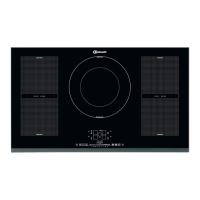
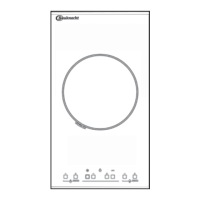
This document describes the Bauknecht CTAI6360IN induction hob, a domestic appliance designed for cooking. It emphasizes safety, proper usage, and maintenance to ensure optimal performance and longevity.
Function Description:
The Bauknecht CTAI6360IN is an induction hob equipped with multiple cooking zones, each with adjustable heat settings from "1" (minimum) to "9" (maximum). Some cooking zones also feature a "Booster" (P) function for rapid heating, allowing users to quickly bring water to a boil. The hob is controlled via a touch-sensitive panel with indicators for heat settings, a timer, and a key lock.
Key functions include:
- On/Off: The hob is switched on by pressing the power button for approximately 2 seconds until the cooking zone displays light up. To switch off, the same button is pressed until all displays turn off.
- Heat Setting Adjustment: After switching on and placing a pot on the chosen cooking zone, heat settings are adjusted using the "+" and "-" buttons. The display shows "0" when switched on, and can be adjusted up to "9" or "P" for Booster.
- Booster Function (Fast Boil): Available on some cooking zones, this function provides maximum power for rapid heating. It can be activated by pressing "+" until "P" appears, or by pressing "-" after switching the hob on. After 10 minutes, the Booster automatically sets the zone to level 9.
- Switching Off Cooking Zones: Individual cooking zones can be turned off by selecting the zone (a dot lights up) and pressing "-" until the level shows "0". Alternatively, pressing "+" and "-" simultaneously will switch off the zone.
- Timer Function: The hob features a timer that can be set for a maximum of 99 minutes (1 hour and 39 minutes) for one cooking zone at a time. To set, select the desired cooking zone, then use the timer's "+" and "-" buttons. The timer begins countdown a few seconds after setting, indicated by a flashing dot. An acoustic signal sounds and the zone switches off automatically when the time elapses. To deactivate, press "-" until "0:0" is displayed, or press "+" and "-" simultaneously.
- Minute Minder: This function, usable only when the hob is off, allows setting a countdown up to 99 minutes. Press "+" below the timer indicators, then adjust with "+" and "-". An acoustic signal sounds when the time is up. If the hob is switched on while the minute minder is active, the countdown is automatically cancelled.
- Child Lock: This safety feature locks the hob controls to prevent accidental activation. To activate, switch on the hob, then press and hold the key lock button for three seconds. An acoustic signal and a luminous indicator confirm activation. The control panel is locked except for the OFF function. To unlock, repeat the procedure.
- Automatic Pot Detection: The hob automatically detects pots on all cooking zones. If no pot is detected, the power level indicator for that zone flashes.
Important Technical Specifications:
While specific power ratings are not detailed in the provided text, the document implies standard induction hob operation.
- Residual Heat Indicator (H): Displays "H" when a cooking zone's temperature is above 60 °C, indicating residual heat. This serves as a safety warning and allows the zone to be used for keeping food warm or melting butter.
- Thermoprotector: The hob is equipped with an internal thermoprotector to prevent damage from high external heat sources (e.g., an undercounter oven). If electronic circuit temperatures exceed a safety threshold, the thermoprotector activates, switching off the hob and displaying an error message. The hob can be switched on again once temperatures return to normal.
- Automatic Shut-off: If no function is selected within 10 seconds of switching on, the hob automatically switches off.
- Recommended Pot Diameters: The manual provides a table with recommended pot bottom diameters for different cooking zones (XL: 28 cm; M: 17-26 cm; L: 21 cm; S: 14-21 cm; S: 9-14.5 cm).
- Compliance: The hob complies with all applicable safety and electromagnetic compatibility legislation, European Directive 2002/96/EC on Waste Electrical and Electronic Equipment (WEEE), EEC (CE) regulation n. 1935/2004 for contact with foodstuffs, Low Voltage Directive 2006/95/CE, EMC Directive 89/336/EEC, and Directive 93/68/EEC.
Usage Features:
- Induction System Compatibility: Only pots and pans bearing the "INDUCTION SYSTEM" symbol are suitable. A magnet can be used to check compatibility; if a pot is not magnetically detected, it is unsuitable.
- Pot Requirements: Pots must have a smooth bottom to prevent scratching the glass ceramic surface. Empty pots, especially enamelled or aluminium ones, should not be used to avoid damage to both the hob and the pots. Hot pots should never be placed on the control panel.
- Safety Precautions:
- Individuals with heart pacemakers should maintain a safe distance from the appliance.
- Keep children away from hot cooking zones to prevent scalding or burns.
- Do not touch cooking zones or place objects on them while the "H" indicator is lit.
- If the hob surface is damaged (cracked/broken glass), discontinue use and contact After-sales Service.
- Ensure cooking zones and pot bottoms are dry before use.
- Do not place metal objects (knives, forks, spoons, lids) on cooking zones as they can become very hot.
- Exercise extreme vigilance when cooking with boiling oil or fat due to fire risk. In case of oil fire, never use water; switch off the hob, cover the pot with a lid, and let it cool.
- Press the power button after cooking to switch off the hob.
- Energy Saving Tips: Use pots with bottom diameters equal to the cooking zone, flat-bottomed pots, and keep lids on when cooking. Use minimal water for vegetables and potatoes, and consider a pressure cooker. Place pots centrally on the cooking zone.
Maintenance Features:
- Cleaning: Clean the hob after each use to prevent damage and baked-on deposits. Ensure cooking zones are off and the "H" indicator is not displayed before cleaning.
- Use a soft, clean cloth, absorbent kitchen wipes, or a proprietary cleaner for glass ceramic hobs. Avoid abrasive sponges or metal scouring pads.
- Clean food spills immediately, especially sugar and high-sugar content foods, using a scraper for glass.
- Remove stubborn residues with a scraper or proprietary detergents.
- Immediately clean up salt, sugar, and sand spills to prevent scratching.
- Never clean the hob with a steam cleaner.
- Dust Check: Periodically check for dust under the appliance, near the cooling air inlet or outlet openings. Dust accumulation can hinder ventilation and cooling of the electronic module, reducing hob effectiveness.
- Troubleshooting Guide: The manual provides a table of error codes (e.g., C81, C82, F42, F43, F12, F21, F25, F36, F37, F40, F47, F56, F58, F60) with descriptions, possible causes, and remedies.
- Common issues include continuous pressure on the control panel (water or utensils), excessively high internal temperatures, and incorrect connection voltage.
- If the hob cannot be turned off, disconnect it from the power supply immediately.
- After-Sales Service: Before contacting service, users are advised to troubleshoot using the manual, switch the appliance off for 30 seconds, and then restart. If the fault persists, contact an authorized After-sales Service, providing a description of the fault, exact type and model, service number (found on the rating plate or warranty booklet), and complete address and phone number.
- Disposal: Packaging materials are 100% recyclable. The appliance itself is marked for compliance with European Directive 2002/96/EC (WEEE) and should be delivered to the nearest collection centre for recycling to prevent environmental and health damage. Disposal must follow local environmental regulations.

 Need help?

 To Next Page
 General