
 Need help?
Do you have a question about the Baylan BT.11 and is the answer not in the manual?
Specifies the model designation of the electricity meter.
Indicates the type of electricity meter, e.g., 3-Phase, 4-Wire.
Defines the meter's accuracy class rating.
Details the method of electrical connection.
Specifies the rated operating voltage of the meter.
Defines the acceptable range of operating voltages.
Indicates the standard operating frequency.
Specifies the minimum current for meter operation.
Defines the minimum current threshold for measurement.
Specifies the rated current of the meter.
Defines the maximum current the meter can handle.
Specifies the Ingress Protection level.
Indicates the electrical safety protection class.
Specifies the acceptable humidity range.
Defines the acceptable operating temperature range.
Lists the relevant industry standards the meter complies with.
Indicates errors related to the Real-Time Clock.
Shows when the meter's internal battery is low.
Displays tariff slice information.
Shows energized phases and current directions.
Indicates that demand information is displayed.
Displays the units for the meter readings.
Configurable time zones and tariffs for different day types.
Automatic implementation of daylight saving time.
Records events like top cover or terminal cover opening.
Records start and end times of magnetic interference.
Optional recording of load profiles at set intervals.
Records voltage connection faults and power interruptions.
Displays key information like date, time, and total consumption.
Shows energy consumption for each tariff period.
Displays maximum demand values and their timestamps.
Identification of the manufacturer, address, and product type.
Details of the EU type approval certificate and notified bodies.
Lists directives, standards, place, and date of declaration.
Displays meter's serial number and software version.
Records dates and times of top and terminal cover openings.
Displays instantaneous voltage and current for each phase.
Shows instantaneous frequency and active power.
Emphasizes cutting power before assembly and disassembly.
Details phase and neutral connection procedures.
Explains how the meter indicates phase sequence faults.
Specifies the 5-year warranty period and product coverage.
Outlines consumer rights in case of defective products.
Lists conditions not covered by the warranty, like misuse or accidents.
Defines the maximum repair time and procedures.
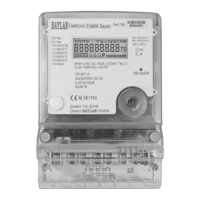
This document describes the BAYLAN BT.10 and BT.11 Three Phase Active Electronic Electricity Meters, designed for measuring electricity consumption in a 3-phase, 4-wire network.
The BAYLAN BT.10 and BT.11 meters are advanced electronic devices engineered to accurately measure active energy consumption. They are capable of operating within a wide voltage range and are designed for direct connection. These meters are equipped with an LCD display that provides comprehensive information about electricity usage, system status, and various parameters. They support multi-tariff functionality, allowing for different energy consumption rates to be applied at various times of the day or week, including weekdays, Saturdays, Sundays, and public holidays. The meters incorporate an automatic daylight saving implementation, adjusting their internal clock as needed.
A key feature of these meters is their robust data logging capabilities. They record various events and parameters to ensure transparency and accountability. This includes logging the opening dates and times of the top cover and terminal cover, with the terminal cover opening events recorded monthly for the last 12 months. The meters also detect and record instances of magnetic tampering, noting the start and end times of such interventions. Energy consumption for each tariff, maximum demand, and the date and time of the demand are stored for the last 12 months. For detailed analysis, the meters can record 8-channel load profiles at 15-minute intervals for up to 180 days (optional feature). Furthermore, they log the last 10 occurrences of voltage and current connection faults, as well as the start and end dates of the last 99 short and long power cuts.
The meters provide real-time information on the LCD, including date, time, total energy consumption, and consumption for each tariff (T1, T2, T3, T4). They also display instantaneous voltage for each phase, instantaneous current for each phase, instantaneous frequency, and instantaneous active power. Communication interfaces, such as optical and RS485 ports, enable external reading of all recorded data and parameters.
The meters are designed for user-friendly operation and clear information display. Upon powering up, the main information is displayed sequentially with 5-second intervals. Users can quickly cycle through the information by pressing a button. A 5-second press of the button will switch the screen to a sub-menu for more detailed information. If the button is not pressed for 30 seconds, or if it's pressed for 5 seconds to return from a sub-menu, the display reverts to the main menu. During power cuts, pressing the button allows users to view information on the screen, with each press showing the next piece of data.
The LCD display includes several indicators to provide immediate feedback on the meter's status. A flashing "RTC Error" indicates an internal clock error. If the top cover is opened, a corresponding symbol will flash on the screen, persisting under any circumstances. Similarly, if the terminal cover is open, a symbol will be continuously displayed; if it's flashing, it means the terminal cover has been opened and closed previously. Blinking during magnetic intervention indicates an ongoing magnetic interference, while a continuous display signifies that magnetic interference has occurred before. A "Low battery" indicator signals a low internal battery, and an "RTC battery low" indicator specifically points to a low battery for the real-time clock. A communication symbol becomes visible during active communication. Tariff slices (T1, T2, T3, T4) are clearly indicated, and the display shows which tariff consumption information is currently available. Symbols for L1, L2, L3 indicate the energized phases and current directions, while "P" signifies that demand information is being displayed. Units such as Hz, VA, kWh are also shown.
Installation requires careful attention to safety and proper connection. Energy must be cut off before assembling or disassembling the meter. Phase and neutral connections must follow the provided wiring diagram, ensuring cable ends are properly opened, screws are tight enough to prevent damage to conductors, and there are no faulty connections. The meter terminal cover must close without tension. The meter begins operation and displays information only after proper installation and energization. Flashing L1L2L3 symbols indicate a phase sequence fault, and a lock symbol appearing on the display signifies an incorrectly installed terminal cover.
The BAYLAN BT.10 and BT.11 meters are designed for minimal user maintenance. Calibration and programming are performed during manufacturing, and no user-level maintenance or programming is required or possible after purchase. The outer surface of the meter should only be cleaned with non-abrasive cleaning agents.
The meters are built with robust self-diagnostic and logging capabilities that contribute to their long-term reliability and ease of service. They automatically record critical events such as cover openings, magnetic tampering, and power cuts, which can be invaluable for troubleshooting and warranty claims. The internal battery for the real-time clock has a life of at least 10 years, with a 4-year replacement period, ensuring accurate timekeeping over an extended period. The RTC accuracy is specified as less than 0.5 seconds per day.
In case of a defective meter, the warranty conditions outline the consumer's rights, including free repair, reduction from sales price, or replacement. Repairs are handled by authorized service stations, and the repair period is limited to 20 business days. If a malfunction cannot be fixed within 10 working days, a similar product must be provided to the customer for use until the repair is complete. Defects arising from unauthorized use are not covered by the guarantee. The meters comply with international standards such as EN 50470-1 and EN 50470-3, ensuring their quality and reliability.
 General
| MID Approval | Yes |
|---|---|
| Maximum Working Pressure | 16 bar |
| Body Material | Brass |
| Nominal Flow Rate (Qn) | 1.5 m³/h |
| Maximum Flow Rate (Qmax) | 3 m³/h |
| Minimum Flow Rate (Qmin) | 0.03 m³/h |
| Transitional Flow Rate (Qt) | 0.06 m³/h |
| Pulse Output | Optional |
| Power Supply | Battery (Lithium) |

 To Next Page
