14
This is a basic introduction to avalanche rescue techniques. On our website, you will also find a
listofavalancheinstructors.Westronglysuggesttakinganavalanchecourseinyourareabefore
venturing into the backcountry. Each person needs a working beacon, probe and shovel—and must
know how to use them. Before leaving, call your local avalanche forecast center and determine the
danger level in the area you intend to visit:
US: www.avalanche.org Canada: www.avalanche.ca Europe: www.lawinen.org
Searching for victims
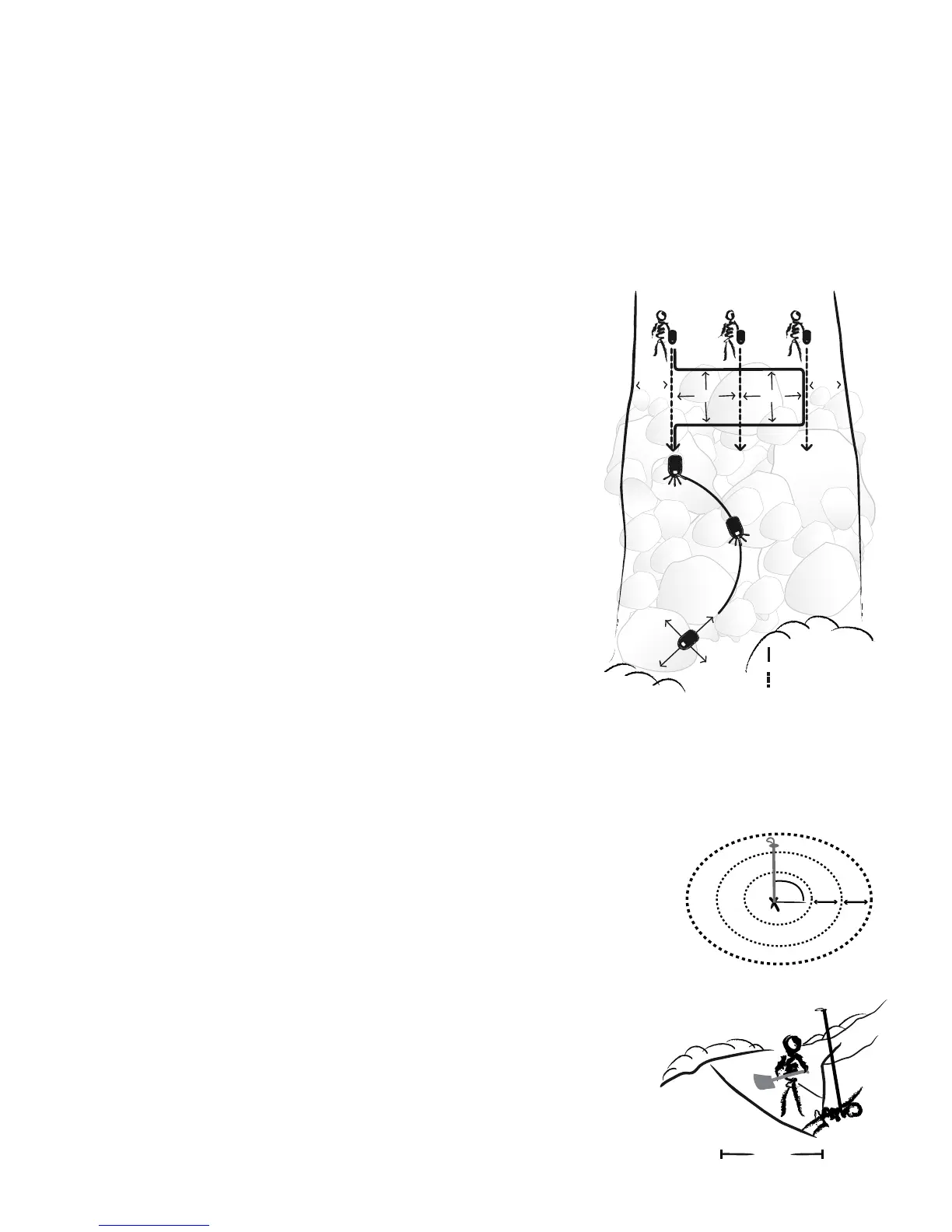
If a member of your group is buried, you must perform a beacon
search. The objective is to find the strongest signal (lowest
distance reading) and immediately begin probing the area. In the
event of a burial, switch all avalanche beacons to search mode.
The guidelines below assume the use of a digital beacon.
Signal search: If there is a “last seen point,” start your signal
search there. Otherwise, start your signal search at the top,
bottom or side of the slide path. See diagram on right to
establish a search pattern.
Coarse search: Once a signal is engaged, align your beacon
so that any of the center three lights are flashing and move
quickly in the direction it is pointing. Make sure the number in
thedistancedisplayisdecreasing.Ifitisincreasing,turn180
degrees. Inside ten meters, move slowly and try to keep the center search light engaged.
Fine search: Withinthreemeters,useyourbeaconascloseaspossibletothesnowsurfaceand
look for the smallest distance reading. Confirm by “bracketing” in the perpendicular direction.
Probing/Pinpointing: At the point where the distance has reached a
minimum, probe the area in concentric circles, with each probe hole about
10inches(25cm)apart.Yourprobeshouldenterthesnowperpendicularto
the slope. Once you have confirmed the victim’s location, leave the probe
in the snow.
Shoveling: Whileshovelingmightseemelementary,itusuallyconsumes
the majority of time during an avalanche beacon rescue. For best
results, start shoveling just downhill of the probe. Make your hole
one “wingspan” wide. In burials deeper than one meter, excavate
downhillabout1.5timestheburialdepth.Formoreadvancedshoveling
techniques,seeourwebsite:www.backcountryaccess.com/shoveling.
avalanche path
20m20m
single searcher
search path
multiple searchers
search paths
40m
40m
˚
˝ ˝
CM CM
1.5 x
burial depth
Avalanche Rescue


 To Next Page
 Loading...