6
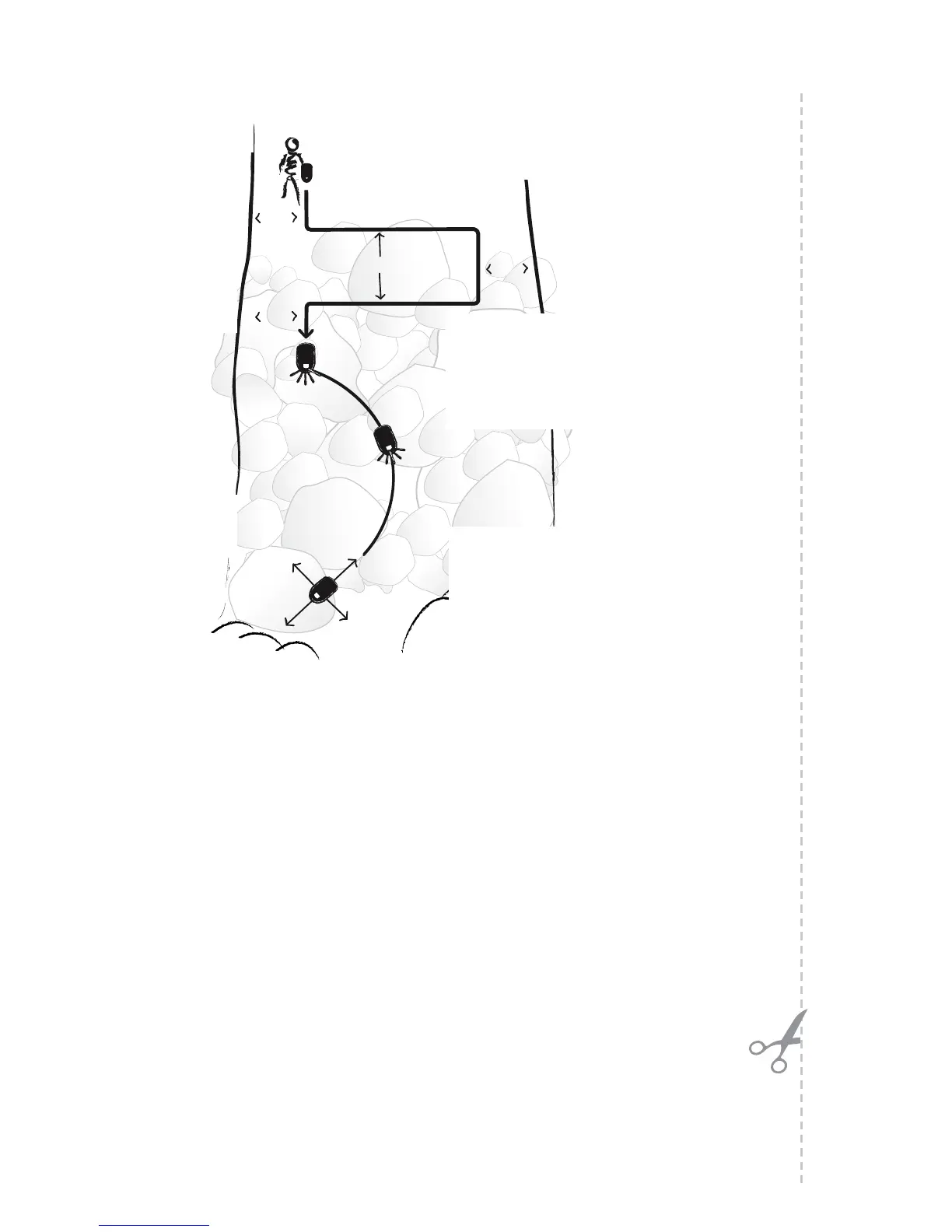
20m
20m
20m
avalanche path
40m
Objective: Locate signal
•Ifno"lastseenpoint,"searchentirepath
•RotateTrackerhorizontally
•Max40mbetweensearchersorswitchbacks
Objective: Locate smallest distance reading
(strongest signal)
•UseTrackerclosetosnowsurface
•Ignorefluctuationsindistanceanddirection
•Beginprobingatlowestdistance
•Probeinconcentriccircles10in(25cm)apart
Objective: Move quickly to 10m,
slowly to 3m
•Keepflashinglightwithincenter3windows
•MovequicklyindirectionTrackerispointing
•Makesuredistanceisdecreasing
•Slowdownat10m
SIGNAL
SEARCH
>40m
FINE
SEARCH
< 3m
Quick Reference
COARSE
SEARCH
3–40m
Probing/Pinpointing
At your lowest distance reading, probe in concentric circles, with each
probe hole about 10 inches (25 cm) apart. Your probe should enter the
snow perpendicular to the slope. Once you have confirmed the victim’s
location, leave the probe in the snow.
Shoveling
Shoveling is difficult and exhausting and consumes the majority of
time during an avalanche rescue. For best results, start shoveling
just downhill of the probe. In burials deeper than 1 meter,
excavate downhill about 1.5 times the burial depth, at least one
“wingspan” wide.
Multiple Burials
Complex multiple burials are quite rare in recreational settings
and usually can be treated as a series of single burials. For more
information on multiple burial search techniques, see page 12.


 To Next Page