ENGLISH
76
Familiarization
Avalanche Awareness
Travel with considerate partners:
• Cross potentially dangerous terrain one at a time.
• Identify and practice stopping in safe zones.
• Have an escape route in mind if the slope does avalanche.
• Communicate with your partners before moving on to the slope.
When traveling in a group, be aware of the errors groups
typically make:
• Recreating at an area that’s been visited without incident before
and feeling condent in its stability.
• Not speaking out or communicating concerns about a path
or slope, fearing conict.
• Being overcondent in the groups’ abilities.
• Determination to reach a destination without re-evaluating terrain
and conditions.
If in doubt, it is always best to avoid questionable terrain and return
when the snow is stable.
If you are caught in an avalanche:
• Yell “avalanche” and wave your arms to alert your group.
• Deploy your avalanche airbag if you have one.
• Try to escape the slide by grabbing trees or rocks or “swimming”
to the side.
• Try to keep your airway clear of snow.
• When you feel the slide slowing, thrust a hand upward in hopes
of it being seen.
• Place your other hand in front of your face to increase the
air space.
• Remain calm, breathe slowly and conserve your air.
Searching for victims:
• Do not go for help! You are the victim’s only chance of survival!
• Establish a last seen point.
• Conrm you are not in danger of a second avalanche occurring.
• Look for visual clues to the victim’s location.
• Begin your signal search for the victim using your avalanche
transceiver.
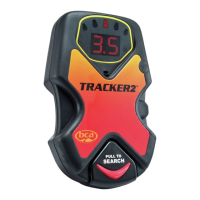
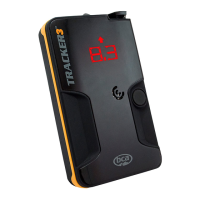
Thank you for choosing Tracker3, featuring Tracker2’s famous
ease-of-use in a smaller, lighter package.
Remember, transceiver searches are only part of the avalanche rescue
process. It is equally important to practice the probing and shoveling
techniques found later in this section. For training videos on transceiver
searching, probing, and strategic shoveling techniques, please visit
www.backcountryaccess.com/education.
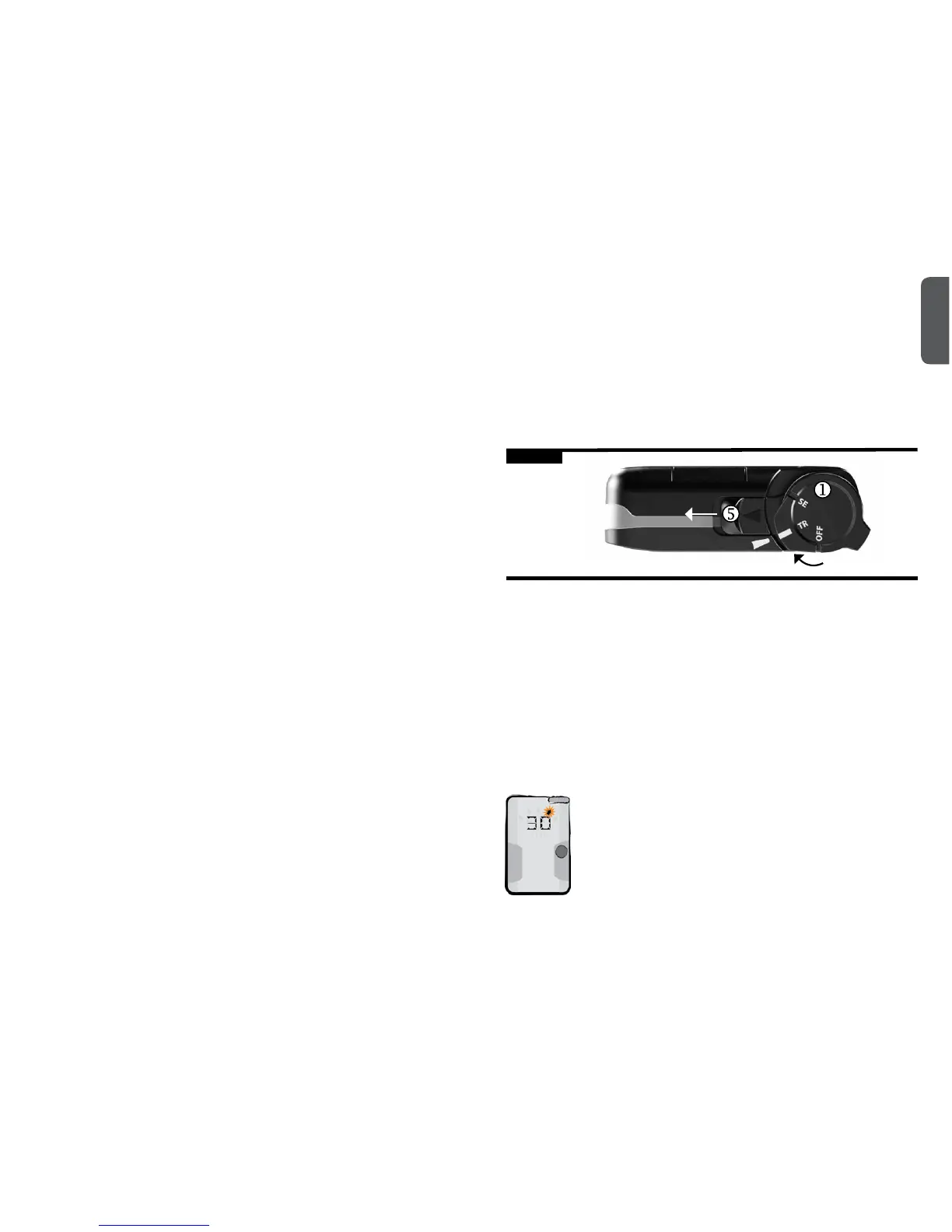
Transmit mode: From the ‘O’ position, pull the sliding lock
n in the
direction of the arrow and turn the dial switch
j
on top of Tracker3 to
the transmit (“TR”) position (see Figure C).
Figure C
Top view of
Tracker3.
The battery life is then shown in the distance/battery power display
k
in Figure A.
After displaying battery power, Tracker3 ashes “TR” and enters transmit
mode. The transmit light
l
ashes with every transmit pulse.
This light will not ash if the battery power is below 20 percent.
In addition to being displayed at startup, the battery power level can also
be checked in transmit mode by pressing the Options button
o
.
Note: the battery percentage is approximate. Replace batteries
m
before
reaching 40 percent.
When in transmit mode, the Tracker3 cannot be turned to o or search
without pulling back the sliding lock.
Search mode: Pull the sliding lock
n and rotate the dial
switch to the search (“SE”) position. In search mode, the
display will periodically ash “SE” until a signal is detected.
Upon detecting a transmitting signal, Tracker3 will begin to
display distance and directional readings. At distances of less
than two meters, the directional lights are no longer shown.
Return to transmit: When in search mode, the sliding lock does not need
to be moved in order to return to transmit mode. Simply rotate the switch
back to the transmit position. The Tracker will beep and ash “TR” for
several seconds before it begins to transmit.


 To Next Page