20
You may find that your new oven cooks differently than the one it replaced. Use your new oven for a few weeks to
become more familiar with ii: If you still think your new oven is too hot or too cold, you can adjust the thermostat
yourself.
Do not use thermometers, such as those found in grocery stores, to check the temperature setting of your oven.
These thermometers may vary 20-40 degrees.
NOTE: This adjustment will not affect the broiling or the self-cleaning temperatures. The adjustment will be retained
in memory after a power failure.
The type of margarine will affect baking performance!
Most recipes for baking have been developed using high fat products such as butter or margarine (80%
fat). If you decrease the fat the recipe may not give the same results as with a higher fat product
Recipe failure can result if cakes, pies, pastries, cookies or candies are made with low fat spreads. The
lower the fat content of a spread product the more noticeable these differences become.
Federal standards require products labeled "margarine" to contain at least 80% fat by weight. Low fat spreads, on
the other hand, contain less fat and more water. The high moisture content of these spreads affects the texture and
flavor of baked goods. For best results with your old favorite recipes, use margarine, butter or stick spreads con-
taining at least 70% vegetable oil.
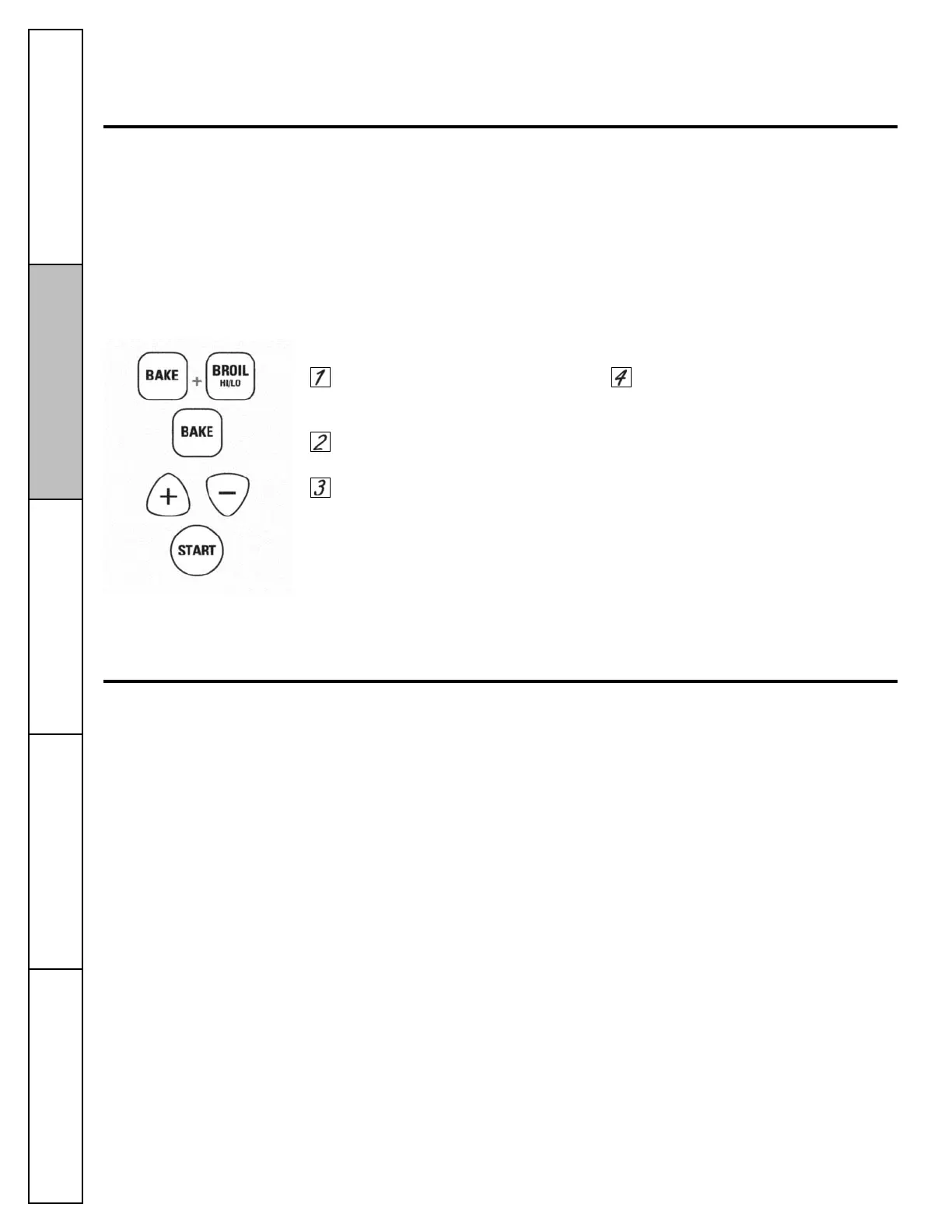
To Adjust the Thermostat (on models with + or- pads only)
Touch the BAKE and BROIL HI/LO
pads at the same time for 3 seconds until
the display shows SF.
Touch the BAKE pad. A two digit num-
ber shows in the display.
The oven temperature can be adjusted up
as much as 35°F or down as much as
35°F Touch the + pad to increase the
temperature by 1 degree increments.
Touch the -pad to decrease the tempera-
ture by 1 degree increments.
When you have made the adjustment,
touch the START pad to go back to the
time of day display. Use your oven as
you would normally.
Adjust the oven thermostat - Do it yourself!
Consumer Support Troubleshooting Tips Installation Instructions Operating Instructions Safety Instructions



 To Next Page