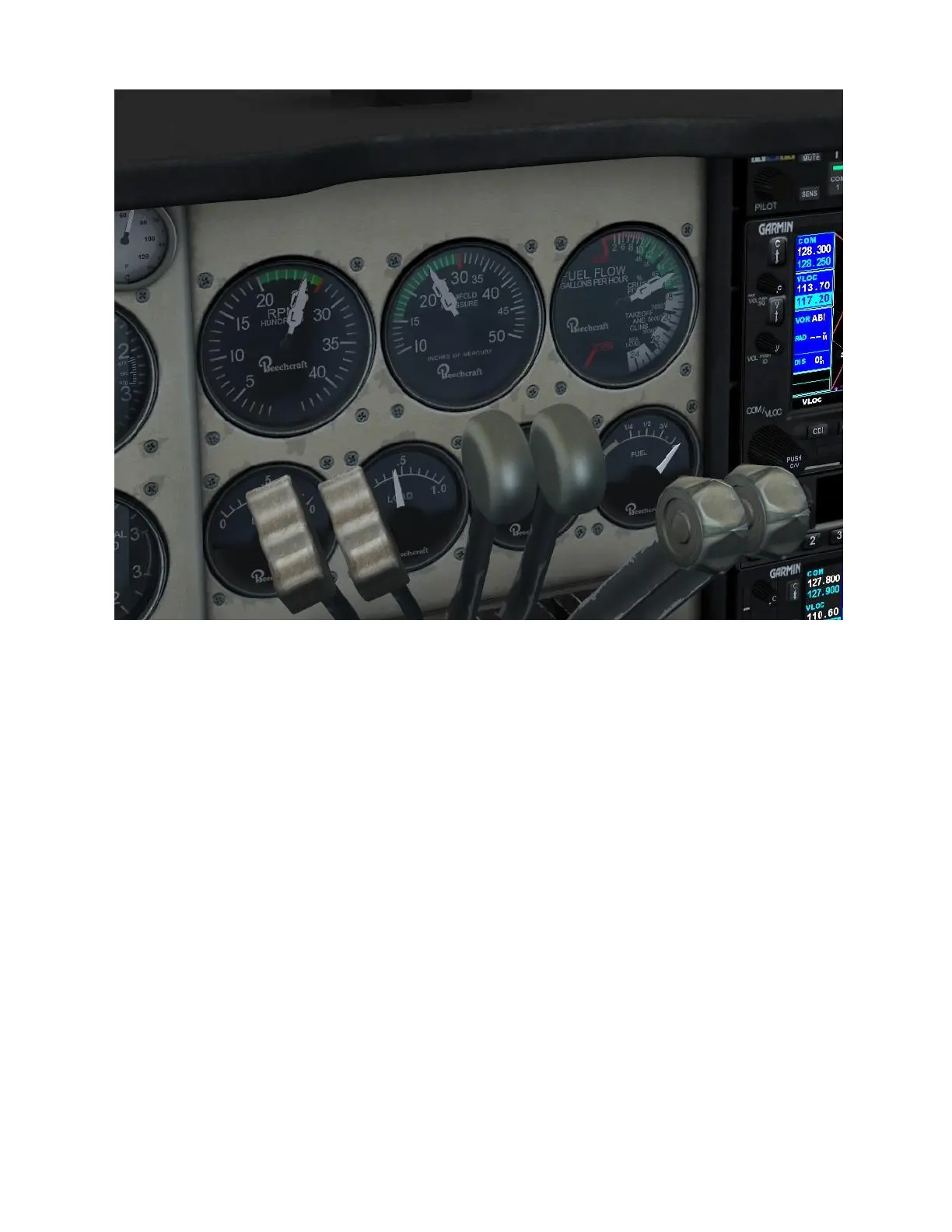
Figure 9
Note that in figure 9 how the six levers on the throttle quadrant are arrayed, and how the
needles on the three primary engine gauges appear. This is the quintessential “25 squared”
setting as you can see how the RPM, manifold, and fuel flow values are symmetrical for the left
and right engines (overlapping needles) and are set at 2500 RPM’s, 25 inches of MP, and that
75% power fuel flow status. Note, this screen capture was taken just as the aircraft was passing
5,000 feet MSL and that is why the throttles in the center are full forward. Climb above 5,000
feet MSL will see the MP decline the higher you go from there even with the throttles full
forward.
Step eight: There is an old as aviation adage, “Takeoffs are optional – landings are mandatory!”
Now it is time to think about landing. Piston twins are designed for raw climb power and
speed. So, to land them we have to fly them slower than their ideal cruising speeds. To do this,
we need to know the proper power and aircraft attitude management techniques, which is a
fancy way of saying to configure the flaps and gear, plus use the engine controls (throttles, prop
controls, and mixtures) to set the ideal manifold pressures and RPM’s on the left and right
engines.




 To Next Page