(EN) Controls
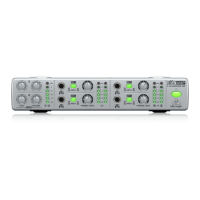
(1) LEVEL control: To adjust the input
level of a signal, turn this control
toward 0 (minimum level) or,
alternatively 6 (maximum level).
(2) BALANCE control: To adjust the
stereo image of a signal, turn
this control toward L (left) or,
alternatively R (right).
(3) A + B meter: To monitor the
combined level of both signals
(A and B), usethis meter. An LED
glows next to the value that
identies the combined level
(-24 dB to 0 dB). If the signal is too
strong, the CLIP LED glows. Most
of the time, the optimal level is 0
dB (a full signal).
(4) (headphone) connector:
To connect a headphone, use this
stereo, ¼"TRS connector.
(5) INPUT button: To select an Input
Channel, push this button.
(6) PHONES LEVEL control:
To adjust the level of a
headphone signal, turn this
control toward 0 (minimum
volume) or, alternatively 6
(maximum volume).
(7) CH meter: To monitor the level
of a headphone signal, use
this meter. AnLED glows next
tothe value that identies the
headphone volume (-24dBto 0
dB). If the signal is too strong, the
CLIP LED glows. Most of the time,
theoptimal volume is 0 dB (a full
signal).
(8) (power) button: To
turn the AMP800 on and o,
push this button.
(9) POWER connector.
(10) PHONES OUT connectors:
For each Headphone Channel
(1, 2, 3, and 4), therear panel
includes an additional headphone
connector, which is a stereo,
¼"TRS connector.
(11) LINK OUT A connectors: If you
need more than the 4 Headphone
Channels that a single AMP800
provides, connect these balanced,
¼" TRS connectors (Left and Right)
to the inputs of another AMP800.
The LINK OUT A connectors
send only the signal of Input
Channel A, without any LEVEL or
BALANCEsettings.
(12) INPUT connectors: For each
Input Channel (A and B), the rear
panel includes 2 balanced, ¼" TRS
connectors (Left and Right).
(13) SERIAL NUMBER.
15






 To Next Page


