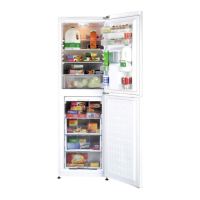
This document describes a BEKO Frost Free Combi Fridge / Freezer, specifically models CFD6914APB, CFD6914APS, and CFD6914APW. It serves as an installation, operation, and food storage instruction manual, aiming to help users get the best from their new refrigerator.
Function Description
The BEKO Frost Free Combi Fridge / Freezer is designed for storing and freezing edible foodstuff. It features a fridge compartment for short-term storage of fresh food and drinks, and a freezer compartment rated for freezing and storing pre-frozen food. The appliance incorporates an Advanced Electronic Temperature Control System (AETCS) to maintain optimal temperatures. The freezer compartment is frost-free, meaning it defrosts automatically, and a fan circulates cold air to prevent ice build-up. The fridge compartment also defrosts automatically, with defrost water collecting in a drain tube at the back of the appliance. A water dispenser is integrated into the fridge door, providing chilled water without needing to open the main door, thus saving electricity.
Usage Features
The refrigerator's operation is controlled by a thermostat knob located on the ceiling of the fridge compartment, with settings from 1 to 5, where 5 is the coldest. For initial use, it's recommended to set the thermostat halfway between 1 and 5 and monitor the temperature to achieve an average fridge temperature of +5°C (+41°F). The normal freezer storage temperature should be -18°C (0°F).
For optimal food storage, the manual provides detailed recommendations:
- Fridge Compartment: Baked, chilled cooked food, dairy products, and cans should be stored on the upper shelves. Meat, sausages, and cold cuts should be placed on the middle shelves, while fruits, vegetables, and salads go into the crisper bins. Bottles can be stored in the door section. Cooked dishes should be in airtight containers. Fresh produce should be cleaned and stored in crisper bins. Raw meat should be wrapped in polythene bags and placed on the lowest shelf, kept separate from cooked food, and stored for only two to three days. Food should be packed, wrapped, or covered, and hot food should be allowed to cool before being placed in the fridge. Certain fruits and vegetables (like pineapples, melons, cucumbers, and tomatoes) should be wrapped in polythene bags if kept near 0°C. Chilled cooked food should be placed near the cold wall at the rear of the fridge liner.
- Freezer Compartment: This compartment is suitable for freezing fresh food and storing commercially frozen food. When freezing fresh food, it's advised not to freeze large quantities at once to preserve food quality. Small quantities (up to 1/2 kg) can be frozen without adjusting the temperature control knob. Fresh food can be placed in any part of the freezer, taking care not to mix it with already frozen food.
- Ice Cubes: Water should be filled 3/4 full into the ice-cube tray and placed in the Ice Bank. Frozen trays can be loosened with a spoon handle.
- Water Dispenser: To use, push the lever with a glass. The flow rate depends on how far the lever is depressed. The water tank should only be filled with pure drinking water, with a capacity of 2.2 litres (3.8 pints), and not overfilled. A safety lock is provided to prevent accidental dispensing, especially by children. The maximum height for a glass is 16 cm.
Maintenance Features
Regular maintenance is crucial for the appliance's longevity and efficient operation:
- Cleaning: The appliance should be switched off and unplugged before cleaning. Harsh abrasive instruments, soap, strong household cleaners, detergents, and wax polish should be avoided. The cabinet should be cleaned with lukewarm water and wiped dry. The interior can be cleaned with a damp cloth wrung out in a solution of one teaspoon of bicarbonate of soda to one pint of water. Care should be taken to prevent water from entering the lamp housing. If the appliance is not used for a long time, it should be switched off, emptied, cleaned, and the door left ajar.
- Condenser: Dust accumulating on the condenser at the back of the appliance should be removed once a year with a vacuum cleaner.
- Door Seals: Door seals should be checked regularly to ensure they are clean and free from food particles.
- Door Racks: To remove door racks for cleaning, empty them and push them upwards from the base.
- Freezer Drawers: To remove a freezer drawer, pull it out as far as possible, tilt it upwards, and then pull it out completely.
- Freezer Flap Door: To remove, open the door 3 inches and gently pull the flap off. Ensure it's in place before closing the freezer door.
- Defrost Water Drain Tray: The special plastic container at the back of the appliance that collects defrost water should be kept clean. To clean, switch off and unplug the appliance, push the lug down with a screwdriver tip, pull out the tray, clean it, and reassemble.
- Water Tank: To clean the water tank, remove it, open the latches on both sides, detach the top cover mechanism, clean with warm water, and reinstall. Ensure hooks fit securely into hangers on the door to prevent leaks. The water tank and its components are not dishwasher-proof.
- Light Bulb Replacement: If the interior light fails, switch off and unplug the appliance. Remove the light diffuser cover using a flat-tipped screwdriver. Check if the bulb is loose; if not, replace it with a new 15-watt (max) screw cap (SES) bulb.
- Door Reversal: The manual provides detailed instructions for reversing the doors, recommending assistance for safety and to prevent damage. This involves removing hinges, rotating them, and repositioning plugs and bushings. After reversal, the appliance should be left for at least 4 hours before switching on.
The manual also includes energy-saving tips, such as ensuring proper ventilation, minimizing door opening times, and defrosting frozen food in the fridge compartment. It emphasizes safety warnings, including proper electrical connection, earthing, and avoiding damage to the refrigerant circuit.

 Need help?
 General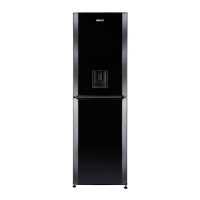

 To Next Page